Buying Guide
The best high-visibility safety jackets should be matched to the visibility class, weather exposure, and work requirements rather than chosen by color alone. This comparison uses listing specifications and features, not hands-on testing. Before ordering, confirm the standard required by your employer or worksite, then compare shell construction, lining, ventilation, storage, and fit.
Start with the required visibility class
ANSI/ISEA 107 classifications are not interchangeable. Several selections here document Type R, Class 3 visibility, including Ergodyne GloWear 8377, Portwest UH443, the TICONN rain jackets, FFTSAFEWARP, SOIGCOR, FATONE, the TICONN bomber, TCCFCCT, and LYReview. The Drizomo jacket is documented as Type O, Class 1, which may suit off-road occupational settings but should not automatically be substituted for a Class 3 garment.
Look for the reflective layout as well as the standard. Full-body or encircling stripes appear across many of the top high-visibility safety jackets and can help make the wearer’s outline more recognizable in low light. The Portwest listing also describes a biomotion tape pattern. Published visibility claims are not a substitute for checking the exact site rule, garment labeling, and required class.
Choose the shell for the weather
For sustained rain, prioritize a coated shell and sealed construction. FFTSAFEWARP lists a 10,000-plus mm waterproof rating and seam sealing. SOIGCOR lists taped seams and a 300D PU-coated Oxford shell. Portwest documents a 5,000mm water-resistance rating, while FATONE lists a 5,000mm precipitation rating and heat-pressed seam sealing. These details provide more useful comparison points than simply calling a jacket waterproof.
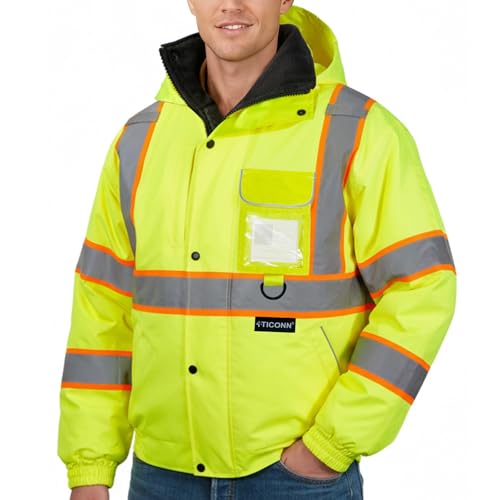
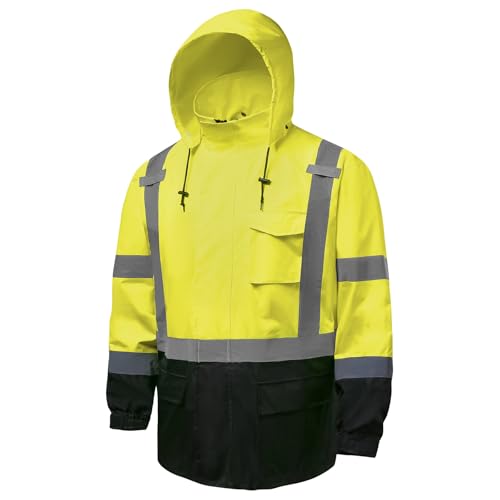
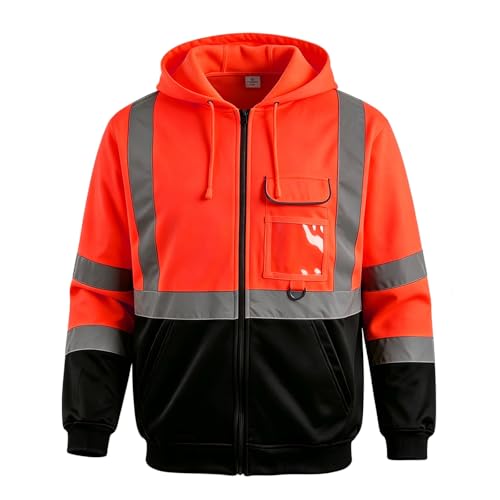
The TICONN ANSI Class 3 rain jacket uses a 150D Oxford PU-coated shell and a rain flap, while the TICONN bomber lists a 300D shell, PU coating, and storm flap. The Ergodyne bomber is described as wind and water resistant, so it may work in variable conditions but should not be treated as equivalent to a fully specified rain shell. The LYReview hoodie is explicitly not waterproof and is better used in dry weather or beneath rain gear.
Match insulation to temperature
Insulation can improve comfort in cold work, but it also adds bulk and may be excessive during active tasks. Ergodyne documents 160g quilted insulation and a -40°F temperature rating, making it the most clearly specified cold-weather option in this group. The TICONN bomber also lists a 160g fleece lining. Drizomo goes further with 240gsm polar fleece and 100gsm quilted padding, although its Type O Class 1 category must be checked against the job requirement.
The TCCFCCT listing mentions a lightweight lining but does not provide an insulation weight. For moderate conditions, fleece or brushed-fleece options such as LYReview can provide warmth without the construction of a full winter bomber. For rain over warm clothing, the uninsulated Portwest, TICONN, FFTSAFEWARP, SOIGCOR, and FATONE shells may be easier to layer.
Look for ventilation and adjustable closures
Breathability matters when a wearer moves between outdoor exposure and physical work. TICONN’s rain jacket includes underarm vents, SOIGCOR lists four back ventilation holes, and FATONE lists back ventilation shafts. Portwest specifies a vented back yoke and eyelets. Mesh linings appear in SOIGCOR and FATONE, while FFTSAFEWARP describes built-in breathable mesh.
Cuffs, hems, collars, and hoods also affect practical use. Adjustable cuffs and drawstring hems can help tailor coverage over work clothing. Portwest has a pack-away hood; FFTSAFEWARP and TCCFCCT list removable hoods; FATONE has a hidden hood; and Ergodyne’s hood zips in or out.
Consider storage and communication features
A jacket can be more useful when its pockets match the task. Drizomo lists seven multifunction pockets. Clear ID windows help display credentials, while D-rings and microphone tags can support keys or radios. Radio attachment points are specifically described on FFTSAFEWARP, SOIGCOR, and TCCFCCT. If you carry equipment, check pocket closures and whether the listing identifies pockets as waterproof.
Check fit and layering room
Use the seller’s size chart rather than relying on the displayed variant alone. Layering may require extra room beneath an uninsulated shell or bomber. Adjustable cuffs, hems, hoods, and elastic closures can help refine fit, but they do not replace accurate measurements. Also check whether the design works with required equipment and headgear.
Understand the comparison limits
The rankings reflect documented specifications only. They do not establish real-world waterproof duration, durability after repeated washing, warmth in a particular temperature, reflective performance at a particular distance, or comfort during a full shift. Read the garment label and workplace policy before purchase.
Final recommendation
TICONN Fleece-Lined Waterproof Bomber Jacket ranks first overall in this specification-based comparison under the published weighted criteria.
Ergodyne GloWear 8377 Winter Bomber Jacket is the first overall specification-based choice among these best high-visibility safety jackets because it combines a stated -40°F temperature rating, 160g insulation, Class 3 visibility, and a 300D wind- and water-resistant shell.
For sustained rain, SOIGCOR and FFTSAFEWARP offer the most complete waterproof-focused feature sets. SOIGCOR adds a 300D shell, taped seams, ventilation holes, waterproof pockets, and radio-ready shoulder straps. FFTSAFEWARP provides seam sealing and a stated 10,000-plus mm waterproof rating. Portwest is a standards-focused alternative with broad certification information and a pack-away hood.
The TICONN rain jacket is a lighter option for active work because it combines sewn-on reflective tape, underarm vents, and adjustable closures. FATONE is another layer-friendly rain design with a mesh lining, ventilation shafts, and a hidden hood. For cold rain, the TICONN fleece-lined bomber and TCCFCCT bomber add warmth and work storage, while Drizomo offers the heaviest documented lining but uses Type O Class 1 rather than Class 3.
The top high-visibility safety jackets are not identical, and the right choice depends on whether the priority is winter insulation, sustained rain coverage, ventilation, radio storage, or a flexible fleece layer. LYReview is the most suitable selected design for dry, warm work where a full-zip hoodie is more practical than a waterproof coat. Always verify the required class and size before ordering.
Frequently Asked Questions
What should I check first when choosing the best high-visibility safety jackets?
Check the required ANSI/ISEA class first, then match the shell and lining to the weather. Class 3 options include several Type R jackets, while Drizomo is listed as Type O, Class 1. After that, compare seam sealing, waterproof ratings, insulation, ventilation, storage, and size-chart information.
Are all high-visibility jackets waterproof?
No. Rain-focused options such as FFTSAFEWARP, SOIGCOR, FATONE, Portwest, and the TICONN rain jacket document coated shells or other water-protection features. LYReview explicitly states that it is not waterproof, and Ergodyne is described as wind and water resistant. Confirm the listing and garment label before using a jacket in sustained rain.
Is a Class 3 jacket always the right choice?
Not necessarily. The correct class depends on the worksite, traffic exposure, and employer requirements. Class 3 is documented for many selected jackets, while Drizomo is listed as Type O, Class 1. Follow workplace policy rather than assuming one visibility category meets every requirement.
Which selected jacket is better for cold weather?
Ergodyne provides the clearest cold-weather documentation with a stated -40°F temperature rating and 160g quilted insulation. TICONN’s bomber lists a 160g fleece lining, and Drizomo lists 240gsm polar fleece plus 100gsm quilted padding. Drizomo’s Type O Class 1 classification should be confirmed for the intended job.
Can a fleece safety hoodie replace a rain jacket?
Only when the weather and work requirements allow it. LYReview provides Class 3 visibility and brushed fleece but is explicitly not waterproof. It may work as a dry-weather layer or beneath a rain shell, while a documented rain jacket is more appropriate for prolonged wet exposure.