Buying Guide
The best impact hex keys are not one uniform tool format. The supplied products divide into 1/4-inch hex-shank bits for drills and impact drivers, and drive-based hex socket sets for ratchets or impact tools. Start by matching that interface to the tool already in your kit. A 1/4-inch shank is the practical choice when you want quick changes in an impact driver, drill, or compatible manual screwdriver. A 3/8-inch or larger socket drive is more appropriate when your work is already organized around impact sockets.
Bit-style sets dominate this comparison. TGFTGF, toolant, GRENPRO, OSTTE, DCWecher, VESTTIO, and TLEEP all document 1/4-inch hex-shank compatibility or direct use with impact drivers. That makes them convenient for furniture assembly, home repair, bicycles, engine work, and general screwdriving. Their magnetic tips may help hold a fastener during positioning, but the supplied evidence does not establish a measured holding force or performance result.
Socket-style sets use a different workflow. Sunex 3646 is a low-profile impact hex driver set, while SEDY offers 1/4-, 3/8-, and 1/2-inch drive options through adapters and multiple socket groups. NEIKO 01131B is a dedicated 3/8-inch SAE socket set. These choices may be preferable when fasteners are stubborn, when a ratchet system is already in use, or when a socket profile fits the surrounding hardware better than a long screwdriver bit.
Match size coverage to your fasteners
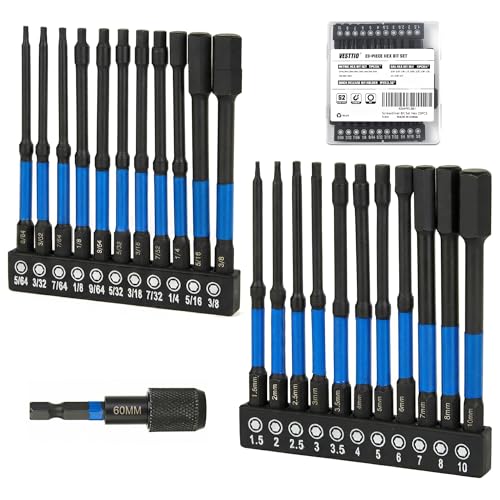
Mixed metric and SAE coverage is a useful starting point for a general toolbox. TGFTGF includes 12 SAE and 12 metric bits; OSTTE lists 12 of each; and toolant, GRENPRO, DCWecher, VESTTIO, and Sunex also document both measurement systems. This helps avoid discovering that a needed fastener falls outside a single-system kit.
Metric-only TLEEP 26 is more focused. Its stated range reaches 10mm, and the two lengths can be useful when your work is consistently metric. NEIKO is the opposite kind of specialist: its seven listed sizes are SAE only. A focused set can make sense if your equipment uses one standard, but mixed coverage is generally more adaptable for household and automotive work.
Piece count alone should not decide the purchase. SEDY’s 36-piece count includes multiple drive sizes and adapters, while TLEEP’s 26-piece count includes two lengths, a holder, and a ratchet screwdriver. Check what the number represents, not just the number printed in a title.
Consider material and impact-oriented construction
S2 alloy steel appears across many bit-style listings, including TGFTGF, toolant, GRENPRO, DCWecher, VESTTIO, OSTTE, and TLEEP. Several listings also describe hardened or heat-treated construction, CNC-machined tips, torsion zones, or impact-resistant designs. These are relevant specifications for buyers who expect powered fastening, but they are not substitutes for a hands-on durability test.
The socket options use different documented materials. Sunex lists Cr-Mo steel and one-piece construction, while SEDY lists Cr-V steel and a manganese phosphate finish. NEIKO specifies drop-forged Cr-Mo steel and an impact-grade build. If your priority is a socket set for high-torque applications, these material and construction details deserve more attention than cosmetic finish alone.
Decide how much reach you need
Length is a major separator. DCWecher’s three-inch bits are intended for recessed fasteners in engine bays, cabinet corners, furniture joints, and appliance panels. VESTTIO uses four-inch bits and a 60mm extension bar. These designs may make access easier around obstructions, but long bits can be inconvenient when the tool has little room to swing or when the fastener is close to the surface.
The common two-inch format is a practical middle choice. TGFTGF, toolant, GRENPRO, and OSTTE use that general length, while Sunex’s low-profile design and NEIKO’s three-inch sockets address different access needs. TLEEP 26 is flexible because it includes both 25mm and 60mm metric bits. Think about the actual working envelope around the fastener rather than choosing the longest option by default.
Look for useful identification and storage
Size markings matter when a set contains many nearly identical pieces. Sunex documents laser-etched and roll-stamped markings, SEDY uses laser-etched markings and a labeled case, and toolant lists engraved markings with labeled holders. TGFTGF adds red and yellow covers to distinguish SAE from metric bits. These features may simplify selection, although the supplied data does not quantify any time savings.
Cases and holders also affect portability. Sunex, SEDY, NEIKO, TGFTGF, and VESTTIO explicitly include storage solutions. DCWecher includes a holder, while some other listings provide less specific storage information. If bits travel between a garage and a job site, an organized case may be worth prioritizing over a slightly larger piece count.
Match the set to the job
For mixed home and automotive maintenance, choose a metric-and-SAE bit set with magnetic tips and a standard 1/4-inch shank. For recessed fasteners, prioritize DCWecher or VESTTIO because their listed lengths are three and four inches. For a compact manual-and-powered combination, toolant adds four small L-shaped keys, while TLEEP 26 adds a ratchet screwdriver. For socket-based work, Sunex, SEDY, and NEIKO offer drive formats rather than ordinary insert bits.
Final Recommendation
Sunex 3646 Impact Hex Driver Set ranks first overall in this specification-based comparison under the published weighted criteria.
Sunex 3646 is the first overall specification-based choice among these best impact hex keys because it combines Cr-Mo steel, one-piece construction, low-profile access, dual markings, ANSI compliance, and a storage case. It is not the broadest bit kit, but its documented socket-style design is especially coherent for impact-tool work.
The top impact hex keys for deep access include DCWecher and VESTTIO, with the former offering three-inch bits and the latter four-inch bits plus an extension. SEDY is the broad-drive choice, NEIKO is the focused SAE option, and TGFTGF is a balanced mixed bit kit with color recognition. Buyers who need manual flexibility should consider toolant or TLEEP 26, while OSTTE and GRENPRO provide conventional mixed-size coverage for general repairs. These conclusions are specification-based comparisons, not hands-on test results.
Frequently Asked Questions
Are impact hex keys the same as regular Allen keys?
No. The products compared here are designed to connect to powered tools or impact-rated socket drives. Many use a 1/4-inch hex shank, while Sunex, SEDY, and NEIKO use socket-style drive formats. A standard L-shaped Allen key is intended for manual use unless its listing specifically documents powered or impact use.
What are the best impact hex keys for recessed fasteners?
Look for a documented long-reach design. DCWecher lists three-inch bits, and VESTTIO lists four-inch bits plus a 60mm extension bar. TLEEP 26 offers both 25mm and 60mm metric lengths. Longer tools can help reach around panels or into engine bays, but they may be less convenient where working clearance is shallow.
Should I buy metric and SAE hex bits together?
A mixed set is generally more adaptable when the fastener standard is unknown or projects vary. TGFTGF, toolant, GRENPRO, DCWecher, VESTTIO, and OSTTE document metric and SAE coverage. A single-standard kit can still be sensible for dedicated equipment; TLEEP 26 is metric-focused and NEIKO 01131B is SAE-focused.
Is a socket set better than a 1/4-inch hex-bit set?
Neither format is universally better. A 1/4-inch bit set changes quickly in compatible drills and impact drivers. A socket set can fit a ratchet workflow and may offer larger drive options or a low-profile design. Sunex is the low-profile socket choice, SEDY covers several drive sizes, and NEIKO focuses on 3/8-inch SAE sockets.
What specifications should I check before ordering?
Confirm the drive interface, measurement system, included sizes, bit or socket length, steel type, and storage method. Also check whether the listing documents magnetic tips, torsion-zone construction, or a manual adapter. For the best impact hex keys for your specific job, prioritize the feature that solves your actual limitation: reach, size coverage, drive compatibility, or portability.