Buying Guide
Choosing the best extra-long hex keys starts with the fasteners you actually encounter. An extra-long shaft can improve reach and leverage, but a longer tool is not automatically the most convenient option in every space. Compare the measurement system, size range, end design, shaft style, material, and storage method before choosing a set.
Start with SAE, metric, or both
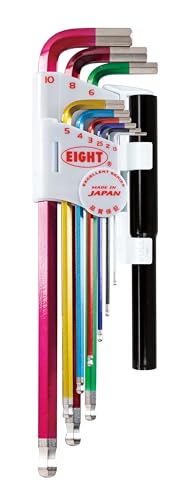
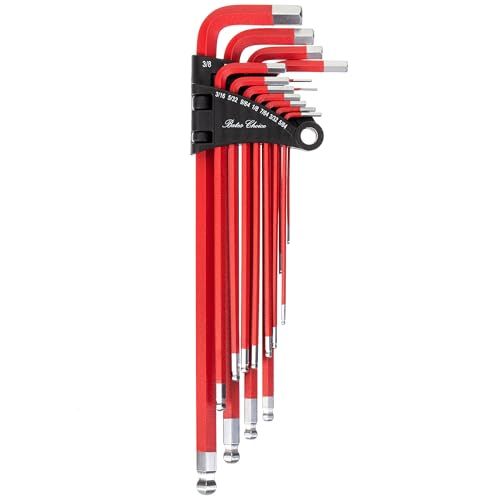
SAE sizes are expressed in fractions or decimals of an inch, while metric sizes are measured in millimeters. Mixing the two systems can lead to a poor fit and damaged fasteners, so the first buying decision should be coverage. The Titan 12713 and Bates Choice 13-Piece XL SAE set focus on inch sizes. The Bates Choice 9-Piece XL Metric set, Pozoho, EIGHT, and ELEAD metric sets focus on millimeters.
If your toolbox serves both household and mechanical tasks, a combination kit is more flexible. Eklind 17322 includes 12 inch sizes and nine metric sizes in one product. DISEN also combines nine SAE and nine metric sizes. These options reduce the need to carry two separate systems, although a dual-system kit can take more room than a focused set.
Match shaft length to the workspace
Long arms are most helpful when a socket is recessed, an obstruction blocks a straight approach, or additional leverage is needed. Several listings describe their tools as extra long without giving a full shaft measurement. Bates Choice provides length ranges for both its SAE and metric sets, while Eklind 50914 specifies nine-inch shafts. Bondhus 25445 goes further with a documented 12-inch long arm on every key.
Reach should be considered alongside clearance. A very long L-key may be useful around a large assembly but awkward beside a panel or nearby wall. T-handle tools such as Eklind 50914 give a broad grip and direct leverage, while standard L-keys can offer more flexibility when the working angle changes. The correct choice depends on whether your priority is deep access, turning force, or maneuverability.
Decide whether a ball end is useful
Ball ends are designed to enter a compatible hex socket at an angle rather than only straight on. The Titan 12713 and ELEAD 15-Piece set specify entry angles of up to 25 degrees, while Eklind 17322 lists up to 30 degrees.
This feature can help when the fastener is partially obstructed or alignment is inconvenient. It should not be treated as a substitute for a straight, fully seated approach when maximum contact is needed. A practical set often benefits from a ball end on one side and a conventional end on the other.
Look at the material and surface treatment
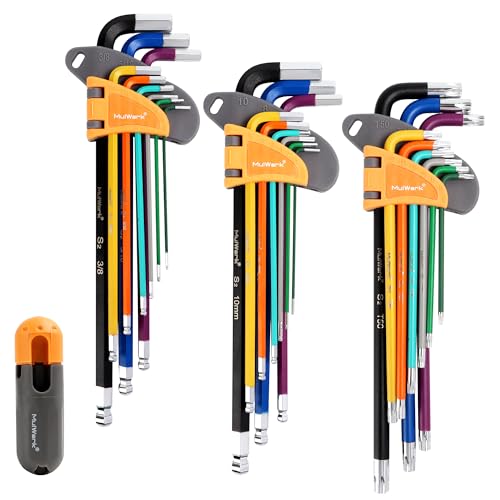
The supplied listings identify several tool steels. S2 steel appears in the Bates SAE set, Bates metric set, Titan, and ELEAD 15-Piece set. Eklind identifies heat-treated alloy steel, Pozoho uses hardened chrome vanadium steel, and Bondhus identifies proprietary Protanium steel. These descriptions provide useful construction information, but they do not establish independent performance testing.
Finishes also vary. Black oxide appears on the ELEAD and Pozoho listings, while Eklind describes a rust-resistant finish and bright finish. Titan specifies a satin-plated textured finish, and Bondhus lists ProGuard finish. Consider a corrosion-oriented finish if the keys will be stored in a damp garage or used around outdoor equipment, but remember that storage conditions still matter.
Consider leverage accessories and handles
Some products add a way to increase turning force beyond the long arm itself. ELEAD includes an extension bar with a knurled grip. Pozoho includes a T-handle adapter. EIGHT lists two extension pipes for specified size ranges. These additions can be useful when a stubborn fastener needs more grip or when the L-shaped key is uncomfortable to hold.
However, an adapter or pipe is another component to keep track of, and the supplied evidence does not establish how much force any accessory can safely withstand. Treat these parts as convenience features rather than proof of universal heavy-duty capability. For straightforward access, an unmodified L-key may be easier to position.
Check size identification and storage
Size markings reduce selection mistakes, especially when several keys look similar. Titan uses laser-etched sizes and color coding, Bates supplies a size-marked plastic organizer, and Eklind uses red for inch and blue for metric. DISEN, Pozoho, and EIGHT also describe color-coded designs. These details are small but practical when a set is used repeatedly.
Storage varies from plastic holders and cases to pouches or no documented organizer. Eklind 50914 includes pouch storage, Eklind 17322 and Titan include plastic holders, and ELEAD 41 includes a case, although that product was not selected because its listing combines hex and Torx tools. Before buying, check whether the storage format suits a toolbox drawer, portable kit, or workshop wall.
How this comparison was scored
The editorial ranking uses category-specific specifications rather than customer sentiment or marketplace signals. Reach and leverage receive 25 percent, size coverage 25 percent, access-oriented design 20 percent, material and finish 20 percent, and handling and storage 10 percent. The scores reflect only supplied listing evidence. They are not hands-on test results, and they do not claim that one steel grade will perform identically in every application.
Final Recommendation
Eklind 17322 Extra-Long Ball-Hex Combo Set ranks first overall in this specification-based comparison under the published weighted criteria.
The final choice among the best extra-long hex keys depends on the documented features that match your intended use.
Eklind 17322 is the first overall specification-based choice for shoppers who need both SAE and metric coverage. Its 22-piece format, extra-long ball-hex keys, up-to-30-degree angled access, alloy-steel construction, color coding, and sized holder make it a well-rounded documented package.
For a focused SAE kit, Titan 12713 is a strong alternative because it combines 13 sizes, extra-long arms, ball-end entry, S2 steel, and marked storage. For metric work, ELEAD 15-Piece offers a broad 1.27- to 10-mm range plus an extension bar. Shoppers seeking the top extra-long hex keys should choose by fastener system first, then decide whether ball-end access, a T-handle, or an extension accessory best fits the workspace.
Frequently Asked Questions
What are the best extra-long hex keys for both SAE and metric fasteners?
Eklind 17322 and DISEN are the selected combination sets. Eklind provides 22 pieces with 12 inch sizes and nine metric sizes, while DISEN provides 18 pieces split evenly between nine SAE and nine metric sizes. Eklind adds ball-end access and a sized holder; DISEN emphasizes a stated length increase and color coding.
Are ball-end hex keys useful in tight spaces?
They can be useful when a compatible socket is difficult to approach straight on. Titan and ELEAD specify up to 25-degree entry, and Eklind 17322 specifies up to 30 degrees. A straight end is still preferable when full seating and direct alignment are available, so check whether the selected design provides the end style you need.
Which selected set has the longest documented arms?
Bondhus 25445 documents a 12-inch long arm on all seven keys. Eklind 50914 specifies nine-inch shafts, while the Bates Choice SAE and metric listings give ranges reaching nine inches. Bondhus therefore emphasizes the longest stated reach, but its seven-piece size coverage is narrower than the larger combination and multi-size sets.
Is a T-handle better than an L-shaped hex key?
Neither format is universally better. Eklind 50914 uses cushion-grip T-keys and nine-inch shafts for a direct handled grip. L-shaped sets are generally more flexible for changing orientation and working around obstructions. Pozoho adds a T-handle adapter to an L-key set, giving shoppers another way to compare handled leverage with the portability of individual keys.
Confirm the measurement system and required sizes first. Then check the documented arm length, whether the set has a ball end or conventional end, the listed steel and finish, and how the keys are stored. If your work involves recessed fasteners, prioritize reach and access design; if it involves many different fasteners, prioritize coverage.