Buying Guide
Choosing the best t-handle hex keys starts with the fasteners you actually encounter. A T-handle puts the turning force across a wider grip than a loose L-shaped key, while the shaft can provide useful reach into recessed hardware. The right set is therefore less about the highest piece count and more about matching measurement system, access style, handle design, and storage to the work.
Start with SAE, metric, or both
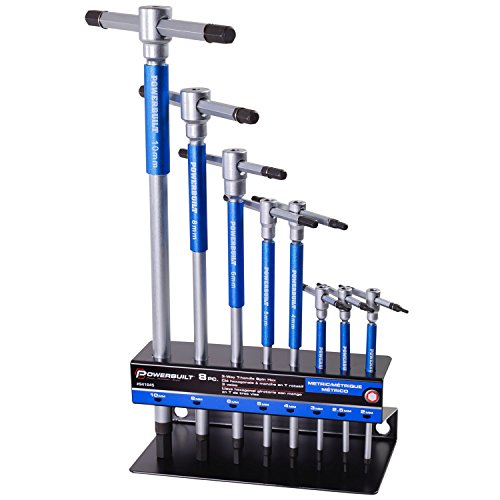
Measurement coverage is the first filter. A metric-only set can be a sensible choice for bicycles, machinery, and hardware specified in millimeters, but it will not replace SAE keys. The Powerbuilt and AKM TOOL sets are metric-focused, with the former covering 2mm through 10mm and the latter covering 2mm through 10mm with additional intermediate sizes. They are focused options when inch fasteners are not part of the job.
For mixed household, automotive, furniture, or workshop use, combination sets reduce the chance of reaching for the wrong system. GRENPRO provides nine sizes in each system, while Eklind 60625 supplies 11 inch and eight metric sizes. HORUSDY also uses two nine-piece groups. More pieces can improve coverage, but it can also mean a larger holder and more tools to sort.
Compare reach and access features
Long arms help reach recessed fasteners and can provide leverage, but the listing evidence does not establish that every long shaft is the same length. Look for a product that states how its access works. Klein Tools JTH610E documents six-inch blades and double-ended use. GEARWRENCH 83514 allows short- or long-arm positioning, which can help switch between clearance and leverage.
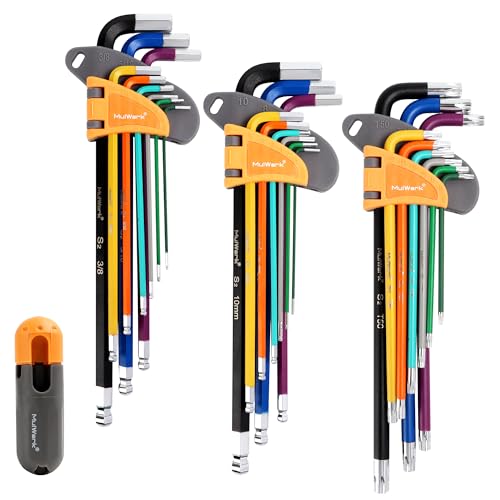
Ball ends are another access feature. GRENPRO and HORUSDY document ball-end keys, and Klein Tools JTH610EB is specifically described with a long-arm ball end for angled work. A ball end can be useful when the handle cannot stay perfectly aligned with the fastener, although a straight end remains the more direct choice when alignment and torque are the priority. Treat the angle information as a design specification, not as a promise of performance in every situation.
Sliding designs add another form of flexibility. Powerbuilt uses a sliding top handle that can form a T or L shape, plus a free-spinning sleeve. AKM TOOL describes a three-way sliding design with a free-spinning collar. These features may help with fast turning or awkward access, but they also create more moving parts than a fixed T-handle.
Examine grip and leverage details
T-handles are useful because they give the hand a broad crossbar for turning. Grip material still matters for control. The Klein Tools sets use dual-material Journeyman handles, while HORUSDY, WORKPRO, and ELEAD identify TPR or cushion-style handles. Eklind 50914 and Eklind 60625 describe slip-resistant cushion grips. These details support a more comfortable hold, but the supplied data does not justify claims about fatigue reduction during a particular task.
For stubborn fasteners, consider whether the design provides direct leverage rather than relying on a special feature. A fixed long-arm T-handle, a dual-end format, or a sliding handle can each serve a different purpose. The GEARWRENCH and Powerbuilt designs are especially flexible on paper because their handles can change position. For routine work, however, a simpler fixed handle may be easier to identify and put away.
Many selected sets identify alloy steel, chromium vanadium steel, or S2 alloy steel. GRENPRO and WORKPRO list chromium vanadium steel, while GRENPRO and GRENPRO’s listing identifies its steel as heat treated or hardened depending on the product description. GRENPRO’s selected set specifies hardened S2 alloy steel. Eklind sets describe heat-treated alloy steel, and Klein Tools specifies treated steel.
Surface treatments also deserve attention. HORUSDY describes anti-corrosion and anti-rust properties, WORKPRO lists black phosphating, and several Eklind descriptions mention a rust-resistant finish. These are useful documented details for buyers who store tools in less-than-ideal conditions. They do not prove that a tool cannot corrode, so storage and maintenance remain relevant.
Prioritize identification and storage
A set is easier to use when the correct size is visible quickly. Eklind uses red and blue color coding for inch and metric tools, while GRENPRO and AKM TOOL document color holders or labeling. Klein Tools places markings on top of each handle, and WORKPRO and ELEAD state that markings appear on both sides. These are small features that become more valuable when a set contains many similar-looking keys.
Storage varies from pouches to racks and metal stands. Eklind 50914 uses a pouch, whereas Klein Tools JTH610E, HORUSDY, Powerbuilt, and AKM TOOL include rack or stand-style storage. A rack is convenient for a bench or wall, while a pouch may be easier to move between locations. Check the supplied dimensions and workspace before choosing a larger organized set.
Final Recommendation
GRENPRO 18PC T-Handle Ball End Set ranks first overall in this specification-based comparison under the published weighted criteria.
The final choice among the best t-handle hex keys depends on the documented features that match your intended use.
GRENPRO 18PC T-Handle Ball End Allen Wrenches Sets Metric & SAE is the highest-scoring returned product and the first overall specification-based choice. It combines 18 pieces, both measurement systems, ball-end access, an extended T-handle attachment, hardened S2 alloy steel, markings, and a color holder. For buyers comparing the top t-handle hex keys by documented versatility rather than marketplace signals, it has the most complete feature mix in this selection.
Eklind 60625 is a strong alternative when broad inch-and-metric coverage, cushion grips, color coding, and a stand matter most. Powerbuilt is the more specialized choice for metric users who want sliding handles and a free-spinning sleeve. For a conventional mixed set, GEARWRENCH 83514, WORKPRO, ELEAD, or HORUSDY offer straightforward dual-system coverage with different approaches to grip and storage. SAE-focused buyers should look closely at Klein Tools JTH610E, while AKM TOOL suits users who prefer adjustable three-way access.
Frequently Asked Questions
What should I look for in the best t-handle hex keys?
Start with the measurement system and size range, then compare shaft access, handle style, steel and finish details, and storage. A mixed SAE/metric set is more flexible, while a focused metric or SAE set may be easier to organize. Ball ends and sliding handles can expand access, but they are not required for every task.
Is a sliding T-handle better than a fixed handle?
Neither design is universally better. Powerbuilt and AKM TOOL document sliding configurations that can change the handle position, while many other selected sets use fixed T-handles. Sliding designs may offer more access positions or faster spinning, whereas fixed designs are simpler and have fewer moving components. Choose based on the spaces and fasteners you work with most.
Do I need both metric and SAE keys?
You need both only if your projects use both systems. Combination sets such as GRENPRO, Eklind 60625, HORUSDY, GEARWRENCH 83514, WORKPRO, and ELEAD provide that coverage. If your equipment consistently uses one system, a focused set such as Powerbuilt for metric or Klein Tools JTH610E for SAE may avoid unnecessary pieces.
How should T-handle hex keys be stored?
Use the supplied rack, stand, pouch, holder, or case when possible. Clear markings and color coding make size selection faster and help keep the set complete. Rack-style storage suits a fixed bench or wall, while a pouch is more portable. Keep the keys dry and follow the maker’s care guidance, since a rust-resistant finish is not the same as immunity from corrosion.