Buying Guide
The best 9-inch hex keys are defined less by length alone than by how that length works with the handle, steel, tip design, and available sizes. A long shaft can improve access around an obstruction and provide more leverage than a compact L-key, but a long tool is only useful when the fastener size and handle format match the job. This comparison uses listing specifications and feature statements, not hands-on testing or customer sentiment.
Start with the measurement system
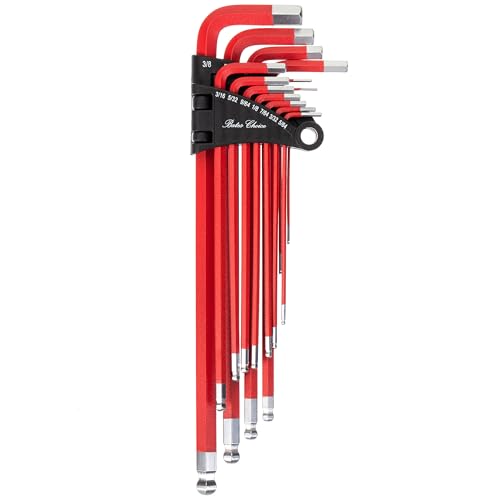
Choose SAE, metric, or a mixed set before comparing handle details. SAE sets use fractional inch sizes, while metric sets use millimeters. The Klein Tools JTH910E is an inch-only set with 10 pieces. Eklind 53198 is a more focused eight-piece inch set, covering 3/32 to 1/4 inch. For a wider SAE range, Bates Choice lists 13 pieces from 3/64 to 3/8 inch.
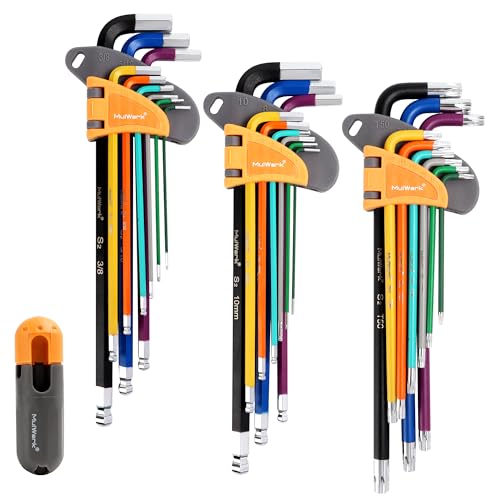
Metric buyers have several choices. Eklind 55198, Eklind 64808, and Eklind 64908 each list eight metric sizes from 2 to 10 mm, although the ball-hex design distinguishes the 64808 from the standard Power-T format of the 64908. If your toolbox includes both systems, Eklind 50914 lists nine inch sizes and five metric sizes in one 14-piece kit. Honoson also lists inch and metric groups, making it a broad-format alternative.
Match the handle to the work
T-handles are useful when you want a crossbar that is easier to hold than a narrow L-key. The selected Eklind Power-T tools document textured cushion grips and longer shafts. The Eklind cushion-grip sets describe smooth vinyl handles and slip resistance. Klein’s Journeyman set and JTH9M10 single key use dual-material or soft-touch grip language, respectively.
Handle-through-blade construction can matter when the job calls for substantial turning force. Klein JTH910E and JTH9M10 both document blade-through-handle designs for high-torque applications. That wording describes construction intent; it does not establish a particular performance result. For routine assembly, furniture, bicycles, or light workshop work, a comfortable grip and correct size may be more important than a high-torque-oriented structure.
Consider ball ends carefully
Ball-end or ball-hex keys can help when a straight approach is awkward. Eklind 64808 specifically states that its ball-hex keys can work at up to a 30-degree angle. Bates Choice also lists ball ends, along with chamfered tips. These features can be useful around obstructions, but the straight end remains important for situations where direct engagement is preferred. A standard key such as Eklind 64908 may be the simpler fit when angled entry is not needed.
Check the construction evidence
Look for the material and finish statements that fit your environment. Eklind’s selected sets specify alloy steel that is heat treated, quenched, and tempered, with a rust-resistant finish. Klein’s set lists treated steel for torsion resistance and rust prevention. Honoson lists alloy steel and black oxide finish, while Bates Choice identifies S2 steel. These are documented construction descriptions, not independent durability test results.
A corrosion-resistant finish is useful for ordinary tool storage, but it does not make a key maintenance-free. Keep the tool dry, use the correct size, and avoid forcing a key into a damaged socket. Chamfered ends, listed by Klein and Bates Choice, may make insertion more convenient, but the supplied evidence does not quantify fit or wear.
Think about storage and identification
A set is easier to use when sizes can be identified quickly. Klein’s set has markings on top of each handle and a metal stand. Eklind 50914 uses red and blue color coding for inch and metric tools and includes a pouch. The Eklind metric kits identify metric tools in blue, and the individual Power-T key has its size molded into the handle. Bates Choice includes a plastic organizer with size markings.
Storage needs vary by workspace. A stand is convenient for a bench, while a pouch or stacking design may fit better in a portable toolbox. A single key takes the least room but gives up coverage. The selected Eklind 61916 and Klein JTH9M10 illustrate that single-size approach: each is a dedicated long T-handle for one specified fastener size.
Choose a set or a single key
A complete set is usually the practical starting point when you do not know which sizes a project will require. The trade-off is extra pieces and storage space. A single key makes sense for a known replacement, a recurring fastener, or a toolbox that already contains the other sizes. Before buying, verify the fastener measurement system, the exact size, and whether the listing describes a straight, ball-end, or T-handle format.
Final recommendation
Eklind 50914 Cushion Grip T-Key Set ranks first overall in this specification-based comparison under the published weighted criteria.
Eklind 50914 Cushion Grip T-Key Set is the first overall specification-based choice in this comparison of the best 9-inch hex keys. Its 14-piece coverage, combination of inch and metric sizes, cushion grips, longer shafts, color coding, and pouch make it a versatile documented option.
Klein Tools JTH910E is another strong choice for buyers who want a dedicated SAE set. Its 10-piece range, 9-inch blades, dual-material handles, treated steel, markings, and metal stand give it a balanced documented feature set. Choose Eklind 50914 when combined inch-and-metric coverage matters more than a dedicated SAE set. For metric work, Eklind 64908 is the straightforward standard Power-T option, while Eklind 64808 is the better fit when the documented ball-end angle is useful. The top 9-inch hex keys also include strong single-tool choices: Klein JTH9M10 for 10 mm and Eklind 61916 for 1/4 inch.
Frequently Asked Questions
Among the best 9-inch hex keys, are 9-inch hex keys better than short hex keys?
They can provide more reach and a longer lever, which is useful when a fastener sits behind an obstruction or needs more hand clearance. The selected listings specifically describe longer shafts as providing extra reach and leverage. However, length is not automatically better: a long key may be less convenient in a confined space, and the correct size and tip engagement remain essential.
Should I buy SAE or metric hex keys?
Buy the system that matches your fasteners. SAE sets such as Klein Tools JTH910E, Eklind 53198, and Bates Choice use inch sizes. Metric sets such as Eklind 55198, Eklind 64808, and Eklind 64908 list millimeter sizes. If both systems appear in your work, Eklind 50914 documents both in one kit, while Honoson also lists both inch and metric groups.
What is the advantage of a ball-end hex key?
A ball end can permit angled entry when a straight approach is difficult. Eklind 64808 explicitly documents operation at up to a 30-degree angle, and Bates Choice lists ball ends. These tools should still be matched carefully to the fastener. The supplied evidence does not establish that ball ends are preferable for every high-torque task.
Is a T-handle better than an L-shaped hex key?
A T-handle offers a crossbar and a grip surface designed for controlled turning. The selected T-handle listings describe cushion, soft-touch, or non-slip handles, and several mention leverage or high-torque-oriented construction. An L-shaped set may be more compact, but no selected product in this comparison is presented as a conventional compact L-key set. Choose based on access, storage, and the type of turning control you need.
How should I store long hex keys?
Use the storage format documented for the set. Klein Tools JTH910E includes a metal stand, Eklind 50914 includes a pouch, and Bates Choice includes a marked plastic organizer. Some Eklind tools are described as stacking neatly. For individual keys such as Eklind 61916 or Klein JTH9M10, a toolbox compartment or hang hole can keep the tool easy to locate. Keep steel tools dry and return them to storage after use.