Buying Guide
Selecting the best johnson boat propellers is primarily a fitment exercise. A propeller can look similar to the original and still be unsuitable if its diameter, pitch, spline count, rotation, gearcase, or engine application differs. The products in this comparison are aftermarket listings that identify Johnson, Evinrude, BRP, or OMC compatibility. They are not presented as hands-on-tested products, and the ranking reflects the completeness and usefulness of the supplied specifications.
Start with the engine and shaft
Confirm the exact engine make, model, horsepower, production year, and gearcase before comparing designs. The listings use broad ranges such as 40-140 HP, but that range does not prove that every engine in the family accepts every listed propeller. For example, the JSPROP 13 3/4 x 15 and the AQUAMOVE 13 3/4 x 13 both state 40-140 HP coverage, yet they have different pitches and should not be treated as interchangeable. The AQUAMOVE model also references OEM number 765181, while the JSPROP option references 765182.
Small outboards need the same care. The JSPROP 9 1/4 x 11 is listed for 8-15 HP engines with 13 splines, while the JSPROP 10 1/2 x 11 is aimed at 15-35 HP engines and uses 14 splines. Those two products have similar pitch language but different shaft interfaces and application ranges. Verify the original propeller or the engine manual rather than relying only on horsepower.
Match diameter, pitch, and rotation
Diameter is the measurement across the circle swept by the blades. Pitch is the theoretical forward travel per revolution under stated conditions. In this pool, diameters range from 9 1/4 inches to 14.5 inches, and pitches range from 11 to 19 inches. A replacement should normally match the original specification unless a qualified technician has identified a reason to change it.
Rotation also matters. Every selected product is listed as right-hand, or RH, rotation. That makes the comparison straightforward, but it also means these products should not be assumed suitable for a left-hand or counter-rotating installation. Check the rotation marking on the existing propeller and the engine documentation before ordering.
Check spline count and OEM references
Spline count is one of the most important mechanical checks. Most selected products use 13 splines, but the JSPROP 10 1/2 x 11 uses 14 spline teeth and the YOUNG PROPS 14 1/2 x 19 uses 15 teeth. A diameter and pitch match cannot compensate for an incompatible shaft interface.
OEM or reference numbers can make verification easier. Examples include 765182 on the JSPROP 13 3/4 x 15, 765181 on the AQUAMOVE and JSPROP 14 x 13 listings, 778773 on the small JSPROP model, and 765188 on the YOUNG PROPS large-engine model. Treat these numbers as cross-reference information, not as a substitute for checking the complete engine and propeller specifications.
Consider blade and material details
All ten selected products document three blades, aluminum or alloy-aluminum construction, and right-hand rotation. Aluminum is commonly represented here as a practical replacement material, but the listings do not establish identical alloy grades, laboratory strength, or real-world service life. Avoid assuming that one aluminum propeller will withstand the same conditions as another solely because both use the same broad material label.
Some listings provide additional construction information. The VRIWOY model identifies high-strength aluminum and a rubber pressed-in hub. The AQUAMOVE listing describes marine-grade aluminum and rubber bushings. These details help distinguish the published designs, but they are still listing claims rather than independent test results.
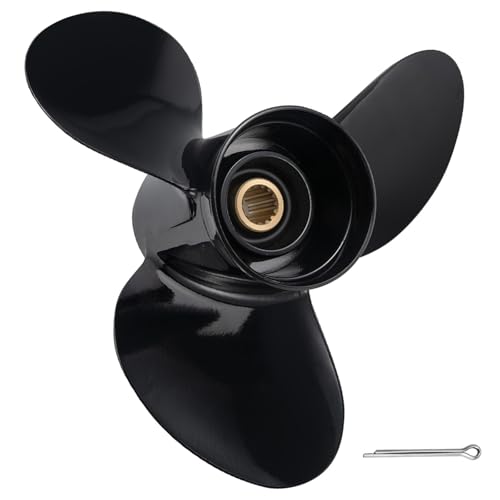
Hub details are useful when replacing a damaged propeller. Several JSPROP listings describe a pressed-in hub and position the propeller as an easy-install replacement. The AQUAMOVE and VRIWOY listings specifically describe rubber-bushing or rubber-pressed-in hub construction.
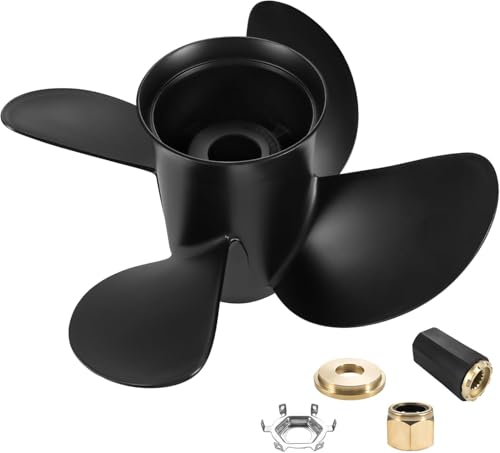
Hardware should also be checked. Because included hardware varies, inspect the listing and compare it with the existing installation before assuming that a nut, washer, pin, or hub kit is supplied.
Warranty statements can add purchasing context, but they do not prove performance. Several selected JSPROP listings state one-year warranties, while the VQPROPs and VRIWOY listings provide shorter periods. YOUNG PROPS states 12-month replacement coverage for blade fracture and bush slipping, subject to exclusions. Read the conditions carefully, especially exclusions for normal wear, accidental damage, modification, or improper installation.
Final recommendation
JSPROP 13 3/4 x 15 Johnson Propeller ranks first overall in this specification-based comparison under the published weighted criteria.
JSPROP 13 3/4 x 15 Johnson Propeller is the highest-scoring returned product and the first overall specification-based choice. It provides a strong combination of broad stated 40-140 HP coverage, a clear 13-spline and 15-pitch configuration, a pressed-in hub, reference number 765182, and one-year warranty information. It is not automatically correct for every Johnson engine, so the diameter, pitch, rotation, spline count, and OEM reference must still match.
Among the top johnson boat propellers, the JSPROP 13 1/2 x 15 is a close alternative for the same broad horsepower family when its diameter and model reference match the original. The YOUNG PROPS 14 1/2 x 19 is the more specialized selection for the listed 135-300 HP range. For smaller engines, the JSPROP 9 1/4 x 11 and JSPROP 10 1/2 x 11 offer clearly separated 13-spline and 14-spline applications, respectively.
The best johnson boat propellers are therefore not chosen by brand name alone. Choose the entry whose complete fitment data agrees with the engine manual or the removed propeller. If any key measurement is uncertain, pause the purchase and confirm it with a marine technician or the manufacturer’s application information.
Frequently Asked Questions
Among the best johnson boat propellers, are all of these propellers direct replacements for Johnson engines?
No. Each listing provides its own engine range, dimensions, spline count, rotation, and sometimes an OEM reference. Some cover Johnson and Evinrude applications, while others also mention BRP or OMC stern drives. A product being described as compatible with Johnson does not establish fit for every Johnson model.
What should I check first when choosing a propeller?
Start with the engine model and horsepower, then confirm the gearcase, shaft spline count, rotation, diameter, pitch, and OEM or reference number. The existing propeller may provide some of this information, but damaged or unreadable markings should be checked against the engine manual.
Is a higher pitch always better?
No. Pitch is part of the propeller’s intended operating setup and should match the engine, boat, and existing specification. The selected products range from 11 to 19 inches of pitch, but the listings do not provide enough evidence to recommend changing pitch for a particular boat. Do not infer that the 19-pitch YOUNG PROPS model is an upgrade for an engine listed with a lower pitch.
What does a pressed-in rubber hub do?
The VRIWOY and AQUAMOVE listings describe rubber-bushing or rubber pressed-in hubs as components intended to absorb vibration or help manage an impact. Hub construction also affects fit and installation. These descriptions should not be interpreted as a guarantee that a propeller or drivetrain will avoid damage.
Can I use a right-hand propeller on a left-hand setup?
The selected products are all listed as right-hand rotation. They should not be assumed suitable for a left-hand or counter-rotating installation. Confirm rotation in the engine documentation and on the original propeller before ordering.