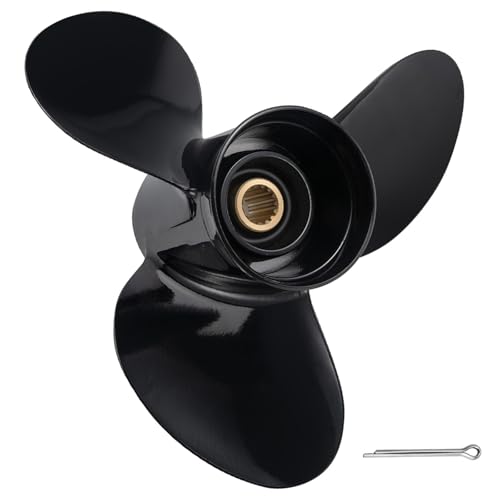
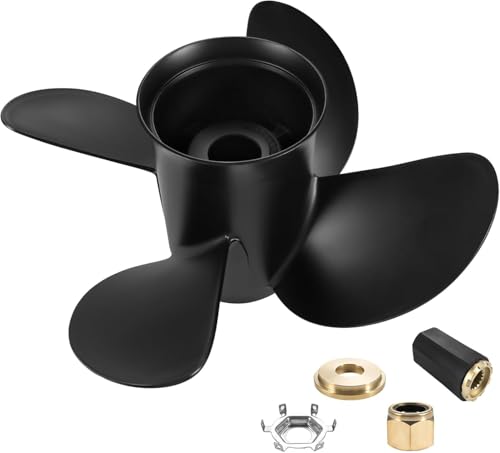
Buying Guide
Choosing among the best outboard boat propellers starts with fitment, not appearance. A propeller must match the outboard’s brand and horsepower range, but that is only the first check. Diameter, pitch, spline count, rotation, gearcase size, blade count, and hub arrangement all affect whether the part is a sensible replacement for the motor and boat.
Confirm the engine application
Start with the engine manufacturer and exact model or horsepower. The selected products cover Yamaha, Mercury, Suzuki, and Tohatsu applications, but their ranges are not interchangeable. For example, the CAPTAIN model lists Yamaha applications from 50 to 130 HP, while the VEVOR model specifies selected Mercury engines from 40 to 140 HP with a 4 1/4-inch gearcase. Smaller choices are more narrowly targeted: PropelTech lists Suzuki 20–30 HP engines, and the Qiclear compact model lists Tohatsu applications from 9.9 to 20 HP.
A horsepower range alone is not enough. Compare the replacement part number when one is supplied. The Qiclear Yamaha model lists 6E5-45945-01-EL, DLNIG lists 663-45958-01-EL, and SZQBZMJ provides Yamaha, Suzuki, or engine-specific replacement numbers depending on the model. Part numbers can help distinguish otherwise similar-looking propellers.
Match diameter and pitch
Diameter is the approximate circle covered by the blades, while pitch describes the theoretical distance the propeller advances in one revolution through a solid medium. In this comparison, larger outboards commonly appear with larger dimensions, such as 13 1/4 by 17 inches on the CAPTAIN, VEVOR, and Qiclear Yamaha models. Compact motors use smaller combinations, including the 8.5 by 9-inch SUNGZE and 9 1/4 by 9-inch SZQBZMJ Suzuki model.
Do not treat a higher pitch as automatically better. The correct selection depends on the motor, boat, load, and the manufacturer’s intended setup. The most suitable evidence-based approach is to compare the dimensions and part number of the current propeller, then confirm the application with the engine documentation. If a listing presents several pitch choices, select only the one that matches the intended setup.
Check splines, rotation, and gearcase size
Spline count is a critical mechanical match. The selected products list 10, 12, 13, 14, or 15 spline arrangements. A 15-spline Yamaha or Mercury propeller should not be assumed to fit a 13-spline application simply because the diameter and pitch look similar. Rotation also matters: the selected products with stated rotation are right-hand models.
Gearcase size is another useful cross-check. VEVOR and Qiclear identify a 4 1/4-inch gearcase, Qiclear’s small Tohatsu model identifies 2 1/2 inches, and PropelTech lists a 3-inch gearcase application. When a listing omits gearcase information, use the OEM part number and current propeller as additional checks rather than guessing.
Choose aluminum, stainless steel, or a blade layout
Most selected models use aluminum. The listings describe aluminum as corrosion-resistant or high quality on several products, including VEVOR, Qiclear, Meruzue, and DLNIG. Aluminum is also represented across both large and compact applications. The CAPTAIN model is the only selected stainless-steel option, and its listing adds cupping and a diffuser ring to the specification set.
Material is only one consideration. The Meruzue model uses four blades and is specifically positioned for acceleration, hole shot, towing, heavy loads, and rough water. Most other selected models use three blades. That difference is a design choice, not a universal ranking: a three-blade replacement may be the better fit when it matches the original equipment dimensions and part number.
Review the hub and installation details
A hub transfers engine power to the propeller and can also provide some protection from shock loads. VEVOR lists an M21 interchangeable hub kit and an internal rubber hub. Among the selected products, the Qiclear Yamaha and DLNIG listings provide strong dimensional and OEM-reference information, but their supplied evidence is less specific about included hardware.
Before installation, compare the hub arrangement, spline count, washer, spacer, and nut requirements. The SZQBZMJ Yamaha listing explicitly describes installation with the existing washer, spacer, and nut. Do not assume every included or required component is the same across brands.
Final recommendation
VEVOR Mercury 13 1/4 x 17 Aluminum Propeller ranks first overall in this specification-based comparison under the published weighted criteria.
CAPTAIN Yamaha Stainless Steel 13 1/4 x 17 is the first overall specification-based choice among these best outboard boat propellers. Its listing combines broad Yamaha application coverage with stainless-steel construction, clear dimensions, 15 splines, right-hand rotation, three blades, cupping, and a diffuser ring. It is not a universal recommendation; verify the engine and existing propeller before ordering.
For Mercury owners, VEVOR is the most fully documented alternative, especially where the listed 4 1/4-inch gearcase and heavy-load application are relevant. Meruzue is the distinctive choice when a documented four-blade design is appropriate for a Mercury 30–60 HP setup. Yamaha shoppers have strong OEM-reference options in Qiclear and DLNIG, while compact Suzuki and Tohatsu applications are addressed by PropelTech, SZQBZMJ, and SUNGZE. These are the top outboard boat propellers in this comparison because their public listings provide enough technical detail to support a careful match.
Frequently Asked Questions
How do I choose the best outboard boat propellers for my engine?
Match the engine brand, model or horsepower, diameter, pitch, spline count, rotation, and gearcase size. Then compare the OEM or replacement part number when available. A propeller that fits the brand but misses the spline or gearcase specification should not be treated as compatible.
Is a four-blade propeller better than a three-blade model?
Not in every application. The selected Meruzue model documents four blades and is positioned for acceleration, hole shot, heavy loads, towing, and rough water. Most other selected products use three blades. The correct choice depends on the engine, boat, load, and the original propeller specification.
Does stainless steel make a propeller the right choice?
Stainless steel is documented on the CAPTAIN model, but material alone does not establish fit or suitability. Confirm the diameter, pitch, spline count, rotation, and Yamaha application first. Aluminum models in this comparison provide many compatible options across Yamaha, Mercury, Suzuki, and Tohatsu engines.
Why are pitch and spline count important?
Pitch affects the propeller’s theoretical advance per revolution, while spline count determines how it connects to the engine shaft. Both must match the intended application. Compare the old propeller, engine documentation, and listing details before selecting a replacement.