Buying Guide
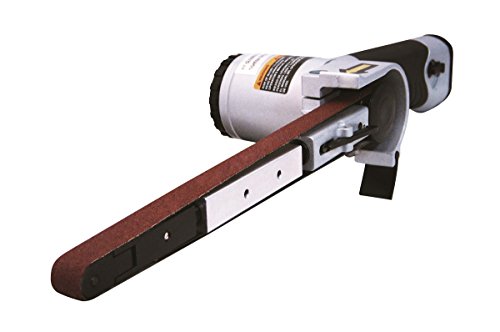
The best pneumatic power belt sanders are compact tools for controlled material removal where a disc or conventional sander cannot easily reach. The selected listings include narrow 3/8 x 13-inch file-style tools, broader 1/2 x 18-inch models, and 3/4 x 20-1/2-inch equipment. Belt size affects the working envelope: narrow belts suit recessed corners and detail access, while wider belts provide more abrasive contact for broader surfaces.
Match belt size to the work
A 3/8 x 13-inch belt is the most access-oriented format documented here. Astro Tools 3036, NuoDunco’s 3/8-inch set, Hoteche, JET, and ABRAPRO use that compact size. These models are appropriate starting points for weld edges, inside corners, and small contours. The Ingersoll Rand 360-418 and Astro Pneumatic 3037 use 1/2 x 18-inch belts, offering a middle format for spot-weld removal and general finishing. For broader contact, the NuoDunco 3/4-inch set uses a 3/4 x 20-1/2-inch belt.
Compare speed and control
Published maximum speeds in this group range from 16,000 to 20,000 RPM. A higher figure does not establish better results; it identifies the available speed range in the listing. Ingersoll Rand and JET document 20,000 RPM, while AIRCAT and Hoteche list 18,000 RPM.
Variable-speed control is useful when the material, grit, or contact area changes. Ingersoll Rand adds a power regulator, JET has a variable-speed throttle and built-in regulator, and AIRCAT combines a variable-speed trigger with a regulator. Astro’s 3036 and 3037 list variable-speed control. Hoteche documents speed adjustment, and ABRAPRO lists stepless adjustment. These features support adjustment, but the supplied evidence does not provide independent performance comparisons.
Check arm movement and access
Arm or head adjustment distinguishes many of the selected tools. Ingersoll Rand documents a tool-free articulating arm; JET documents 360-degree head rotation; AIRCAT documents a 360-degree adjustable arm; and both NuoDunco sets document 360-degree head adjustment. Hoteche lists an adjustable arm, while ABRAPRO lists 360-degree angle adjustment.
These descriptions indicate positioning flexibility for complex workpieces, but they do not guarantee a particular working angle or finish. Astro’s 3036 and 3037 emphasize tension levers, variable speed, and pulley space instead of a stated rotating arm. Choose the adjustment system that corresponds to the angles you routinely need.
Consider weight and grip design
The selected listings range from the 1.28-pound 3M 28366 to the 3.45-pound NuoDunco 3/4-inch set. AIRCAT lists a 1.8-pound composite housing, JET lists lightweight aluminum construction, and Hoteche lists a lightweight low-vibration housing. Ingersoll Rand lists a 2.4-pound weight.
Weight alone is not a complete ergonomic assessment. 3M documents balanced distribution and gripping material, JET lists a vibration-absorbing grip, and AIRCAT describes ergonomic designs. Several other listings mention non-slip or comfort grips. These are public listing claims, not independent test findings. For overhead or extended work, pay attention to listed weight, grip style, and arm position.
Plan for compressor compatibility
Air requirements are not consistently published. NuoDunco’s 3/4-inch and 3/8-inch sets specify operation at 90 PSI and 3–5 CFM. Hoteche lists standard 90 PSI operation and average 6 CFM. Those figures help with compressor planning, but average consumption and shop capacity are different measurements.
For Ingersoll Rand, Astro, JET, AIRCAT, 3M, and ABRAPRO, the supplied evidence does not provide complete PSI and CFM figures. Do not infer compatibility from RPM or horsepower. Verify the model’s current air specification and compare it with the compressor’s delivered airflow at the required pressure. NuoDunco also states that pneumatic-tool oil should be added before and after use, so maintenance belongs in the selection process.
Review included belts and grit range
Included abrasives can reduce the need to buy belts immediately, but grit selection matters. Ingersoll Rand includes 60-, 80-, and 100-grit Norton belts. Astro 3037 includes 36-, 40-, and 60-grit belts for removal work, while Astro 3036 includes 80-, 100-, and 120-grit belts for finer work. NuoDunco’s 3/4-inch set includes 12 belts in 40, 60, 80, and 120 grits; its 3/8-inch set includes 14 belts in 60, 80, and 120 grits. ABRAPRO lists 20 zirconia belts across four grits.
The 3M and JET listings do not document included belts in the supplied evidence. Confirm belt availability, dimensions, abrasive type, and replacement options before ordering.
Final recommendation
NuoDunco 3/4-Inch Air Belt Sander Set ranks first overall in this specification-based comparison under the published weighted criteria.
Ingersoll Rand 360-418 is the first overall specification-based choice among the best pneumatic power belt sanders in this comparison. Its 1/2 x 18-inch belt, 20,000 RPM motor, power regulator, tool-free articulating arm, 2.4-pound listed weight, and included belts provide a balanced profile for general finishing and tight-space work.
NuoDunco’s 3/4-inch set is a suitable alternative when broader contact, multiple grits, and documented 90 PSI and 3–5 CFM operation matter. Choose the NuoDunco 3/8-inch set for detail access. JET JAT-750 emphasizes rotating-head access and throttle control, while AIRCAT 6325 focuses on a lightweight composite housing and adjustable arm. Hoteche is directed toward spot-weld access, 3M favors precision handling, and ABRAPRO supplies a large zirconia-belt package.
Among the top pneumatic power belt sanders, Astro’s 3037 and 3036 offer straightforward belt formats with included grits for removal or finishing. Before purchase, confirm current specifications, compressor capacity, belt availability, and safe operating procedures.
Frequently Asked Questions
What are the best pneumatic power belt sanders for tight spaces?
The narrow 3/8 x 13-inch models are the clearest fit in this comparison. JET JAT-750, Astro Tools 3036, NuoDunco’s 3/8-inch set, Hoteche, and ABRAPRO document narrow belts or confined-space use. Ingersoll Rand, AIRCAT, and the NuoDunco sets add documented arm or head adjustment that may help with difficult angles.
Choose based on access and coverage. A 3/8-inch belt suits narrow corners, weld edges, and detailed work. A 1/2-inch belt offers a middle ground for spot-weld removal and general finishing. A 3/4-inch belt can provide broader contact, as shown by the NuoDunco 3/4-inch set, but may be less convenient in confined areas.
How much air does a pneumatic belt sander need?
Requirements vary by model. NuoDunco lists 90 PSI and 3–5 CFM for its selected sets, while Hoteche lists 90 PSI and average 6 CFM. Several other products do not include PSI or CFM in the supplied evidence. Check the specific manufacturer’s requirement and your compressor’s delivered airflow rather than relying on a general category estimate.
Are included sanding belts important?
They can reduce the need to buy abrasives immediately and let you begin with different coarseness levels. Astro 3037 emphasizes coarse grits, Astro 3036 includes finer grits, and ABRAPRO and NuoDunco provide larger assortments. Verify replacement-belt availability and make sure the included belt dimensions match the work you plan to perform.
What maintenance does a pneumatic belt sander require?
Pneumatic tools require an appropriate air connection and routine care. The NuoDunco listings specifically instruct users to add pneumatic-tool oil before and after use and store the tool in a dust-free environment. Follow the selected model’s manual, inspect belts and connections, and use required protective equipment. These precautions do not replace the manufacturer’s instructions.