Buying Guide
A useful way to compare the best lithium-ion tool combo kits is to start with the work you actually expect to do. A kit with a drill, impact driver, saw, and work light is a general-purpose foundation. A package that adds a grinder, reciprocating saw, or oscillating tool is more suitable for remodeling and construction. Smaller two- and three-tool kits can be the better fit when the work is limited to fastening, drilling, sanding, routing, or jigsaw cutting.
Count task-specific tools rather than relying only on the advertised tool total. The DEWALT DCK940D2 lists nine tools, but some of that count is made up of a speaker and LED light. The DEWALT DCK1021D2 similarly adds cleanup, lighting, and audio functions to its ten-tool package. Those additions can be useful, but they are not substitutes for a saw or driver.
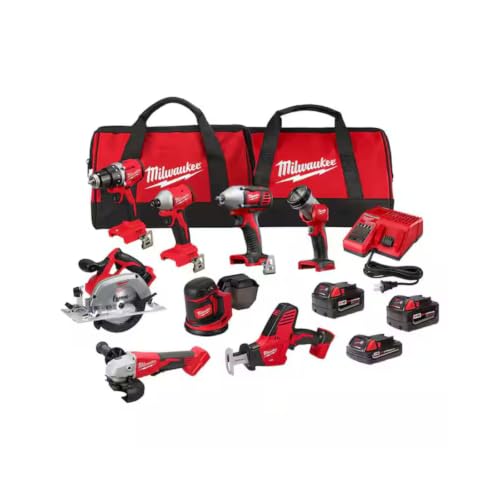
For a broad construction mix, the Milwaukee M18 FUEL 7-Tool Combo Kit and Milwaukee M18 8-Tool Combo Kit document combinations of drilling, driving, circular sawing, reciprocating sawing, and grinding. The M18 FUEL package also includes a mid-torque impact wrench, while the eight-tool package lists a multi-tool. These differences matter if your projects involve automotive fastening, demolition, plunge cutting, or detail work.
Check the battery package
Battery quantity and capacity affect how conveniently a kit can support several tools. The Milwaukee M18 8-Tool Combo Kit lists three batteries, including two high-capacity packs and one compact battery. The Milwaukee M18 FUEL 7-Tool Combo Kit lists two 5.0Ah batteries. The RIDGID R9635 lists two 4.0Ah batteries, and several other kits include two batteries of differing capacities.
Do not treat a larger battery as automatically better for every task. A compact pack may be easier to handle in a drill or impact driver, while a higher-capacity pack can be more appropriate for a saw or grinder. Also check whether the listing includes a charger and whether the kit stays within a battery platform you already own. RYOBI states compatibility with more than 125 ONE+ tools, while RIDGID states compatibility with its 18V tools, batteries, and chargers.
Compare brushless and control features
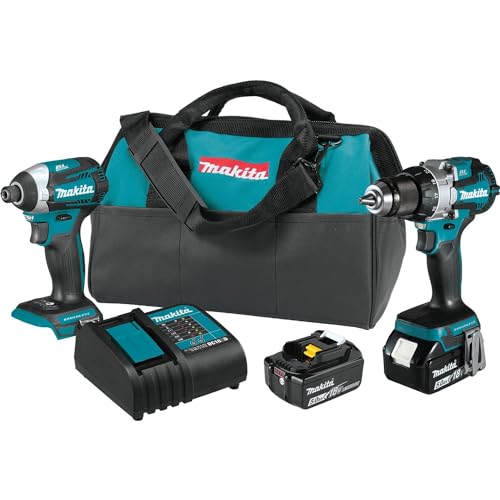
Brushless construction is explicitly documented for the Milwaukee M18 FUEL, Makita XT616T, Makita XT296ST, and DEWALT DCK307D1P1 selections. The supplied listings also describe electronic controls, variable speeds, torque settings, and overload protection. These are useful specification differences, but they should not be converted into unsupported claims about real-world durability or runtime.
The Makita XT616T is especially easy to compare on paper because its listing provides speed, torque, stroke-rate, cutting-capacity, and grinder-speed figures. The Makita XT296ST gives a more focused brushless hammer-drill specification, including 970 in-lb of maximum torque and two speed ranges. For users who value control in finish work, the DEWALT specialty kit’s variable-speed router dial is a meaningful feature.
Consider portability and storage
A larger kit can reduce the need to purchase additional tools, but it also requires more storage and organization. The Milwaukee M18 FUEL package includes two tool bags, and the Milwaukee eight-tool kit lists two heavy-duty contractor bags. The DEWALT DCK1021D2 includes two bags, while the RYOBI kit lists one bag. These details help distinguish a jobsite-ready package from a smaller starter set.
Tool count is not the only portability factor. The Makita XT616T listing gives a 6.0-pound with-battery weight for its hammer driver-drill and a 3.3-pound with-battery weight for its impact driver. The Makita XT296ST is also positioned as a compact two-tool setup. By contrast, the broadest kits may be more appropriate for a workshop or contractor vehicle than for a small household storage area.
A combo kit often becomes the starting point for additional bare tools. Platform compatibility can therefore be more important than a small difference in initial tool count. RYOBI documents a particularly large ONE+ compatibility range. Milwaukee states that its M18 system includes more than 200 solutions, while DEWALT packages use the 20V MAX battery system. These platform statements are useful for planning future expansion, though the exact compatibility of any later tool should still be checked before purchase.
For a focused start, the BLACK+DECKER BD4KITCDCRL supplies a drill/driver, compact circular saw, work light, two batteries, and a 20V MAX system. For woodworking, the DEWALT DCK307D1P1 is more targeted. For a general household or remodeling setup, the RYOBI, RIDGID, DEWALT, and Milwaukee multi-tool packages provide wider coverage.
Final Recommendation
Milwaukee M18 FUEL 7-Tool Combo Kit ranks first overall in this specification-based comparison under the published weighted criteria.
The final choice among the best lithium-ion tool combo kits depends on the documented features that match your intended use.
Milwaukee M18 FUEL 7-Tool Combo Kit is the first overall specification-based choice. Its seven-tool selection, two 5.0Ah batteries, brushless FUEL tools, detailed controls, and two bags give it the most specification-aligned balance for demanding general work. Among the top lithium-ion tool combo kits, it is the most complete single-package option in this comparison based on the supplied specifications.
The Makita XT616T is a close alternative for buyers who want unusually detailed published specifications and a brushless six-tool mix. DEWALT’s DCK940D2 and DCK1021D2 are better suited to shoppers who prioritize maximum tool count, while the Milwaukee eight-tool kit stands out for its three-battery arrangement. For narrower needs, the Makita XT296ST, BLACK+DECKER BD4KITCDCRL, and DEWALT DCK307D1P1 avoid paying for tools outside the intended work.
Before buying, verify the included battery capacities, charger, storage, and exact tool list for the current listing. Platform compatibility can make a compact starter kit more useful over time, while a larger package may be the more efficient way to cover several jobsite tasks immediately.
Frequently Asked Questions
Start with the tools required for your work, then compare battery count and capacity, charger inclusion, motor type, control features, and storage. A kit should earn its place through useful task coverage rather than tool count alone. For example, a package with a drill, impact driver, circular saw, and reciprocating saw covers more core construction tasks than a larger package that adds several non-tool accessories.
Not necessarily. Brushless construction is a specification advantage documented in several selections here, including the Milwaukee M18 FUEL and Makita kits, but the supplied evidence does not establish that every buyer needs it. A brushed or unspecified kit can still be appropriate for occasional DIY work if its tool selection and battery package match the intended tasks.
It depends on the work. The Makita XT296ST is a focused drilling-and-fastening option, while the Milwaukee M18 FUEL and Makita XT616T cover cutting and grinding as well. A smaller kit can reduce storage needs and avoid paying for unused tools. A broader kit may be more practical when several tool categories are needed immediately.
Do all lithium-ion combo kits use interchangeable batteries?
No. Interchangeability is normally limited to the manufacturer’s stated battery platform. RYOBI identifies its ONE+ compatibility, RIDGID identifies its 18V system, and DEWALT identifies its 20V MAX system. Check the platform name and included charger before assuming that an existing battery will fit a new tool.
Which kit is best for woodworking?
The DEWALT DCK307D1P1 is the most focused choice among these selections because it includes a compact router, random orbital sander, and jigsaw. Its variable-speed router dial and brushless motor descriptions for the sander and jigsaw align with routing, sanding, and curved or detail cutting tasks. It is less suitable as an all-purpose construction kit because it does not list a drill, impact driver, or reciprocating saw.