Buying Guide
The best lithium-ion string trimmers are not defined by voltage alone. A useful comparison begins with the cutting system, then considers how the tool is controlled, what arrives in the box, and whether the design fits the way you maintain your yard. The products above were selected from public listing features and specifications. They were not hands-on tested, and the ranking does not summarize customer opinions.
Choose the cutting width and line size
Cutting width affects how much area the trimmer can cover in one pass. The Toro Flex-Force offers a selectable 14- or 16-inch width, while the EGO ST1511T, Makita GRU01Z, and DEWALT DCST922P1R list 15-, 15-, and 14-inch paths respectively. These wider options may make sense when clearing larger open areas, provided the user is comfortable with the tool’s listed size and weight.
A narrower path can be useful around beds, fences, shrubs, and other obstacles. The Makita XRU23Z and XRU24Z list 13-inch paths, while the BLACK+DECKER LST300 and WORX WG163 list 12-inch paths. Line diameter also matters in the published specifications. EGO and Toro document 0.095-inch options, whereas the Greenworks and WORX models list.065-inch line. Do not assume that a larger line or wider path automatically suits every property; match those details to the amount of grass and weed growth you normally trim.
Decide whether you need an edger
Several selected models are more than straight trimmers. The BLACK+DECKER LST136 converts to an edger, the Ryobi P20014 has a pivoting head, and the Makita XRU24Z uses a rotating head for edging. The WORX WG163 adds rubberized wheels and a spacer guard, giving the operator physical guidance along a border and helping keep the line away from plants and ornaments.
Edging features are useful for sidewalks, driveways, and flower-bed borders, but they add design complexity. If your main task is simply cutting grass around obstacles, a conventional trimmer head may be enough. If clean borders are a regular part of your routine, prioritize a documented conversion method, pivoting head, rotating head, or wheels rather than relying on a generic two-in-one label.
Compare control and adjustment features
Speed controls can help tailor the tool to the job. The EGO ST1511T lists two speed settings, the Makita XRU23Z combines a high/low button with a variable-speed trigger, and the DEWALT DCST922P1R lists both a variable-speed trigger and Hi/Lo control. BLACK+DECKER’s LST136 uses a PowerCommand dial to select more power or more runtime. These features provide documented choices, but the supplied data does not establish how any model performs in a particular type of vegetation.
Adjustment is another way to improve positioning. EGO lists a telescopic aluminum shaft, Makita’s XRU24Z lists a shaft range from 48.25 to 56.5 inches, and the WORX head tilts 90 degrees. The Toro listing instead emphasizes a selectable cutting length. Look for the adjustment that addresses your actual need: shaft length for reach and posture, head angle for slopes and tight spaces, or cutting-width selection for changing between detail work and broader coverage.
Check the battery and charger details
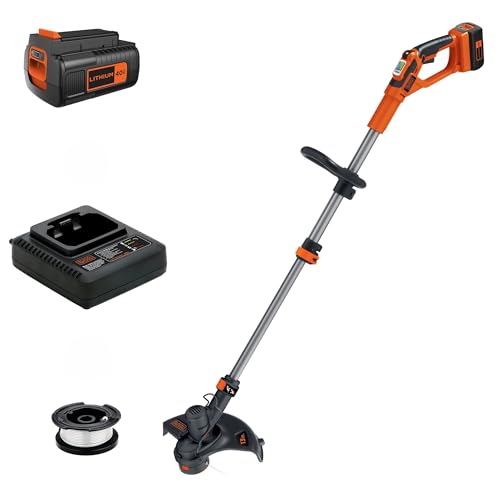
A complete kit is ready to use after charging. The EGO, Toro, BLACK+DECKER LST136, and WORX WG163 listings include a battery and charger. The WORX kit lists two batteries, while the EGO kit lists a 2.5Ah battery and Toro lists a 2.5Ah battery in its title. The DEWALT DCST922P1R title identifies a 5Ah battery, although the product is renewed.
Tool-only products can be sensible when you already own compatible batteries. The Makita GRU01Z uses the 40V XGT platform, the Makita XRU23Z and XRU24Z use 18V LXT, the Ryobi P20014 works with Ryobi batteries and chargers, and Greenworks identifies compatibility with G-MAX 40V batteries. However, a bare tool is not a complete operating package. Add the cost and availability of the correct battery and charger before comparing it with a kit.
Handling details vary considerably. The WORX listing gives a 5.5-pound machine weight, the BLACK+DECKER LST136 lists the current price, and the Makita XRU23Z lists the current price. The EGO and DEWALT listings are heavier at 10.27 and the current price. These are published product weights, not test measurements, and included battery weight may affect the final feel.
Storage can be just as important as operating weight. DEWALT’s folding hinge is explicitly intended to reduce length for storage and transport. Telescoping shafts may help with positioning, while compact models such as the Makita XRU24Z are aimed at precision trimming. Warranty information also differs: EGO lists five years for the tool, Makita lists three years on its selected models, and the renewed DEWALT listing specifies 90 days. Treat warranty coverage as a buying detail, especially when comparing new and renewed products.
How this comparison was scored
The editorial criteria are cutting capability, control and adjustability, battery and charger package, handling and design, and platform and warranty support. Each product received a score from 0.0 to 10.0 for every criterion using only the supplied features and specifications. The weights total 100, with cutting capability receiving the greatest emphasis. Marketplace ratings, review totals, purchase activity, badges, and current price signals were not used as public criteria. This is a specification-based comparison, not a performance test.
Final Recommendation
EGO Power+ ST1511T 15-Inch Cordless Trimmer ranks first overall in this specification-based comparison under the published weighted criteria.
The final choice among the best lithium-ion string trimmers depends on the documented features that match your intended use.
EGO Power+ ST1511T is the highest-scoring returned product and the first overall specification-based choice. Its 15-inch path, 0.095-inch line, brushless motor, telescoping shaft, automatic PowerLoad system, two speed settings, and included 2.5Ah battery and charger create the most balanced package in this comparison. Toro’s Flex-Force is a compelling alternative when adjustable 14- or 16-inch coverage is the priority. For existing battery-platform owners, Makita’s GRU01Z, Makita’s XRU23Z, and Ryobi’s P20014 avoid duplicating a battery system, though the Makita and Ryobi tools are sold without batteries and chargers.
Among the top lithium-ion string trimmers for detail work, Makita XRU24Z stands out for its rotating head, five-position pivoting head, and telescoping shaft. WORX WG163 is a practical edging-focused option because it includes wheels and a spacer guard. BLACK+DECKER LST136 offers a complete 40V kit with a power/runtime dial, while DEWALT DCST922P1R is the storage-oriented choice because its hinge folds the tool. Greenworks BST4000 is best considered by users who already have a compatible G-MAX battery.
Before buying, verify whether the listing is tool-only or a complete kit, confirm the battery platform, and compare the documented cutting width and line diameter with your yard. Those checks are more useful than choosing by voltage alone.
Frequently Asked Questions
What should I look for in the best lithium-ion string trimmers?
Start with cutting width and line diameter, then check speed controls, shaft or head adjustment, battery inclusion, and platform compatibility. Wider paths and thicker listed line may suit broader or heavier trimming, while narrower paths and pivoting heads can be easier to position around beds and borders. Also check whether the model converts to an edger if border work is important.
A tool-only model can be a practical choice when you already own compatible batteries and a charger. Makita XRU23Z, Makita XRU24Z, Makita GRU01Z, Ryobi P20014, and Greenworks BST4000 are examples in this comparison. If you do not own the platform, calculate the additional battery and charger requirements before choosing a bare tool over a complete kit.
Which selected trimmer is designed for edging?
WORX WG163 uses rubberized wheels and a 90-degree tilting head. BLACK+DECKER LST136 converts from trimmer to edger, while Makita XRU24Z uses a 180-degree rotating head. Ryobi P20014 also lists a pivoting head for edging. These documented designs address edging in different ways, so consider whether you prefer wheels, a conversion, or a rotating or pivoting head.
Is a brushless motor necessary?
It is not necessary for every yard, but brushless construction is a documented feature on EGO ST1511T, Toro Flex-Force, Makita GRU01Z, Makita XRU23Z, and WORX’s supplied motor description. Buyers who prioritize brushless equipment can narrow their selection to those models. The supplied evidence does not establish real-world cutting results, noise, or durability beyond the listed product claims.
How should I compare battery voltage?
Voltage is only one part of the comparison. Also consider the battery’s stated amp-hour capacity, whether one or two batteries are included, the listed runtime, and whether the tool is compatible with batteries you already own. EGO lists up to 45 minutes with its included 2.5Ah battery, while Makita GRU01Z lists up to one hour with a specified 4.0Ah battery sold separately. Those figures are listing claims, not independent test results.