Buying Guide
The best lithium-ion impact drivers should be compared by the work they are documented to handle, not by a single headline number. Public listings commonly emphasize torque, RPM, impact rate, motor type, control modes, size, and included batteries. Those details answer different buying questions, so a driver with the highest stated torque is not automatically the right tool for every task.
This comparison uses listing specifications and feature statements only. It does not represent hands-on testing, measured runtime, noise testing, durability testing, or customer sentiment. Ratings in the list were based on the supplied evidence for fastening power, speed control, access, brushless efficiency, and kit contents.
Match power to the fastening work
Torque is useful for distinguishing broad capability, but the numbers should be read alongside speed and control information. The DEWALT DCF845B lists 1,825 in-lbs. of torque and 3,400 RPM, while the Milwaukee 3650-21P lists 1,700 in-lbs. and 3,600 RPM. These figures indicate substantial stated output, but they do not establish how either tool will perform on a particular material or fastener.
The Makita XDT19Z and XDT14Z offer slightly lower stated torque than the DEWALT model but add Quick-Shift features and multiple speed settings. That kind of control can be more relevant than maximum output when a project includes different screw sizes or workpieces. The Milwaukee 2656-20 lists 1,500 in-lbs. of torque and up to 3,450 IPM, making it a straightforward choice for an existing M18 owner who does not need advanced electronic modes.
Look for useful control modes
Variable-speed triggers allow the user to adjust output through trigger pressure, while selectable modes provide repeatable limits or operating profiles. The DCF845B has three speed settings, and the Makita XDT19Z has four. The XDT14Z adds a tightening mode for self-drilling screws, and the XDT18ZB lists Assist Mode for starting a fastener at low speed before tightening begins.
These features are documented design provisions, not guarantees of avoiding stripped screws or cross-threading. They can nevertheless make a driver more adaptable on paper. If your work is mostly repetitive fastening, a simpler trigger may be adequate. If the same driver will move between delicate hardware, self-drilling screws, and larger fasteners, more adjustment is worth considering.
Consider access, length, and handling
Compact dimensions matter when a driver must fit between framing, inside cabinets, or above shoulder height. The Makita XDT18ZB is listed at 5-1/4 inches long, the Milwaukee 2850-21P at 5.1 inches, and the Metabo HPT WH18DEX at 4.72 inches. Those figures make the three models especially relevant for restricted access, although published dimensions are not a substitute for checking the actual clearance of a task.
The Makita XDT18ZB also lists a 2.6-pound weight with battery, while the Metabo HPT listing gives a 2.0-pound tool weight. Because manufacturers may describe weight differently, these figures should not be treated as directly interchangeable. Still, the supplied specifications support considering these models when overhead work or a smaller form factor is important.
Decide between brushless and other motor descriptions
Brushless motors appear throughout the selected list. DEWALT, Makita, Milwaukee, and Metabo HPT listings describe brushless construction, with several also stating that electronic controls optimize energy use or help manage motor operation. The Makita XDT13Z specifically describes electronic energy matching and a claim of up to 50% longer runtime per charge.
A brushless label can help identify the intended motor design, but the listing evidence does not establish actual runtime in your conditions. Battery capacity, fastener size, material, temperature, and work pace all affect use. The Milwaukee 2656-20 has useful output, lighting, and M18 compatibility, but its supplied listing does not identify a brushless motor, so it ranks lower on that criterion.
Check what comes in the box
Tool-only models can make sense when you already own the matching battery platform. The Makita XDT19Z, Makita XDT14Z, Makita XDT18ZB, Makita XDT13Z, DEWALT DCF845B, and Milwaukee 2656-20 are listed without a battery-and-charger package. Confirming the platform before ordering is important because the tool’s stated voltage does not make batteries interchangeable across brands.
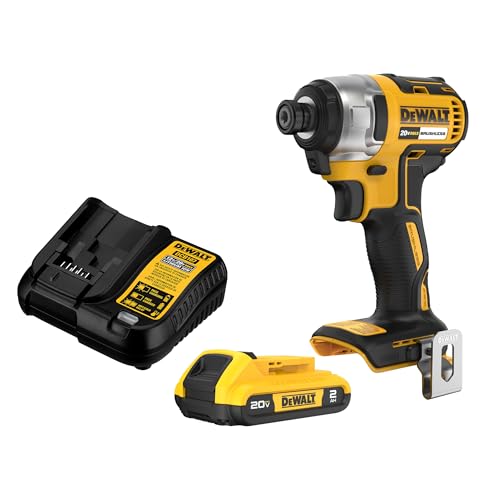
Complete kits are more convenient for a new platform purchase. The Metabo HPT WH18DEX includes two 2.0Ah batteries, a charger, and a bag. The Milwaukee 3650-21P and 2850-21P include a 2.0Ah battery, charger, and bag, while the DEWALT DCF787D1 includes a 20V MAX 2Ah battery, charger, and belt hook. Kit contents can change the practical buying decision even when a tool-only model has stronger control specifications.
Final recommendation
Metabo HPT WH18DEX 18V Impact Driver Kit ranks first overall in this specification-based comparison under the published weighted criteria.
The DEWALT DCF845B is the highest-scoring returned product and the first overall specification-based choice among these best lithium-ion impact drivers. Its listed 1,825 in-lbs. of torque, brushless motor, three speed settings, variable trigger, and three-LED light create a balanced specification profile, provided you already have or plan to add a compatible battery.
For the most electronic control, the Makita XDT19Z is the better fit on paper because it lists four speeds, Quick-Shift Mode, and Assist Mode. For a complete package, the Metabo HPT WH18DEX supplies two batteries and a charger while retaining compact dimensions and strong stated output. The Milwaukee 3650-21P is another kit-oriented option with 1,700 in-lbs. of listed torque. These are among the top lithium-ion impact drivers here for different buying priorities, rather than interchangeable choices.
Before purchasing, identify whether you need a tool-only model or a full kit, compare the battery platform with tools you already own, and confirm that the stated size and control features suit the fasteners and access conditions involved.
Frequently Asked Questions
Which of the best lithium-ion impact drivers has the most stated torque?
The DEWALT DCF845B has the highest stated torque in this selected group at 1,825 in-lbs. The Milwaukee 3650-21P lists 1,700 in-lbs., while the Makita XDT19Z lists 1,590 in-lbs. These are published specifications, not independent test results, so they should be used for comparison rather than as a promise of task performance.
Are the best lithium-ion impact drivers sold with batteries?
Some are, and some are not. The DEWALT DCF787D1, Metabo HPT WH18DEX, Milwaukee 3650-21P, and Milwaukee 2850-21P are listed as kits with batteries and chargers. The DEWALT DCF845B and several Makita models are tool-only listings. Always check the exact package contents and battery platform before ordering.
Is a compact impact driver better for tight spaces?
A shorter listed length can make access easier, but it does not guarantee that a tool will fit every location. The Makita XDT18ZB, Milwaukee 2850-21P, and Metabo HPT WH18DEX document compact dimensions. Also consider the battery size, bit length, grip shape, and the clearance around the fastener.
Do more speed settings make an impact driver more useful?
More settings can provide additional adjustment for different fastening tasks. The Makita XDT19Z lists four speeds, the DEWALT DCF845B and Makita XDT14Z list three, and several others use a variable-speed trigger. More settings do not automatically mean better results; the useful choice depends on whether your work benefits from repeatable speed and drive limits.
Should I choose a brushless model?
A brushless model may be attractive when the listing documents motor efficiency, electronic controls, or longer-life design claims. Most selected products use brushless motors, including the DEWALT DCF845B, Makita XDT13Z, and Metabo HPT WH18DEX. The supplied evidence does not provide independent runtime or durability testing, so treat those statements as product specifications rather than verified outcomes.