Buying Guide
Choosing among the best load limit ropes starts with identifying what the rope must do. A recovery rope, dock line, cargo tie-down, and wire cable may all list a working load limit, but their designs respond to different forces and connection methods. Treat the stated working load limit as a product specification, not as permission to exceed the limits of the complete setup. Anchors, hooks, shackles, cleats, clips, and attachment points also need suitable ratings.
Match the rope to the application
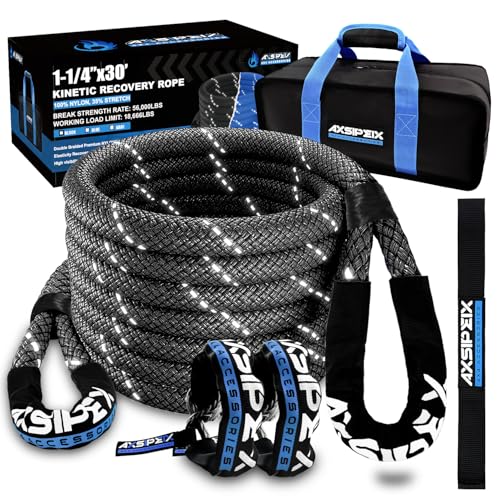
For vehicle recovery, select a purpose-built kinetic recovery rope rather than a general dock line or bare cable. The ALL-TOP and AXSIPEIX products document elastic recovery designs, double-braided nylon construction, protective sleeves, eye loops, and high working load limits. AXSIPEIX also includes soft shackles, while ALL-TOP focuses on a 30-foot rope with reinforced eye areas. These features are specific to recovery pulls and should not be generalized to overhead lifting or other applications not documented in the listings.
Dock lines are a different category. The Amarine Made 50-foot line is the longest single dock line in this comparison and uses 3/4-inch double-braided nylon with a spliced soft eye. The Amarine Made four-pack supplies shorter 15-foot lines, while the NovelBee four-pack supplies 20-foot lines in a smaller 3/8-inch diameter. Those configurations may be more practical when several attachment points are needed. The listed marine features include shock-load resistance, soft eyes, and heat-sealed ends.
For anchor duty, the NovelBee MFP anchor line is specifically described as lightweight and floatable, with low stretch and minimal water absorption. It is not interchangeable with a high-capacity recovery rope simply because both are sold as rope. Its 200-foot length is useful when scope or distance calls for more line, but the stated working load limit places it in a lighter-duty category.
Wire-rope products suit a different set of jobs. Koch offers 125 feet of stainless steel 7-by-19 cable for listed garage-door, winch, and tie-down applications. Ben-Mor provides 100 feet of galvanized 7-by-7 cable for fencing, clotheslines, deck railings, pulleys, and winches. The Lifstar kit adds thimbles and clips to a vinyl-coated cable, which can help when a project needs basic end-formation hardware. None should be treated as a finished sling unless the listing specifically supports that use.
Compare working load limit and break strength
Working load limit is the more useful comparison figure for normal planning because it is the stated load the product is intended to support in its described application. Break strength is a separate figure and should not be substituted for working load limit. For example, ALL-TOP lists a 16,000-pound working load limit and 48,000-pound break strength; AXSIPEIX lists the current price and the current price, respectively. The dock lines also separate the two values, with Amarine Made listing the current price working load and the current price breaking strength for its 50-foot line.
Do not compare numbers without considering diameter, construction, attachments, and force direction. A rope’s working load limit may be affected by knots, bends, abrasion, edge contact, shock loading, or the rating of the connected hardware. The Keeper Rope Wrangler, for instance, lists a 250-pound working load limit and uses an integrated locking mechanism for cargo control; that does not make it equivalent to a high-capacity recovery rope.
Consider material and construction
Nylon appears in the recovery and dock-line selections because the listings describe double-braided construction and shock or elastic behavior. The recovery ropes use nylon N66, while the dock lines use double-braid nylon intended for marine mooring. Polypropylene serves a different purpose in the NovelBee anchor line, where floatability and low water absorption are documented. Steel cable provides a compact, rigid alternative for pulley, winch, fencing, and related installations. Galvanized and stainless finishes address different environmental considerations, but the listings do not establish a universal corrosion lifespan.
Coatings and sleeves are also application-specific. AXSIPEIX documents a wear-resistant polymer coating and protective sleeve, and the Lifstar cable uses a vinyl coating described as reducing fraying and improving resistance to abrasion and weathering. ALL-TOP lists protective sleeves around the eye areas. These features can help inspection or handling, but they do not remove the need to check the rope for damage before use.
Check length, diameter, and connection style
Length affects setup flexibility, storage, and the amount of material that must be managed. The selected products range from the 16-foot Keeper to the 200-foot NovelBee anchor line. Diameter also matters: the 3/8-inch dock lines and anchor line are different from the 1.25-inch AXSIPEIX recovery rope. Larger diameter may indicate a different capacity and handling profile, but it should never be used as a substitute for the documented working load limit.
Connection details can save a separate hardware decision. Recovery ropes use eye loops, and AXSIPEIX includes soft shackles. Dock lines use spliced soft eyes. The Lifstar kit includes thimbles and clips, while the Keeper has a hook and locking tension mechanism. Koch and Ben-Mor are cable lengths rather than complete assemblies with finished end fittings. Confirm that the end connection matches the anchor point and that any included hardware has a suitable rating.
Inspect and use conservatively
Before use, check for cuts, abrasion, damaged eyes, corrosion, crushed sections, loose strands, or compromised clips and thimbles. Follow the product’s stated application and working load limit, and account for the weakest component in the system. Avoid treating a general-purpose cable as suitable for overhead lifting when the listing does not support that use; Ben-Mor explicitly excludes aircraft controls and overhead lifting. Likewise, use the Keeper only within its stated cargo-control role and do not confuse break strength with an operating limit.
Final Recommendation
AXSIPEIX 30-Foot Kinetic Recovery Rope Kit ranks first overall in this specification-based comparison under the published weighted criteria.
The final choice among the best load limit ropes depends on the documented features that match your intended use.
ALL-TOP 30-Foot Kinetic Recovery Rope is the highest-scoring returned product and the first overall specification-based choice. Its documented 16,000-pound working load limit, 30-foot length, 1-inch diameter, nylon N66 double braid, elasticity, reinforced eye loops, and protective sleeves create the most balanced recovery specification profile in this comparison.
AXSIPEIX is a close alternative for shoppers who want a thicker 1.25-inch rope, a higher stated working load limit, reflective details, two soft shackles, and a storage bag. For marine use, the Amarine Made 50-foot dock line is the clearest long-line choice, while the Amarine Made and NovelBee four-packs make sense when several finished dock lines are needed. Koch and Ben-Mor cover longer cable runs, Lifstar adds cable-end hardware, Keeper focuses on lighter cargo, and NovelBee’s 200-foot MFP line is the specialized anchor option.
Together, these are the top load limit ropes and cable-format options for distinct documented jobs rather than interchangeable substitutes. Select by application first, then verify working load limit, length, diameter, connection hardware, and the condition of every component before loading.
Frequently Asked Questions
What are the best load limit ropes for vehicle recovery?
The ALL-TOP and AXSIPEIX kinetic recovery ropes are the most directly matched options because their listings specify elastic recovery construction, nylon double braids, eye loops, protective sleeves, and high working load limits. AXSIPEIX includes two soft shackles, while ALL-TOP lists a two-year warranty and a 30-foot, 1-inch format.
Is break strength the same as working load limit?
No. Break strength describes a failure threshold listed by the manufacturer, while working load limit is the stated operating limit for the product. Use the working load limit for planning and also account for knots, abrasion, shock loads, connectors, and anchor points. Do not use a break-strength figure as a safe working limit.
Which selected rope is best for docking a boat?
The Amarine Made 50-foot dock line is the most specification-aligned fit when a long single line is needed, with a 3/4-inch diameter and 1,900-pound working load limit. The Amarine Made 15-foot four-pack and NovelBee 20-foot four-pack are alternatives when multiple shorter dock lines are more useful.
Are wire cables included in this comparison interchangeable with rope?
No. Koch, Ben-Mor, and Lifstar are wire-cable products with different materials, constructions, and intended applications. Lifstar includes thimbles and clips, but Koch and Ben-Mor are cable lengths rather than finished rope assemblies. Use each only for its documented type of work and verify compatible fittings.
What should I inspect before using a load-rated rope?
Check the rope or cable, eyes, sleeves, clips, thimbles, hooks, and anchor points for cuts, abrasion, corrosion, crushed areas, loose strands, or other visible damage. Confirm the working load limit of the complete setup, keep within the documented application, and remove damaged components from service.