Buying Guide
Choosing among the best polyester ropes starts with the task rather than the brand. Polyester rope appears in arborist lines, halyards, utility cords, camping lines, and marine-oriented products, but ropes made from the same material can differ considerably in diameter, braid, length, and documented capacity. This comparison uses public listing specifications and features; it is not a hands-on test and does not summarize customer opinions.
Match the rope to the application
For tree work, rigging, or pulling, begin with a product whose listing specifically describes arborist or rigging use. VEVOR, CRAYZA, Ezjsdltech, HOKINETY, and YUZENET all document arborist, rigging, bull-rope, climbing, or tree-work applications. These ropes use larger diameters or reinforced double-braid designs than the lighter utility cords.
VEVOR documents an 8,000-pound breaking strength and working guidance. Ezjsdltech supplies both breaking-strength and safe-working-load information. A breaking-strength figure describes the listed failure capacity, not automatically a permitted working load. CRAYZA has the largest diameter in this comparison, but its supplied listing does not include a numerical breaking-strength figure. HOKINETY’s listing includes conflicting capacity figures, so verify its current documentation before load-bearing use. YUZENET gives a 3,520-pound maximum tensile force and includes cautions about temperature and sheath wear.
For clotheslines, flagpole lines, plant supports, camping, crafting, or general bundling, smaller solid-braid and diamond-braid products may be more practical. ARISKEY supplies a 5/16-inch solid-braid rope for everyday outdoor work. QNR offers several spool sizes for buyers who need repeated cuts or long runs. GOLDEN COCK provides a smaller double-braid option with a stated 2,200-pound breaking strength.
Compare diameter and length
Diameter affects handling, routing, and the amount of material in the rope. CRAYZA is the thickest selection at 3/4 inch. VEVOR and Ezjsdltech use 1/2-inch formats for larger outdoor tasks. HOKINETY and YUZENET use 3/8-inch diameters that balance reach with manageability. The 3/16-inch and 1/4-inch products are more naturally suited to utility lines and lighter applications unless their documented rating and the intended task support more demanding use.
Length is also important. Ezjsdltech provides 150 feet, VEVOR 120 feet, and HOKINETY and YUZENET 100 feet. These prepared lengths are convenient when one finished rope is needed. QNR’s 250-foot, 500-foot, and 1,000-foot spools are better suited to projects requiring multiple sections or custom cuts. A spool can reduce the need for joins, but it requires the user to measure and finish each cut.
Do not choose solely because a rope is longer or thicker. A large rope may be cumbersome in a pulley or storage system, while a thin cord may not provide enough capacity. Check the intended application, diameter, length, and documented strength together.
Understand braid construction
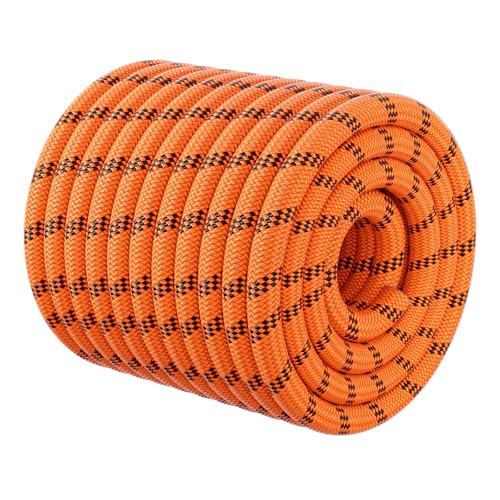
Double-braided ropes have an inner core and outer braid. VEVOR, CRAYZA, HOKINETY, YUZENET, Ezjsdltech, and GOLDEN COCK document double-braid or multilayer construction. Their listings associate these designs with strength, abrasion resistance, flexibility, or rigging use. VEVOR identifies a twisted inner core and 48-strand format. HOKINETY describes a 48-strand outer layer and eight-strand inner core, while Ezjsdltech identifies a 48-strand tightly woven inner core.
Solid-braid ropes appear in the QNR and ARISKEY listings. Their smooth, round profiles may be useful for utility work, knotting, and simple hardware. QNR specifically describes low stretch and resistance to UV and abrasion. ARISKEY emphasizes a smooth profile, knot holding, and reel dispensing. These features do not by themselves establish suitability for climbing or life-safety service.
End treatment also matters. VEVOR, HOKINETY, YUZENET, and Ezjsdltech list heat-fused or hot-melt treatments intended to reduce fraying. ARISKEY says its cut ends can fray if left unfinished. The QNR spool listings do not provide factory end-treatment details, so users cutting them should plan an appropriate finishing method.
The supplied listings associate polyester with low stretch, UV resistance, moisture resistance, abrasion resistance, or resistance to rot. QNR states resistance to UV, abrasion, rot, and organic solvents. CRAYZA lists resistance to moisture, UV rays, chemicals, abrasion, and aging. These statements are product-specific and should not be treated as unlimited exposure protection.
YUZENET provides a storage and work temperature limit and warns that an over-speed drop can accelerate sheath wear. Ezjsdltech advises using a thicker static rope for extreme tasks such as dragging wedged tree trunks or large vehicles. Follow product instructions, inspect the rope, and replace it when its condition or history makes continued use uncertain.
Separate breaking strength from working load
Breaking strength is useful for comparison, but it is not a safe operating recommendation by itself. Ezjsdltech supplies a stated safe-working-load figure in addition to breaking strength. Other listings provide tensile or break information without a separate working-load figure. QNR lists different capacities for its 1/4-inch, 3/8-inch, and 3/16-inch products, while GOLDEN COCK lists a 2,200-pound breaking strength. HOKINETY’s supplied text is inconsistent, which is a reason to verify rather than assume.
Never use a general utility rope for climbing or life-safety service unless the manufacturer specifically documents that use and the necessary standards.
Final recommendation
VEVOR 1/2-Inch x 120-Foot Double Braided Rope ranks first overall in this specification-based comparison under the published weighted criteria.
VEVOR 1/2-Inch x 120-Foot Double Braided Rope is the highest-scoring returned product and the first overall specification-based choice among these best polyester ropes. Its combination of 48-strand double-braid construction, 120-foot length, heat-fused ends, and documented 8,000-pound breaking strength gives it the broadest specification case for demanding outdoor rigging. Ezjsdltech is the better fit when 150 feet is more important, while CRAYZA stands out for its 3/4-inch diameter and documented resistance profile.
For utility work, QNR’s spool formats offer substantial continuous lengths, and ARISKEY provides a manageable 5/16-inch solid-braid option for everyday outdoor tasks. YUZENET, HOKINETY, and GOLDEN COCK fill useful mid-size positions, but their capacity details should be matched carefully to the job. The top polyester ropes are not interchangeable: choose by application, working-load information, diameter, length, and finishing requirements.
How to maintain a polyester rope
Keep rope clean, dry, and stored away from unnecessary heat, chemicals, and sharp edges. Inspect the sheath, braid, and ends before use. Look for abrasion, cuts, melted areas, unusual stiffness, spreading, or other damage. Avoid permanent sharp bends and tangles. For cut-to-length spools, finish the ends appropriately; ARISKEY specifically notes that unfinished cuts may fray. Maintenance cannot make an unsuitable rope suitable, so selection and inspection remain essential.
Frequently Asked Questions
Are the best polyester ropes suitable for climbing?
Some selected listings describe climbing or arborist applications, including VEVOR, CRAYZA, and Ezjsdltech. That wording alone does not establish life-safety certification or suitability for every climbing system. Confirm the manufacturer’s instructions, required standards, working load, hardware compatibility, and inspection requirements before use.
What is the difference between double-braid and solid-braid polyester rope?
Double-braid rope has an inner core and outer braid and is used in several selected arborist and rigging products. Solid-braid rope has a different integrated structure and appears in the QNR and ARISKEY utility products. The appropriate choice depends on application, diameter, strength information, handling needs, and hardware compatibility.
Is a higher breaking strength always better?
No. A higher number does not establish a safe working load or make a rope appropriate for every task. A thicker or stronger rope may also be heavier or less convenient for a light utility project. Match the documented rating and design to the job.
Which of the top polyester ropes is best for a long utility run?
QNR’s 1,000-foot 3/16-inch spool is the longest selected format, while the 500-foot 1/4-inch and 250-foot 3/8-inch spools provide other diameter choices. Select diameter and stated capacity first, then consider whether a spool or prepared cut length is easier for the installation.
How should cut polyester rope ends be finished?
Several selected products list heat-fused or hot-melt cutting treatments. ARISKEY states that its cut ends may fray if left unfinished and describes sealing the tip. For any product, use a finishing method appropriate to the rope and application and follow the manufacturer’s instructions.