Buying Guide
Choosing the best low-light camcorders starts with identifying what the listing actually documents. A camera may advertise high resolution, but resolution alone does not explain how it handles a dim room or a night scene. Look for a stated night-vision mode, a larger sensor, a bright aperture, pixel-size information, or a dedicated image-processing system. In this comparison, the clearest examples include the Minolta MN4K25NV and Hojocojo camcorder with IR features, plus the Insta360 Ace Pro 2, SJCAM SJ30, DJI Osmo Action 4, and Insta360 X5 with sensor and processing details.
Choose the right camera design
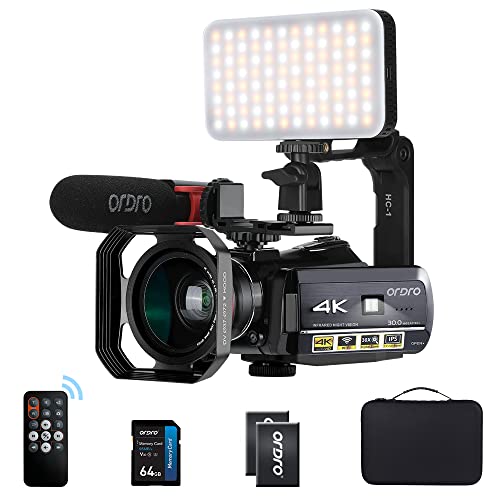
Traditional handheld camcorders are useful when you want a familiar grip, a flip or rotating screen, and a simple point-and-record setup. The Minolta MN4K25NV, ORDRO HDR-AC3, Hojocojo, Acuvar, Muitune DV105, and CAMWORLD AC25 follow that general approach. They are particularly suitable for home videos, vlogging, events, and stationary recording where a screen and external light are useful.
Action cameras serve a different purpose. The Insta360 Ace Pro 2, SJCAM SJ30, Insta360 X5, and DJI Osmo Action 4 are smaller, more rugged designs with stabilization or waterproofing documented in their listings. They are better matched to movement, travel, cycling, water activities, and unusual mounting positions. The trade-off is that many action cameras use wide lenses and may not provide the handling or zoom behavior associated with a traditional camcorder.
Examine the low-light evidence
For genuinely dark scenes, IR night vision is the most direct feature in this group. The Minolta lists advanced IR night vision, while the Hojocojo identifies an 850nm IR flashlight and says it can record in darkness. IR footage may appear different from ordinary color video, so it is worth deciding whether monochrome night recording fits your use.
Sensor information and lens specifications provide another useful signal. The Ace Pro 2 lists a 1/1.3-inch sensor, Leica optics, PureVideo, and dual AI chips. The X5 lists dual 1/1.28-inch sensors and triple AI processing. The DJI Osmo Action 4 lists a 1/1.3-inch sensor and 2.4μm pixel size. The SJCAM SJ30 goes further by identifying a separate low-light lens with an F1.8 aperture and a 1/1.8-inch sensor. These details do not replace testing, but they provide more useful evidence than a general low-light label.
The Acuvar lists a detachable LED with three brightness levels, while the Muitune and CAMWORLD models list built-in lights. ORDRO includes an LED video light, and Hojocojo lists both built-in and external fill lights. Lighting can be more useful than relying on digital gain in a dim room, but it will not illuminate a distant subject effectively.
Match resolution to the recording task
Resolution should be considered alongside frame rate and recording format. The Ace Pro 2 lists 8K30 and 4K60 Active HDR. The SJCAM SJ30 lists 8K20 and 4K60, while DJI lists 4K120. Minolta and ORDRO list UHD 4K, though ORDRO specifies 4K at 24fps. The traditional camcorders lower in the ranking list 2.7K or 4K modes, which may be sufficient for casual home videos and online publishing.
High resolution can preserve more cropping flexibility, but the supplied listings do not establish how each camera performs in every lighting condition. Treat resolution as one part of the specification rather than a guarantee of cleaner night footage. If you need slow motion, check the listed frame rate. If you expect to edit color, DJI’s 10-bit and D-Log M features or the SJCAM SJ30’s stated color options may be relevant.
Check audio and framing controls
Low-light footage is only useful if the sound and composition also suit the project. External microphone support appears on ORDRO, Hojocojo, Acuvar, Muitune, and CAMWORLD listings. The Ace Pro 2 and Insta360 X5 document wind-guard features, while the SJCAM SJ30 supports a wireless microphone and voice control. These are different approaches, so check whether the product includes the microphone or merely supports one.
For self-recording, rotating or flip screens are especially useful. ORDRO lists a 270-degree rotating touch screen; Hojocojo lists a 3-inch flip screen; and Acuvar, Muitune, and CAMWORLD also provide rotating or flip displays. The X5 takes another approach: its 360-degree capture supports selecting angles later. That flexibility is distinctive, but it creates additional editing work.
Consider durability and recording endurance
Waterproofing and stabilization matter if low-light recording will happen outdoors. The DJI Osmo Action 4 lists waterproofing to 18 meters, the Insta360 X5 to 15 meters, and the SJCAM SJ30 to 5 meters without a case. The action cameras also list stabilization features, including horizon control on DJI, SJCAM, and Insta360 models. Traditional handheld models in this selection are better understood as general-purpose cameras rather than documented waterproof systems.
Battery and charging details can affect long sessions. The Insta360 X5 lists up to 185 minutes, DJI lists up to 150 minutes, and SJCAM’s SJ30 bundle lists up to seven hours with its built-in battery and external power handle. Muitune lists two batteries, while Hojocojo lists two batteries and recording while charging. These are published claims from product listings, not independent runtime tests, so actual results may differ by mode and conditions.
How the ranking was calculated
The editorial ranking uses six category-specific criteria: low-light capture capability, video resolution and image detail, audio and microphone support, framing flexibility, connectivity and workflow features, and recording endurance and durability. Low-light capture receives the largest weight because it is the central requirement. The scores are based only on the supplied titles, feature statements, and specifications. This is a specification-based comparison, not a hands-on test and not a summary of customer opinions.
Final Recommendation
Insta360 Ace Pro 2 ranks first overall in this specification-based comparison under the published weighted criteria.
The Insta360 Ace Pro 2 is the first overall specification-based choice among these best low-light camcorders because it combines a 1/1.3-inch sensor, Leica optics, PureVideo processing, dual AI chips, 8K recording, and 4K60 Active HDR. It is the most specification-aligned fit for creators who want documented image-processing features in an action-camera body.
For a traditional handheld design, the Minolta MN4K25NV is the most directly aligned with dark-scene recording because its listing specifically names advanced IR night vision. The SJCAM SJ30 is an outdoor alternative with a dedicated F1.8 low-light lens, while the DJI Osmo Action 4 adds 10-bit color, 4K120 recording, stabilization, and deeper waterproofing. Among the top low-light camcorders, the right choice depends on whether you prioritize IR darkness capture, sensor and processing evidence, rugged movement, or familiar handheld controls.
Frequently Asked Questions
What makes the best low-light camcorders different from ordinary video cameras?
The most useful evidence is a dedicated night mode, IR illumination, sensor information, pixel-size data, a bright aperture, or stated noise-reduction processing. The Minolta and Hojocojo document IR capabilities, while the Ace Pro 2, X5, DJI Osmo Action 4, and SJCAM SJ30 provide sensor, lens, or processing details. A high resolution label by itself does not establish low-light performance.
Is IR night vision better than a built-in LED light?
They serve different purposes. IR night vision is intended for very dark scenes and may produce black-and-white footage, as stated for the Hojocojo. An LED light adds visible illumination and can preserve ordinary color, but it is most useful for nearby subjects. Minolta and Hojocojo are the most direct IR-equipped choices here, while ORDRO, Acuvar, Muitune, and CAMWORLD document LED lighting.
Which selected camera is best for moving outdoor scenes?
The DJI Osmo Action 4, SJCAM SJ30, Insta360 X5, and Insta360 Ace Pro 2 are the clearest outdoor-oriented designs in this selection. Their listings document features such as stabilization, waterproofing, wide-angle capture, or rugged action-camera construction. The DJI lists waterproofing to 18 meters, the X5 to 15 meters, and the SJ30 to 5 meters without a case.
Do I need external microphone support for low-light recording?
Not always, but it can be important when the subject is speaking or when the camera is positioned away from the person recording. ORDRO, Hojocojo, Acuvar, Muitune, and CAMWORLD list external-microphone support. The Ace Pro 2 and X5 emphasize wind-guard hardware, and the SJCAM SJ30 lists wireless microphone compatibility. Check whether a microphone is included or only supported.
Are 8K or 6K camcorders automatically better at night?
No. Resolution describes recorded detail, not the complete low-light system. The Ace Pro 2 and X5 pair high resolution with documented sensor and processing features, while Acuvar lists 6K alongside an LED light. For a dim scene, also examine the night mode, sensor, lens, processing, illumination, and stabilization evidence before choosing among the best low-light camcorders.