Buying Guide
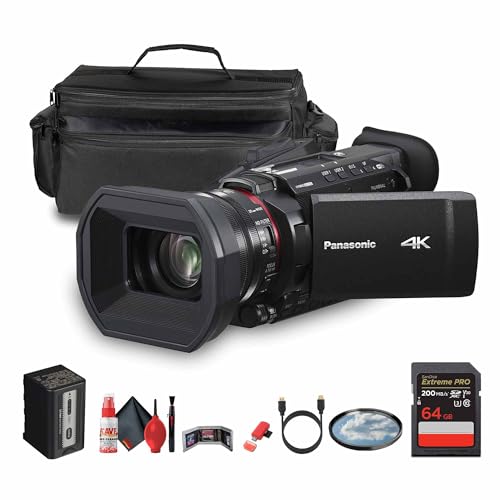
Choosing among the best zoom lens camcorders starts with separating optical zoom from digital enlargement. Optical zoom changes the lens position and is the most useful specification for framing distant subjects. The selected models range from 10x to 24x optical zoom, so consider the distance you normally need to cover. A stage, sports field, or ceremony may benefit from the HC-X1600’s documented 24x reach, while travel and family users may prefer the smaller Panasonic HC-VX981K or Minolta Showtime MN4K100Z.
Optical zoom and framing
Zoom magnification is only part of the decision. The AG-CX350 documents a 24.5mm-to-490mm lens range, giving its 20x zoom a stated wide-to-telephoto span. The HC-X1600 also offers 24x optical reach. Canon’s XA60 and VIXIA HF G70 each use 20x optical zoom, while the compact Panasonic models use 20x Leica lenses. The ORDRO XV80, AC5 Plus, and AX65 document 12x optical zoom, and the Minolta model documents 10x.
A wider starting view helps when recording indoors or close to a group. A longer telephoto end helps isolate distant subjects. The supplied listings do not provide equivalent focal-length ranges for every model, so avoid treating magnification alone as a complete measure of framing.
Resolution and frame rates
Most selected camcorders document 4K recording, but their frame-rate choices differ. The AG-CX350 and HC-X1600 document 4K up to 60p, while the AX65 and Minolta Showtime MN4K100Z list 4K at 24fps and Full HD at 60fps. The ORDRO XV80 lists 5K at 30fps. Higher resolution can preserve more detail for cropping, whereas Full HD at 60fps may be useful when smoother motion is more important than 4K capture.
The Canon XA60 supports XF-AVC and MP4, and the AG-CX350 adds 10-bit 4:2:2, V-Log, and HLG. Those features are aimed at workflows that need more recording and color-handling flexibility. The Panasonic HC-VX981K and HC-WXF991K add 4K in-camera editing features, including cropping or editing for 1080p displays.
Stabilization and autofocus
Handheld zoom magnifies small movements, making stabilization especially important. The HC-X1600 documents hybrid five-axis optical stabilization and Ball OIS. The HC-VX981K and HC-WXF991K specify five-axis hybrid stabilization. Canon’s XA60 lists optical and infrared image stabilization, while the VIXIA HF G70 lists advanced image stabilization.
Autofocus information also varies. The XA60 documents hybrid autofocus, and the VIXIA HF G70 adds face detection and adjustable focusing speeds. The ORDRO XV80 instead documents manual focus, focus lock, and manual white-balance control. That can suit a creator who wants direct control, but it is a different operating approach from face-aware autofocus.
Audio and streaming connections
For interviews, presentations, and event work, check the audio connections rather than judging video resolution alone. The AG-CX350 documents dual XLR inputs with phantom power and support for two- or four-channel recording. The HC-X1600 lists dual XLR inputs, a 3.5mm mini jack, and an integrated stereo microphone. The ORDRO AX65 has an external microphone jack, and the Minolta Showtime MN4K100Z includes a hot-shoe mount for microphones and lights.
Streaming support is also uneven. The HC-X1600 documents built-in dual-band Wi-Fi with RTSP, RTP, RTMP, and RTMPS protocols. The Canon XA60 and VIXIA HF G70 support computer-based streaming through USB and UVC features. Several compact creator models, including the ORDRO AC5 Plus and AX65, document webcam modes, while the Panasonic HC-VX981K and HC-WXF991K emphasize Wi-Fi smartphone features.
Sensors, screens, and monitoring
Sensor details can help explain why models are positioned differently. The AG-CX350 lists a 1-inch MOS sensor, while the HC-X1600 uses a 1/2.5-inch 8.29-megapixel MOS sensor. The Canon XA60 and VIXIA HF G70 list 1/2.3-inch sensor formats. The compact Panasonic models use 1/2.3-inch BSI MOS sensors, and the ORDRO XV80 lists a 1/2.8-inch CMOS sensor.
Monitoring options matter when you cannot rely on the rear screen. The Canon XA60 has a 3.5-inch touchscreen and tilting OLED EVF, while the Panasonic HC-WXF991K documents an electronic viewfinder. Creator models such as the ORDRO AX65 and several compact camcorders use rotating touchscreens for self-recording and unusual camera angles.
Matching the design to your work
For professional field production, the AG-CX350 and HC-X1600 document the broadest audio, recording, card, and connectivity features. For a compact professional-style body, the Canon XA60 and VIXIA HF G70 emphasize 4K, optical zoom, focus control, and computer streaming. For travel or family recording, the Panasonic HC-VX981K, HC-WXF991K, and Minolta model offer smaller documented bodies and straightforward controls.
The ORDRO XV80, AC5 Plus, and AX65 are oriented toward creators who want compact kits, webcam functions, lighting, manual controls, or included accessories. Their listings provide useful feature information, but they do not document the same professional recording and audio depth as the Panasonic and Canon models. This comparison uses listing specifications rather than hands-on testing, so treat undocumented performance characteristics as unknown.
Final Recommendation
Among the top zoom lens camcorders, the ranked products differ under documented optical zoom reach, video resolution and frame options, stabilization and focus, audio and connectivity, sensor and image features, and handling and monitoring.
Panasonic AG-CX350 ranks first overall in this specification-based comparison under the published weighted criteria.
The final choice among the best zoom lens camcorders depends on the documented features that match your intended use.
Panasonic AG-CX350 is the highest-scoring returned product and the first overall specification-based choice for demanding field production. Its 1-inch sensor, 20x optical zoom, 4K60, 10-bit 4:2:2 recording, V-Log, HLG, dual XLR inputs, and dual SD slots give it the most complete documented specification set.
The Panasonic HC-X1600 is the most specification-aligned alternative when 24x optical reach, five-axis stabilization, wireless streaming protocols, and dual XLR connectivity matter. The Canon XA60 and Canon VIXIA HF G70 are sensible choices for users who want a more compact professional camcorder with 20x optical zoom and documented autofocus or UVC support.
For lighter travel use, the Panasonic HC-VX981K and HC-WXF991K provide 4K, 20x optical zoom, and five-axis stabilization in compact bodies. The ORDRO XV80 is the most distinctive creator option because it documents manual focus and white-balance controls alongside 12x optical zoom and 5K recording. The ORDRO AC5 Plus and AX65 add creator-oriented accessories and webcam functions. The Minolta Showtime MN4K100Z is a straightforward compact option with 10x optical zoom and Full HD 60fps recording.
Frequently Asked Questions
What should I look for in the best zoom lens camcorders?
Start with optical zoom reach, then compare stabilization, autofocus, recording resolution and frame rates, audio inputs, and monitoring. A 20x or 24x optical zoom may suit distant events, while a compact 10x or 12x design may be easier to carry. Also check whether the listing documents the connections and recording formats your workflow requires.
Are optical zoom and digital zoom the same?
No. Optical zoom uses the lens’s stated optical range. Digital zoom enlarges the image electronically after the optical range ends. The selected listings document optical zoom for all ten products, but several also list digital zoom. For a specification-based comparison, optical reach is the more useful starting point because it describes the lens itself.
Which selected camcorders support computer streaming?
The Canon XA60 and VIXIA HF G70 document UVC or USB streaming support. The ORDRO AC5 Plus and AX65 document webcam modes, and other selected creator models list webcam functions. The Panasonic HC-X1600 documents built-in Wi-Fi protocols for live streaming. Confirm the required computer, cable, and software setup from the manufacturer’s current instructions before recording.
Is 4K60 better than 4K24 for every use?
Not necessarily. The HC-X1600 and AG-CX350 document 4K capture up to 60p, while the AX65 and Minolta Showtime MN4K100Z document 4K at 24fps and Full HD at 60fps. A higher frame rate can provide smoother motion, but the appropriate choice depends on the subject, editing workflow, and delivery format. The listing evidence does not establish a universal preference.
No. The AG-CX350 and HC-X1600 specifically document dual XLR inputs, while the ORDRO AX65 lists an external microphone jack and the Minolta model lists a hot-shoe mount. Other selected products document microphones or integrated audio without specifying XLR connections. If balanced audio or phantom power is essential, choose a model whose listing explicitly states those features.