Buying Guide
This guide to the best men’s shorty wetsuits is based on published specifications rather than hands-on testing. The products are one-piece shorty designs with short sleeves and short legs or comparable abbreviated coverage. Because listings differ in how much technical information they provide, the rankings favor documented construction details instead of assuming that an unlisted feature is present.
Start with thickness and insulation
Neoprene thickness is one of the clearest indicators of intended thermal coverage, although it is not a complete substitute for fit, lining, or panel design. The selected products range from 1.5mm to 3mm. The DIVE & SAIL shorty is the lightest listed option at 1.5mm and adds a documented UPF 50+ fabric specification. That combination makes it relevant when sun coverage and mobility matter more than maximum warmth.
The Cressi Tiburon uses 1.5/2mm neoprene with elastane sections, while the O’Neill Reactor-2 and NRS shorty use 2mm constructions. These lighter designs may suit warm-water recreation, paddling, swimming, or users who prefer less bulk. The Body Glove Pro3 uses a 2/1mm layout, with 2mm material through the body and legs and flexible panels around the sleeves and underarms.
For a thicker option, the AKONA Tropic places 3mm neoprene through the chest and 2mm material on the arms and legs. The ZCCO shorty uses 3mm neoprene, and the SCUBAPRO Definition, Cressi Tortuga, and Phantom Aquatics models use 2.5mm constructions. The AKONA and ZCCO designs are the clearest choices when the supplied specifications point toward increased insulation. A thicker suit may also feel less flexible, so consider thickness alongside stretch and cut.
Match the closure to your dressing preference
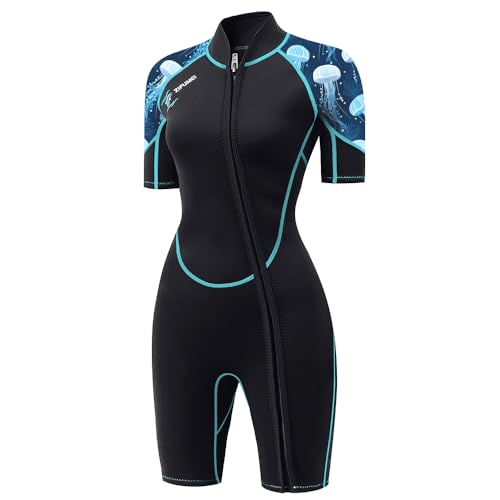
Front and back zippers each have practical differences, but the listings do not establish that one placement is universally easier or more secure. Front-zip options include the AKONA Tropic, Cressi Tiburon, and DIVE & SAIL shorties. The AKONA has an extended front zipper, the Tiburon has a front YKK zipper, and DIVE & SAIL lists a front zipper with a fastener intended to secure it.
Back-zip designs appear on the O’Neill Reactor-2, SCUBAPRO Definition, Cressi Tortuga, Phantom Aquatics, Body Glove Pro3, and ZCCO shorties. The O’Neill listing specifies a water-resistant closure, SCUBAPRO uses a diagonal rear YKK zipper with a brass slider, and ZCCO documents a heavy-duty YKK zipper with a pull and hook-and-loop closure. These details help compare hardware and access without extending the claims beyond the supplied evidence.
The NRS model uses a full-zip entry, which is a useful distinction from a partial or unspecified closure. Before ordering, compare the manufacturer’s size chart with chest, waist, height, and other measurements where supplied. A shorty should fit close to the body according to several listings, but the correct size cannot be inferred from the garment’s nominal size alone.
Look at flexibility and movement zones
Shorty wetsuits already leave more of the arms and legs uncovered than full suits, but panel design still affects how much freedom the garment is intended to provide. O’Neill’s Reactor-2 uses ultra-stretch neoprene and seamless paddle zones with minimal seam placement. Those are directly relevant details for paddling and other activities involving repeated upper-body movement.
The AKONA Tropic lists 200% stretch quantum neoprene and uses thinner 2mm material at the arms and legs. The Cressi Tiburon takes a different approach by using elastane at the sides, sleeves, and collar. Body Glove documents Quadra Flex sleeve and underarm panels, while DIVE & SAIL lists four-way stretch material. These products have the clearest movement-related construction in the supplied evidence.
The SCUBAPRO Definition also lists an advanced cut that increases range of motion. Phantom Aquatics describes unrestricted movement, but its more concrete differentiators are the reinforced shoulders and seat. When comparing flexibility, prioritize details such as stretch fabric, articulated cuts, flexible panels, and reduced seam placement rather than relying only on general language.
Seam construction matters because it can affect comfort and resistance to stress, but the evidence varies by product. AKONA specifies glued and blind-stitched seams, Body Glove lists flatlock stitching, and the Cressi Tortuga lists sewn seams for strength and durability. The ZCCO shorty also documents flatlock seams, while the O’Neill design emphasizes minimal seam placement in paddle zones.
Several products add protection where equipment or surfaces may contact the suit. AKONA includes abrasion-resistant knee pads. Phantom Aquatics reinforces the shoulders against BCD abrasion and adds a high-friction seat panel. NRS uses Eco SupraTex fabric to reinforce the seat. These details make those models relevant for diving, boating, paddling, or activities involving frequent contact with a seat, dock, or equipment.
The Cressi Tiburon lists a collar, sleeve, and side layout intended not to irritate the skin. SCUBAPRO lists a plush inner lining, and Body Glove says its flatlock stitching minimizes seam irritation. These are documented design features, not guarantees of individual comfort. Personal fit, body shape, and layering preferences still matter.
Choose by activity
For surfing and paddle sports, the O’Neill Reactor-2, AKONA Tropic, Body Glove Pro3, and NRS shorty have useful movement or contact-area details. The O’Neill specifically names paddle sports and includes paddle zones; AKONA adds flexible material and knee pads; Body Glove lists sleeve and underarm panels; and NRS adds a reinforced seat.
For diving and snorkeling, SCUBAPRO, Phantom Aquatics, Cressi Tiburon, Cressi Tortuga, and the ZCCO 3mm shorty have particularly relevant evidence. SCUBAPRO is explicitly built around diving, Phantom Aquatics includes BCD-abrasion reinforcement, Cressi documents snorkeling and scuba use, and ZCCO lists diving and spearfishing among its activities. DIVE & SAIL and O’Neill are broader recreational choices, with sun or multi-activity details that may suit beach use.
Final recommendation
AKONA Men’s Tropic Shorty Front Zip 3/2mm ranks first overall in this specification-based comparison under the published weighted criteria.
O’Neill Men’s Reactor-2 2mm Short Sleeve Spring Wetsuit is a strong overall specification-based choice among the best men’s shorty wetsuits in this comparison. Its combination of ultra-stretch neoprene, minimal-seam paddle zones, wind-resistant Smoothskin, and water-resistant back-zip closure gives it a well-rounded documented balance of movement, warmth, access, and versatility. The AKONA Tropic is the stronger alternative when a 3mm chest panel, glued and blind-stitched seams, and knee pads are more important. For diving-specific reinforcement, consider Phantom Aquatics; for a plush lining and advanced cut, consider SCUBAPRO. Together, these are practical choices among the top men’s shorty wetsuits, but the final decision should follow your activity, water conditions, preferred entry direction, and measurements.
Care and fit checklist
Use the size chart supplied with the chosen product, especially when the listing provides chest, waist, or height ranges. Several listings recommend a snug fit, but sizing conventions differ. After use, follow the care instructions for the individual suit. Do not transfer one product’s care instructions to another without checking its listing or manufacturer guidance.
Frequently Asked Questions
Among the best men’s shorty wetsuits, what thickness should I choose?
The selected best men’s shorty wetsuits range from 1.5mm to 3mm. Lighter 1.5mm and 2mm models emphasize mobility and warm-weather use, while 2.5mm and 3mm designs provide a thicker material option. The AKONA Tropic is a mixed 3/2mm design, and Body Glove uses 2/1mm construction. Choose based on the conditions and activity described by the manufacturer rather than thickness alone.
Are front-zip or back-zip shorty wetsuits easier to put on?
The evidence shows that both designs can include convenience features. AKONA lists an extended front zipper, while O’Neill, SCUBAPRO, Phantom Aquatics, and ZCCO document back-zip features. NRS uses a full zip. Ease depends on fit, reach, zipper design, and personal preference, so compare the exact closure details and consult the size chart.
Which selected shorty has the clearest sun-protection feature?
DIVE & SAIL explicitly lists UPF 50+ fabric. Other selected products describe protection from sun, UV exposure, stings, or abrasions, but those claims are not identical to a stated UPF rating. A shorty does not cover all exposed skin, so use appropriate additional sun protection for uncovered areas.
Which models document reinforcement for equipment or seating?
Phantom Aquatics lists reinforced shoulders for BCD abrasion and a high-friction seat panel. NRS lists an Eco SupraTex reinforced seat, and AKONA lists abrasion-resistant knee pads. These features may be useful for activities involving equipment, boats, docks, or repeated contact, but the listings do not provide durability testing results.
How should I use the rankings?
The ranking is a specification-based editorial comparison. It scores each product on thermal insulation, mobility, entry and exit, seam and material durability, protection and coverage, and activity versatility. It does not use customer opinions, popularity, marketplace labels, or hands-on test results. Check the current listing, size chart, and care directions before purchasing.