Buying Guide
The best women’s shorty wetsuits are defined less by appearance than by how their documented thickness, closure, coverage, and construction match the water activity. A shorty generally leaves the lower legs and often the arms partly exposed, making it a useful middle ground between a swimsuit or rash guard and a full wetsuit. The selections above include traditional short-sleeve designs, long-sleeve spring suits, and different neoprene thicknesses.
Choose thickness by conditions
Thickness is the clearest starting point. The 1.5mm DIVE & SAIL model is aimed at lightweight coverage and includes UPF 50+ protection, so it is a logical fit for warmer beach activities where sun protection and freedom of movement matter. It should not be treated as equivalent to a 3mm suit for insulation.
The 2mm category includes the Cressi Lido, Seaskin, Dark Lightning, O’Neill Bahia, and MWTA. These suits occupy a flexible middle ground. The Dark Lightning listing gives a specific 58–68°F range, while the MWTA listing describes its 2mm spring construction for warm-water conditions. The O’Neill Bahia is a 2/1mm design, which indicates a thinner profile than a uniform 2mm suit. The Cressi Lido and Seaskin listings document 2mm materials but do not provide a temperature range.
The 2.5mm SCUBAPRO Definition and the 3mm AICARSHI, JSNORKLET, and AnParc models emphasize more insulation. AICARSHI specifically states a 60–80°F intended range. AnParc adds a water-repellent chest panel, while JSNORKLET emphasizes high-stretch neoprene and protection from sunlight, stings, and abrasions. These details are useful, but actual comfort depends on fit, activity level, water movement, and personal tolerance.
Compare front and back zippers
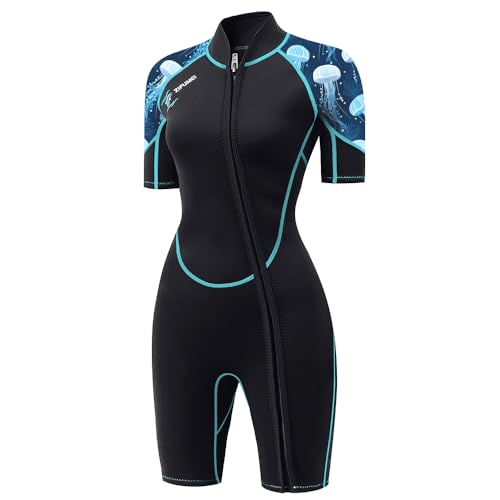
Front zippers are documented on the Cressi Lido, AICARSHI, JSNORKLET, Seaskin, and DIVE & SAIL suits. They can make entry and exit more straightforward, especially for casual users or anyone who prefers not to reach behind the shoulders. A front zipper may also be convenient when changing between activities.
Back zippers appear on the O’Neill Bahia, SCUBAPRO Definition, Dark Lightning, AnParc, and MWTA models. Features such as an extended leash, diagonal placement, or extended pull can improve usability. The Dark Lightning has an extended leash, the SCUBAPRO uses a diagonal rear YKK zipper, and MWTA specifies an extended zipper pull. These details do not make one closure universally better; they identify the kind of access each design provides.
Look for movement-focused construction
Mobility depends on material stretch, cut, and seams. The SCUBAPRO Definition has an advanced cut intended to increase range of motion. The Dark Lightning uses high-elasticity neoprene, while AICARSHI describes ergonomic tailoring and stretchable neoprene. AnParc adds ultra-stretch underarm panels, a useful detail for paddling, swimming, and diving movements.
Flatlock stitching is documented on the O’Neill Bahia, AnParc, and MWTA. Flatlock construction can be a practical choice when reducing seam irritation is important, but the supplied evidence does not establish how any suit feels in hands-on use. The Cressi Lido instead emphasizes anatomical cuts and a close, second-skin fit.
Match coverage to your activity
A shorty can provide more protection than swimwear while keeping the arms or legs relatively open. The DIVE & SAIL model documents protection from sun, reef abrasion, and jellyfish stings. AICARSHI describes full-body coverage, insulation, sun protection, and protection from sea lice and other irritants. AnParc specifies UPF 50+ and a water-repellent chest panel.
Long-sleeve spring suits are a distinct design type. In this top 10, MWTA is the selected long-sleeve example. It may be preferable when arm coverage is more important than the open feel of a conventional short-sleeve suit.
Get the fit right
A wetsuit should fit closely enough to limit excessive water movement inside the suit, but it should not be selected by guesswork. The Cressi listing describes a second-skin fit, and JSNORKLET specifically advises measuring body dimensions and consulting the detailed size chart. AICARSHI and Dark Lightning also direct shoppers to their size information.
Pay attention to the size shown in a listing because the displayed size is only one available variant, not a complete size-range guarantee. Check the manufacturer’s chart for bust, waist, hip, torso, and other required measurements when provided. If a brand warns that the fitted size may feel tighter, treat that as a reason to compare measurements carefully rather than automatically sizing up.
Care and ownership details
Rinse a wetsuit with clean water after use and follow the supplied care instructions. Seaskin specifies cold-water handwashing with mild detergent and flat drying. JSNORKLET and DIVE & SAIL also mention handwashing or careful washing. Avoid assuming that machine washing or heat drying is acceptable when a listing does not say so.
The Cressi Lido lists a two-year limited warranty, while SCUBAPRO and MWTA list one-year warranties. AnParc, JSNORKLET, and other listings provide different or limited warranty information. Warranty terms can change, so verify the current seller and manufacturer conditions before purchase.
Final recommendation
AICARSHI 3mm Front-Zip Women’s Shorty ranks first overall in this specification-based comparison under the published weighted criteria.
Cressi Lido 2mm Lady Shorty Wetsuit is the first overall specification-based choice among these best women’s shorty wetsuits. Its double-lined neoprene, anatomical cuts, front YKK zipper, explicit core-warming description, and broad activity coverage make it the most balanced documented option.
The top women’s shorty wetsuits are not interchangeable. Choose O’Neill Bahia for movement-oriented spring-suit construction, SCUBAPRO Definition for warm-water diving and layering, or AnParc 3mm for a water-repellent chest panel and UPF 50+. AICARSHI and JSNORKLET are strong front-zip 3mm alternatives, while DIVE & SAIL is better suited to lightweight warm-weather coverage. Confirm thickness, closure, sleeve length, and measurements before ordering.
Frequently Asked Questions
Among the best women’s shorty wetsuits, are 3mm shorty wetsuits warmer than 2mm models?
The supplied listings position 3mm suits as more insulation-focused than thinner options, but they do not provide a universal warmth guarantee. AICARSHI documents a 60–80°F range, while Dark Lightning gives a 58–68°F range for its 2/2mm design. Fit and individual tolerance also affect comfort.
Is a front zipper easier to use than a back zipper?
A front zipper can simplify entry and exit, and several selected models describe that benefit. Back-zip designs may still be convenient when they include an extended leash or pull, as seen on Dark Lightning and MWTA. Choose based on reach, mobility, and personal preference.
Can these suits be used for snorkeling and kayaking?
Yes, the selected listings explicitly include snorkeling, kayaking, or both for several models, including Cressi Lido, JSNORKLET, Seaskin, DIVE & SAIL, and AnParc. Always match thickness and coverage to the water conditions and activity duration.
What fit should a women’s shorty wetsuit have?
The evidence supports a close, body-hugging fit rather than a loose fit. Cressi describes a second-skin fit, and JSNORKLET advises measuring body dimensions and consulting the size chart. A suit should be snug without causing unreasonable restriction or discomfort.
How should a shorty wetsuit be washed?
Follow the individual listing’s care instructions. Seaskin specifies cold-water handwashing with mild detergent and flat drying, while other listings recommend rinsing and hanging to dry. Do not assume a suit is machine washable unless the product documentation says so.