Buying Guide
The best chimney roof flashings are selected by fit and application first, not by appearance alone. This comparison uses public listing specifications rather than hands-on testing or customer-opinion summaries. The most important checks are the pipe’s outside diameter, the roof material and profile, the expected heat exposure, and whether the package supplies the hardware or sealant needed for installation.
1. Measure the pipe outside diameter
Measure the outside diameter of the chimney or vent pipe where the boot will sit. Do not choose by nominal pipe size unless the product documentation specifically uses that convention. Flexible cones are trimmed to a marked diameter, so an incorrect measurement can leave too little sealing material or an opening that does not grip the pipe.
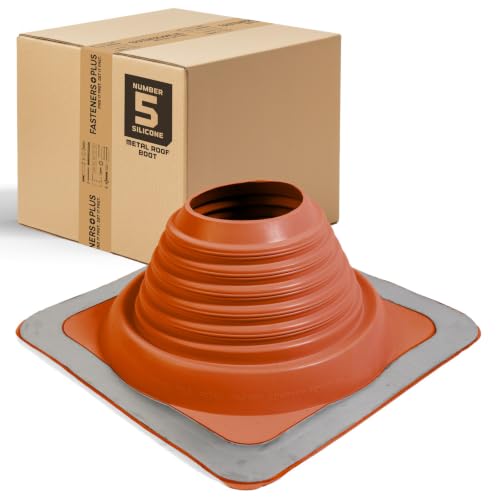
The Sobalai #3 is the small-pipe specialist in this group, covering 1/4 to 5-3/4 inches. Fasteners Plus #4 covers 2-3/4 to 7 inches, while the mid-size choices generally begin around 4-3/4 or 5 inches. For larger penetrations, Flashers #8 and Hedday #8 cover 7 to 13 inches, while Yaocom #8 extends to approximately 13-1/2 inches. A broad range is useful, but it does not remove the need to trim carefully.
2. Match the flashing to the roof
Many products here are pipe boots designed especially for metal roofing. Their flexible aluminum bases can be shaped around corrugated, ribbed, or standing-seam profiles. Flashers #8 documents adaptation to any roof pitch or metal profile, and Hedday identifies ribbed, corrugated, and standing-seam applications. Zlshmoee and Fasteners Plus likewise describe flexible or conforming aluminum bases for metal roofs.
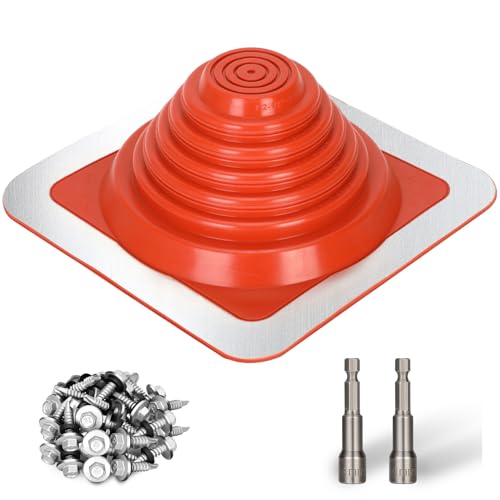
A square base can provide a broad fastening surface on a profiled roof. The ACNOYEL silicone #6 includes a square flexible base and is specifically described for corrugated roofs. The Sobalai #3 also uses a square base, but its compact size is aimed at smaller penetrations. Before installation, confirm that the base can sit flat enough around the ribs and that the pipe location leaves adequate room for fastening.
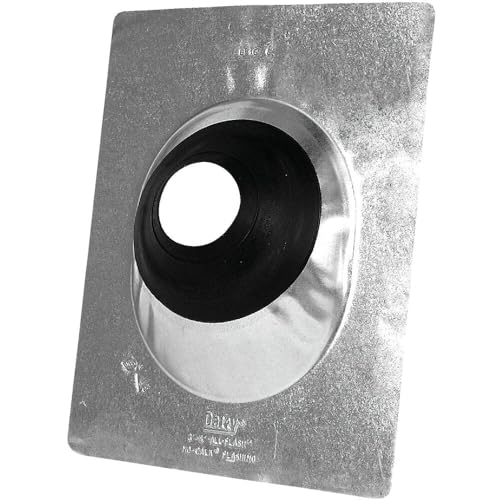
Not every boot in this list is a universal shingle-roof flashing. AllFuel HST is the clearest exception: it is a pitch flashing for shingled roofs with a documented 7/12 to 12/12 pitch range. It is also limited to AllFuel HST Class-A double-wall chimney pipe. That combination makes it a better match for the specified system than a generic metal-roof boot.
3. Check heat limits and material type
Silicone models dominate the higher-temperature portion of this comparison. Fasteners Plus states 437°F continuous and 500°F intermittent service. Aothotop states +500°F heat and -100°F cold tolerance, while several other silicone listings specify -100°F to +450°F. These figures are product specifications, not independent test results, so use the manufacturer’s installation instructions and keep the flashing appropriate to the pipe and appliance.
EPDM can be suitable where its stated temperature range fits the application. The ACNOYEL EPDM model is rated from -65°F to 250°F, and the Yaocom EPDM model is also listed at -65°F to +250°F. Those limits are materially different from the silicone alternatives. If the penetration is associated with a wood stove, furnace, or other high-heat appliance, compare the flashing’s documented temperature rating with the installation requirements before buying.
Material details also affect exterior exposure. AllFuel HST specifies 304 stainless steel, while the pipe boots generally combine silicone or EPDM with aluminum. The listings describe UV, ozone, oxidation, corrosion, or weather resistance for several products, but these claims should not be expanded into guarantees about service life or leak prevention.
4. Decide how much installation support you need
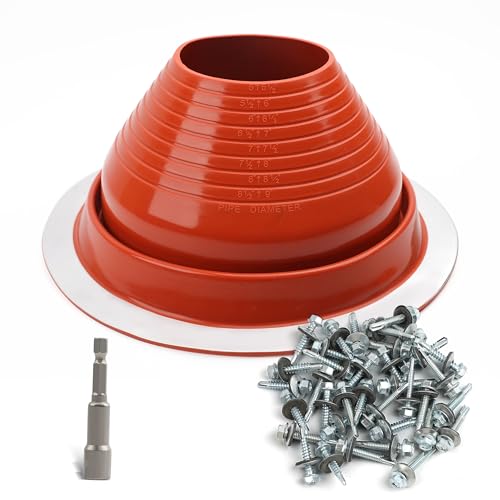
Some packages include only the flashing. Fasteners Plus specifically says stitch screws are not included, so plan for compatible fasteners and sealant. Other products provide a more complete kit. ACNOYEL silicone includes butyl tape, 30 roofing screws, and an 8mm hex socket. Hedday includes self-tapping roofing screws and a matching hex bit. Sobalai lists 50 stitch screws and two hex sockets, while ACNOYEL EPDM includes 30 screws and an 8mm bit socket.
Included accessories can reduce parts matching, but they do not replace correct installation. Follow the product’s instructions for trimming, sealant placement, fastener spacing, and roof-profile shaping. The listing for Hedday, for example, instructs users to measure the pipe, trim the boot, seal the aluminum base, and secure the flashing. Treat the stated procedure as product-specific rather than a universal roofing method.
5. Consider base size and clearance
A larger base may cover more roof area around a large pipe, but it also needs enough unobstructed roof surface. Yaocom #8 lists an approximately 17-inch-wide base, while Flashers #8 lists a 16.5-inch base. Compact options such as Sobalai #3 list an approximately 8-inch square base. Compare the base dimensions with roof ribs, nearby seams, and obstructions before ordering.
Final recommendation
Hedday #8 High-Temp Silicone Chimney Boot ranks first overall in this specification-based comparison under the published weighted criteria.
AllFuel HST Pitch Roof Flashing is the first overall specification-based choice among these best chimney roof flashings when the project uses compatible AllFuel HST Class-A chimney pipe on a 7/12 to 12/12 shingled roof. Its 304 stainless steel construction, UL103HT certification, and clearly stated system fit give it the most specification-aligned specialized evidence.
For metal roofs, Flashers #8 is the broad-range choice for 7- to 13-inch pipes, while Hedday #8 is attractive when included fasteners matter. Fasteners Plus #4 suits smaller pipes and adds a stated 35-year warranty. Sobalai #3 covers the smallest pipe range in the selection. ACNOYEL’s silicone #6 offers a useful package of butyl tape, screws, and a socket. These are the top chimney roof flashings for different documented use cases, not interchangeable products.
Before purchase, verify the pipe outside diameter, roof type, roof pitch, temperature requirement, and base dimensions. If the listing does not clearly match those facts, select a different size or consult the chimney and roofing manufacturers.
Frequently Asked Questions
What should I measure before choosing the best chimney roof flashings?
Measure the pipe’s actual outside diameter at the roof penetration and note the roof material and profile. Also check the available flat area around the pipe for the flashing base. A flexible cone still needs to be trimmed to the measured diameter, and the correct boot size depends on the manufacturer’s stated range.
Are silicone chimney boots suitable for high-heat applications?
Several selected silicone boots list temperature ranges reaching 450°F or 500°F, but ratings differ by product. Fasteners Plus lists 437°F continuous and 500°F intermittent service, while Flashers, Zlshmoee, Hedday, and other silicone models list ranges reaching 450°F. Confirm the product rating against the appliance and installation requirements rather than assuming all silicone boots are equivalent.
The evidence in this comparison mainly describes flexible aluminum-base boots for metal roofs. AllFuel HST is specifically documented for shingled roofs and a 7/12 to 12/12 pitch, but it is limited to compatible AllFuel HST Class-A chimney pipe. Do not treat a metal-roof boot as a universal shingle-roof substitute without product-specific guidance.
Is EPDM or silicone better for a chimney flashing boot?
Neither material is automatically best for every installation. The selected EPDM models list -65°F to 250°F service, while several silicone models list ranges reaching 450°F or 500°F. Silicone may be the more suitable documented option for higher-temperature applications, but the pipe, appliance, roof, and manufacturer instructions must all agree.
Which installation accessories are useful?
Screws, a compatible driver bit, and a sealing material can simplify installation. ACNOYEL silicone includes butyl tape, screws, and an 8mm socket; Hedday includes screws and a hex bit; and Sobalai lists screws and hex sockets. Fasteners Plus does not include stitch screws, so those must be sourced separately.