Buying Guide
The best organic coconut oils are not interchangeable in every situation. The important differences in this category are the organic documentation, whether the oil is virgin or refined, how it was pressed, how much coconut flavor it contributes, and whether the listing supports food use, personal care, or both. The products above were selected from distinct parent groups and ranked only from the supplied listing evidence. This is a specification-based comparison, not a hands-on test and not a summary of customer opinions.
Virgin and extra-virgin oils are generally the better fit when you want the listing to preserve a coconut-forward identity. Nutiva is described as cold-pressed, unrefined, and virgin. Nature’s Way is cold-pressed and unrefined extra virgin, while Garden of Life is raw, cold pressed, and extra virgin. These options are documented for cooking, baking, smoothies, or other food uses and may bring a noticeable coconut character to a recipe.
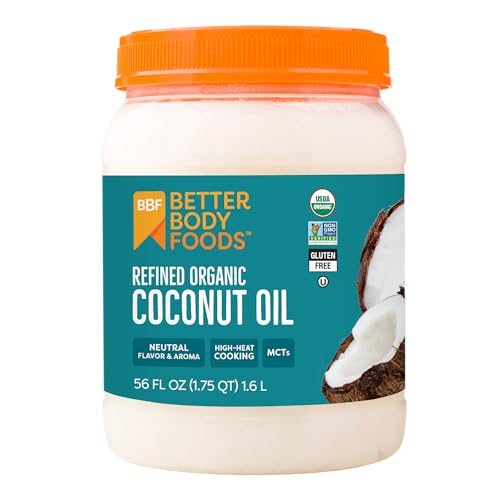
Refined oils are more appropriate when a neutral flavor is the priority. Viva Naturals describes its refined oil as neutral in flavor and aroma and gives a 400°F smoke point. BetterBody Foods likewise describes its refined oil as having no coconut smell or taste and states a 425°F smoke point. Refining is therefore a meaningful trade-off: it can make the oil more unobtrusive in baking and cooking, but it does not match the unrefined profile of virgin products.
Match the oil to cooking temperature
Read the temperature information carefully rather than assuming every coconut oil has the same cooking role. The 365 by Whole Foods Market listing states a medium-heat tolerance up to 280°F, with stir-frying, curry dishes, and smoothies as named uses. Viva Naturals and BetterBody Foods provide higher stated smoke-point figures, which makes their documented positioning more suitable for frying or higher-temperature kitchen tasks.
A smoke point is not a promise of cooking performance, and the supplied listings do not establish independent measurements. It is best treated here as a manufacturer-provided specification. If a product does not state a temperature figure, avoid assigning one based solely on its being organic, virgin, or refined.
Consider flavor and aroma
Virgin oils can add a recognizable coconut taste or scent. Nature’s Way describes a subtle coconut taste, and Dr. Bronner’s explains that its whole-kernel oil has a slightly nuttier flavor than its white-kernel version. Parachute Naturalz says its cold-pressed method conserves flavor and aroma. These characteristics can suit curries, smoothies, and baking, but they may be less desirable in recipes where the oil should stay in the background.
For a milder profile, start with the refined options from Viva Naturals or BetterBody Foods because their supplied descriptions specifically mention neutral flavor or no coconut taste.
Look at ingredient and processing detail
Ingredient transparency varies. Dr. Bronner’s states that its oil contains one ingredient. Sky Organics also identifies organic coconut oil as the one ingredient and documents cold-pressed, virgin, and unrefined processing. Garden of Life provides an unusually detailed list of excluded processes: its oil is described as never hydrogenated, bleached, refined, or deodorized.
These statements describe the product specification; they do not prove a sensory or health outcome. For shoppers comparing labels, the most useful questions are whether the listing names the oil type, identifies the pressing or extraction method, and clearly states whether additives, fragrance, or deodorization are involved.
Decide whether you need one multipurpose oil
Several selected products are documented for both the kitchen and body care. Dr. Bronner’s, Nutiva, Parachute Naturalz, Viva Naturals, and BetterBody Foods all list combinations of cooking, baking, hair, or skin uses. Sky Organics leans more strongly toward hair and skin routines, while Spectrum provides especially limited culinary detail in the supplied evidence.
A multipurpose format can simplify a routine, but use the product according to its label and intended application. If your main goal is food preparation, prioritize products with explicit cooking directions. If your main goal is skin or hair care, prioritize clear body-care directions and ingredient information instead of assuming that every pantry oil has identical cosmetic guidance.
Compare container size and handling
Container size ranges from 14 fluid ounces to 56 fluid ounces among the selected products. BetterBody Foods is the large-format choice for frequent kitchen use, while Nature’s Way offers 32 fluid ounces. Smaller containers such as 365, Garden of Life, and Spectrum may be easier to handle for shoppers who use coconut oil occasionally.
Coconut oil can change from solid to liquid with temperature. Nature’s Way and Sky Organics both describe melting around 76°F. This is a normal handling consideration, not a product defect. A wide jar may be convenient for scooping solid oil, while a bottle or smaller container may suit measured personal-care applications better.
Final recommendation
Dr. Bronner’s Organic Virgin Coconut Oil ranks first overall in this specification-based comparison under the published weighted criteria.
Dr. Bronner’s Organic Virgin Coconut Oil is the highest-scoring returned product and the first overall specification-based choice. Its one-ingredient formula, Regenerative Organic Certification, Fair Trade documentation, whole-kernel explanation, and 30-fluid-ounce size give it the broadest evidence-backed profile in this comparison. The best organic coconut oils for a particular household may still differ: choose Viva Naturals for a documented neutral cooking profile, BetterBody Foods for a 56-fluid-ounce format, Garden of Life for extensive raw-processing details, or Sky Organics for a simple hair-and-skin routine. Together, these are among the top organic coconut oils when the decision is based on stated specifications rather than unverified performance claims.
Frequently Asked Questions
What should I look for in the best organic coconut oils?
Start with a clear organic certification claim, then check whether the oil is virgin, extra virgin, refined, or fractionated. Also look for the stated pressing method, ingredient information, intended uses, container size, and any listed temperature guidance. The most specification-aligned listings make these distinctions explicit instead of relying only on broad wellness language.
Is refined or virgin coconut oil better for cooking?
Neither is universally better. Virgin oils such as Nutiva and Nature’s Way are documented as unrefined and may provide a coconut taste. Refined oils such as Viva Naturals and BetterBody Foods are described as neutral or flavorless, which may suit baking, frying, and sautéing when coconut flavor is not wanted. Use the stated product guidance and temperature information.
Which selected oil has the largest container?
BetterBody Foods Organic Refined Coconut Oil is listed in a 56-fluid-ounce size. It is positioned for frying, sautéing, baking, and medium-heat cooking, and the listing states that it has no coconut smell or taste. A large container is most practical when the oil has a regular role in your kitchen routine.
Can organic coconut oil be used for hair and skin?
Several selected listings document those uses, including Dr. Bronner’s, Nutiva, Parachute Naturalz, Sky Organics, Viva Naturals, and BetterBody Foods. Their descriptions mention moisturizing, conditioning, body oil, or hair-mask applications. Follow the product label and consider a patch test where the listing recommends one; the supplied evidence does not establish suitability for every individual.
Does coconut oil stay liquid?
Not always. Nature’s Way and Sky Organics state that their coconut oil melts and becomes liquid around 76°F, then returns to a solid state when cooled. Storage temperature therefore affects texture. This applies to handling and measuring, while the supplied listings do not establish that every organic coconut oil has exactly the same transition point.