Buying Guide
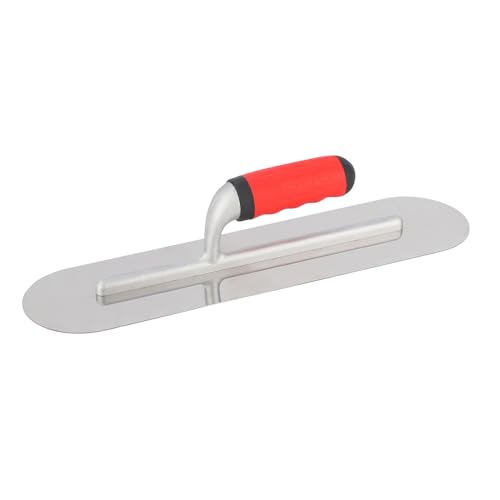
The best plaster and masonry hand trowels are not all designed for the same motion. A long finishing blade is intended to spread and smooth material across a broad surface, while a margin, pointing, or gauging trowel gives better access around joints, corners, edges, and repairs. Start by identifying whether the job is primarily plaster or drywall finishing, concrete smoothing, bricklaying, pointing, or a mixture of these tasks.
Match blade length to the work area
Long blades can cover more surface with each pass. The OX 18-inch model and ESreake 16 x 4-inch model are the largest selected options, making them logical choices for broad plaster, drywall, concrete, or mortar surfaces based on their listed dimensions and applications. Their length may be less convenient in small rooms, around openings, or on narrow repair sections.
Mid-size blades provide a general format. Goldblatt RED and the wood-handle Goldblatt are listed at 12 x 4 inches, while Edward Tools is listed at 11 inches with a 4.5-inch blade width. These sizes can be easier to control than extra-large tools while still offering useful coverage.
Small masonry blades serve a different purpose. The MARSHALLTOWN 5 x 2-inch margin trowel is intended for small repairs, flooring, tiling, and masonry. The SHALL set adds 5.5-inch pointing, 6-inch margin, and 7-inch gauging trowels, while OMISTAR includes pointing and joint tools alongside a plastering trowel. These designs are suited to joints, mortar placement, corners, and localized work rather than smoothing an entire wall.
Consider blade material and finish
Stainless steel is documented across several selected products, including OX, Goldblatt RED, Peohud, Hubaow, and ESreake. The listings associate stainless steel with rust or corrosion resistance, while polished surfaces are described for smooth application or easier cleaning. This makes stainless steel a practical material to consider when the tool regularly contacts wet plaster, mortar, cement, or concrete.
Blade finish also matters. Polished blades are documented on Edward Tools, the wood-handle Goldblatt, Peohud, Hubaow, ESreake, and MARSHALLTOWN. Peohud additionally documents beveled edges on two blades, and OX specifies pre-worn edges and a curved blade. These details are relevant when choosing a tool for finishing, edge work, or reduced marking, but they are not hands-on performance results.
Choose the handle for control
Handle design affects how easily you can position a trowel during repeated passes. OX uses an ergonomic grip with integrated finger protection and a reverse thumb grip. Goldblatt RED documents a PP+TPR soft grip, while ESreake uses plastic and rubber. These features are useful signals for users who expect extended work or prefer a cushioned grip.
Wood handles are documented on the 12 x 4-inch Goldblatt, Peohud, and MARSHALLTOWN models. The supplied listings give less detail about anti-slip shaping for those handles than for rubberized alternatives. SHALL combines PP and TPR, and Hubaow’s set uses rubber handles, giving those products a more explicit focus on grip materials.
A single finishing trowel is a focused choice when you already know the required blade size. OX, Goldblatt RED, the wood-handle Goldblatt, Edward Tools, and ESreake each target finishing with one primary blade format. This can simplify storage and selection.
Sets are useful when a project includes different surfaces or stages. Peohud supplies three flat sizes, and Hubaow supplies three shapes and sizes for varied finishing areas. OMISTAR and SHALL are more masonry-oriented because they include pointing, gauging, margin, brick, or joint designs. A set may provide broader coverage, although some included tools may not be needed for a narrowly defined task.
Check construction details before buying
Look for the connection method, shank material, and documented blade thickness. OX specifies a full-riveted aluminum shank, Goldblatt RED specifies a magnesium shank and 12-rivet connection, and the wood-handle Goldblatt specifies a riveted design. Peohud lists 0.02-inch blades, while Hubaow and ESreake list 0.7 mm blades. These details help distinguish the construction described in each listing without implying a test result.
Confirm dimensions carefully. Product titles may describe overall length while features describe working blade size. Check the selected configuration where a listing offers multiple sizes, such as Goldblatt RED. For narrow work, prioritize blade width and shape rather than overall length alone.
Final Recommendation
OX Plaster Finishing Trowel 18-inch ranks first overall in this specification-based comparison under the published weighted criteria.
OX Plaster Finishing Trowel 18-inch is the first overall specification-based choice among these best plaster and masonry hand trowels because its listing combines a large stainless steel blade, pre-worn edges, curved construction, ergonomic handling, and a riveted aluminum shank. Goldblatt RED is a suitable alternative for users wanting a 12 x 4-inch tool with stainless steel, a magnesium shank, and a 12-rivet connection. For mixed projects, OMISTAR and SHALL provide several masonry-specific tools, while Peohud and Hubaow offer multiple finishing sizes or shapes. The compact MARSHALLTOWN is a focused option for margin work and small repairs. Together, these top plaster and masonry hand trowels cover broad finishing, detail work, bricklaying, pointing, and general repair applications without relying on customer sentiment or hands-on claims.
Frequently Asked Questions
Among the best plaster and masonry hand trowels, what size trowel is suitable for plaster finishing?
The answer depends on the surface and the control required. OX has an 18-inch blade, while ESreake offers a 16 x 4-inch format for broad coverage. Mid-size choices include Edward Tools at 11 inches and the 12 x 4-inch Goldblatt options. Smaller blades are easier to place around edges and tight areas but cover less surface per pass.
Are stainless steel trowels suitable for masonry and plaster?
Several selected products document stainless steel blades for plaster, drywall, concrete, cement, mortar, or masonry applications. Examples include Goldblatt RED, Peohud, Hubaow, OX, and ESreake. Stainless steel is listed as rust or corrosion resistant on some products, but the tool should still be cleaned and dried after use because the evidence does not establish immunity from all job-site conditions.
Should I choose a finishing trowel or a margin trowel?
Choose a finishing trowel for spreading, flattening, smoothing, or polishing larger plaster, drywall, or concrete areas. Choose a margin or pointing trowel for narrow joints, small repairs, brickwork, and localized mortar placement. MARSHALLTOWN and the compact tools in the SHALL set document those more focused masonry uses.
Are multi-piece sets useful for beginners?
A set can be useful when a project includes several tool shapes or sizes. Peohud and Hubaow focus on multiple flat or shaped finishing trowels, while OMISTAR and SHALL include masonry-specific designs. A single tool may be simpler if the work only involves one known blade size. Compare the included shapes with the actual task before choosing a set.
How should a plaster or masonry trowel be maintained?
Remove plaster, mortar, cement, or concrete residue after use and keep the blade dry. Follow the listing’s care guidance where supplied, and store the tool in dry conditions. Do not treat a polished or stainless blade as maintenance-free.