Buying Guide
Choosing among the best professional pool cues starts with deciding which specifications matter most to your stroke and maintenance routine. This comparison uses listing evidence, not hands-on testing. A cue described as professional is not automatically a match for every player, so focus on construction, tip format, joint design, balance, and what is included.
Carbon fiber or maple shaft
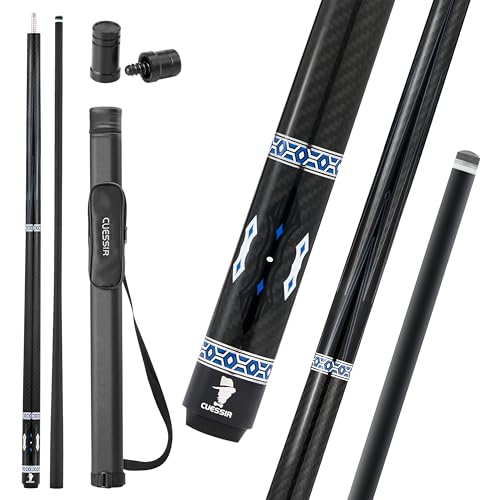
Carbon fiber is the dominant material in this group. RHINO, Poison, KONLLEN, CUEBOTS, Jian Ying, CUESSIR, Cuefessnuance, SYNCSHOT, and Cesrriv Sport document carbon-fiber shaft construction. The supplied listings commonly connect that material with low-deflection or stability-oriented designs, but those claims should be understood as manufacturer or seller specifications rather than test results. Carbon construction may appeal to players who want a shaft marketed for resistance to warping, dents, or splintering.
Maple remains a useful alternative. Tai ba cues documents a hand-selected Canadian maple shaft, while its listing emphasizes control, maintenance, and a conventional feel. It may suit players who prefer wood construction or want a more traditional cue profile. Material alone does not establish that one cue will play better for every person; tip, taper, grip, weight, and personal technique also matter.
Compare taper and deflection language
A pro taper describes the shaft shape through the bridge area. RHINO, KONLLEN, Jian Ying, CUESSIR, Cuefessnuance, and other selected cues document pro-taper or related low-deflection language. A taper can affect how the shaft passes through the bridge hand, while low-deflection construction is presented in the listings as a way to reduce lateral cue-ball movement. These are design descriptions, not measured comparisons between products.
Look for concrete details instead of relying on broad labels. RHINO lists a 30-inch carbon shaft and pro taper. KONLLEN describes reduced front-end mass and a K-FOAMX core. Cuefessnuance specifies a 29-inch foam-filled shaft. Those details make the products easier to compare than listings that only say “professional.”
Select tip size and construction
Tip diameter is one of the clearest differences in the selection. The listed options range from 11.8 mm on Jian Ying and Cuefessnuance to 13 mm on Tai ba cues and Cesrriv Sport. Several products use multi-layer leather or pigskin tips. CUEBOTS lists an eight-layer Japanese pigskin tip, CUESSIR lists a six-layer pigskin tip, and RHINO lists an 11.8 mm or 12.4 mm Time Crystal option.
A smaller tip may be attractive to players who prioritize a more precise contact area, while a larger tip may feel more familiar to players who want a broader contact profile. The supplied evidence does not establish a universal performance advantage, so choose based on your current cue preferences and the tip hardness or material you already understand.
Check joint and balance details
The selected products document several joint formats. RHINO, Jian Ying, CUEBOTS, CUESSIR, Cuefessnuance, and SYNCSHOT list a 3/8-8 stainless joint. Tai ba cues lists brass joints. A clearly identified joint can help with compatibility and maintenance, but the evidence does not support declaring one joint universally superior.
Weight selection is especially useful when replacing a house cue. Tai ba cues documents selectable 18–21 oz weights, Jian Ying states approximately 18–20 oz, CUESSIR lists 19–20 oz, and Cesrriv Sport lists 20–21 oz. KONLLEN documents an adjustable weight system, while RHINO lists support for optional weight-bolt tuning. Confirm the exact supplied configuration before ordering because some adjustment components may not be included.
Consider case and accessories
A case protects a two-piece cue during transport and storage. Poison, CUESSIR, SYNCSHOT, and Tai ba cues document cases, while Jian Ying lists a rigid gift box and several playing accessories. Cesrriv Sport lists a protective case, joint protectors, chalk, and a glove. CUEBOTS lists joint protectors, which help protect connection threads when the cue is separated.
An included case can be more useful than decorative features if you regularly travel to a bar, pool hall, league venue, or home table. Also check whether replacement tips, chalk, gloves, extension handles, or joint protectors are included, since packages differ considerably.
Match the cue to your routine
For a carbon-fiber-focused setup, RHINO, Poison, KONLLEN, and CUEBOTS offer some of the clearest technical descriptions. For a package with accessories, Jian Ying, SYNCSHOT, CUESSIR, and Cesrriv Sport document useful extras. Tai ba cues is the clearest maple-oriented option in this top 10. Players who want to compare tip sizes should examine RHINO or Cuefessnuance, while heavier-weight shoppers may focus on Cesrriv Sport.
Final Recommendation
RHINO Nebula 2 Carbon Fiber Pool Cue ranks first overall in this specification-based comparison under the published weighted criteria.
RHINO Nebula 2 is the highest-scoring returned product and the first overall specification-based choice. Its documented 30-inch carbon-fiber pro-taper shaft, low-deflection positioning, stainless 3/8-8 joint, tip options, wrapless carbon composite butt, and optional weight-bolt support create the most complete technical profile in this comparison.
Among the top professional pool cues, Poison Maelith is a strong alternative for buyers who value the included case, joint protectors, and limited lifetime manufacturing-defect warranty. KONLLEN is more suitable for players who prioritize adjustable balance, while Tai ba cues gives maple users a clearly documented 18–21 oz range and accessory bundle. The best professional pool cues choice ultimately depends on whether you prefer carbon fiber or maple, the tip diameter you already use, and whether transport protection is essential.
Frequently Asked Questions
Are the best professional pool cues always made from carbon fiber?
No. Carbon fiber is common in this comparison, but Tai ba cues documents a Canadian maple shaft and provides a traditional alternative. Material preference should be considered alongside taper, tip, weight, joint, and grip.
What tip size should I compare first?
Start with the size closest to your current cue. The selected products document sizes from 11.8 mm to 13 mm, including RHINO’s 11.8 mm or 12.4 mm options and Tai ba cues’ 13 mm tip. The supplied evidence does not establish one size as best for every player.
Do these cues include cases?
Some do and some do not. Poison, CUESSIR, SYNCSHOT, Tai ba cues, and Cesrriv Sport list cases or protective storage. Jian Ying lists a rigid gift box, while CUEBOTS lists joint protectors. Check the individual package details before assuming a case is included.
Is an adjustable weight system important?
It can be useful when you want to change balance or overall feel. KONLLEN documents an adjustable weight system, RHINO supports optional weight-bolt tuning, and Tai ba cues documents selectable weights. Not every selected cue includes this feature, and RHINO’s weight-bolt set is sold separately.
What makes a professional pool cue comparison useful?
A useful comparison separates documented specifications from unverified performance claims. Review shaft material, taper, tip construction, joint, weight options, case, accessories, and warranty, then match those details to your playing routine. The best professional pool cues for one player may not suit another player’s established setup.