Buying Guide
The best professional monopods are defined less by a single headline feature than by how their support system fits a production workflow. The selected models range from simple carbon-fiber poles to fluid-head systems with adjustable feet, quick-release plates, and alternate operating modes. Start by identifying the camera package, movement style, and transport limits that matter most to your work.
Match the monopod to the rig
Load support is the first specification to check. The SmallRig TRIBEX PRO documents a 25kg capacity, while the COMAN One-Click Lifting Carbon Fiber Monopod, 69‘’ Camera Monopod with Feet lists 20kg and the SIRUI SVM-145 and SIRUI AM-145+S3 document 10kg capacities for their legs. Those figures can accommodate substantial camera, lens, gimbal, or accessory combinations, but actual use depends on the equipment configuration. A head may have a different capacity from the leg, as shown by the SIRUI AM-145+S3’s 10kg leg capacity and 6kg head capacity.
The IFOOTAGE Cobra 3 Strike A150S+K5S lists a 5kg capacity, and the NEEWER TP71 lists 6kg. These specifications may be more appropriate for lighter camera or camcorder setups. The Manfrotto 290 Carbon Fiber Monopod documents a 10kg safety payload, while its simple pole design does not add a fluid base or integrated feet in the supplied evidence.
Choose the adjustment system
One-button and one-touch mechanisms are useful when the camera position changes repeatedly. The COMAN One-Click Lifting Carbon Fiber Monopod, 69‘’ Camera Monopod with Feet, SIRUI AM-145+S3, and IFOOTAGE Cobra 3 Strike A150S+K5S document rapid lift systems. The IFOOTAGE model adds a pedal lock, allowing the operator to lock or unlock the monopod with a foot instead of bending down. The SmallRig TRIBEX PRO uses one-handle hydraulic deployment and auto-locks all three carbon-fiber leg sections.
Twist and lever locks remain practical when you prefer section-by-section control. The Benro MSD46C uses twist locks and six sections, folding to only 17.9 inches. The Manfrotto 290 Carbon Fiber Monopod uses four sections with adjustable aluminum leg locks. The NEEWER TP71 uses four sections with flip locks, and the Professional Camera Monopod with Feet, 73.2 inch Aluminum Portable Travel Video uses five sections. More sections can improve folded size or height flexibility, but they also create more locking points to check during setup.
Decide whether you need feet
A monopod with feet can stand on its base for supported framing, but the base design varies significantly. The SmallRig TRIBEX PRO lets the operator switch between 360-degree panning and fixed mode with a toe-activated pedal. The SIRUI SVM-145 documents a pivoting base with 360-degree swiveling and 36-degree tilting. These systems are useful when the floor is uneven or when the camera must pan without moving the entire pole.
The NEEWER TP71 has a removable adjustable base with 360-degree rotation and 45-degree tilt. The Professional Camera Monopod, 73.2 inch Aluminum Portable Travel Video documents a detachable base with three operating options, including a low-angle camera tripod configuration. The SIRUI AM-145+S3 also converts to a desktop tripod or trekking pole. These modular designs are practical when one support needs to cover different location tasks.
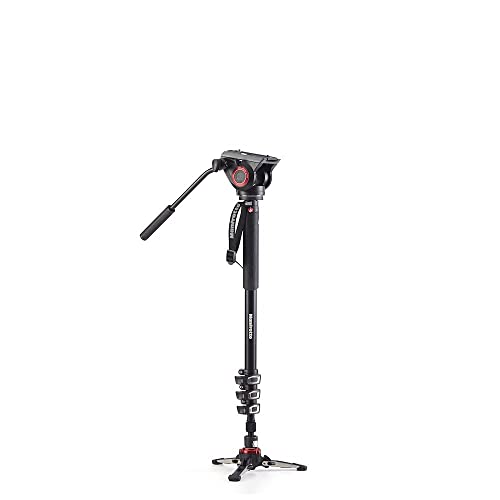
A fluid base or head does not make the monopod a full tripod. It provides a particular support and movement arrangement, so check whether your workflow needs hands-on control throughout the shot. The Manfrotto XPRO+ Video Monopod’s FluidTECH base supports pan, tilt, and swivel, while the IFOOTAGE K5S and Professional Camera Monopod, 73.2 inch Aluminum Portable Travel Video heads document defined pan and tilt ranges.
Compare fluid-head movement
Video shooters should inspect both pan and tilt specifications. The COMAN One-Click Lifting Carbon Fiber Monopod, 69‘’ Camera Monopod with Feet lists 360-degree panning and ±90-degree tilt. The IFOOTAGE Cobra 3 Strike A150S+K5S lists 360-degree pan with +90/-83-degree tilt. The NEEWER TP71 fluid head lists 360-degree swivel and -70/+90-degree tilt. The Professional Camera Monopod, 73.2 inch Aluminum Portable Travel Video lists 360-degree panoramic movement and +90/-60-degree tilt.
The SIRUI S3 fluid head provides 360-degree panning and -50-to-+90-degree tilt. The product documentation specifically describes hydraulic damping, which distinguishes it from a basic pole or a base-only design. For a simpler setup, the Manfrotto 290 Carbon Fiber Monopod or Benro MSD46C may be preferable when the monopod itself is the primary support and a separate head is already part of the kit.
Check mounting and quick-release standards
Mounting compatibility can determine whether a monopod fits cleanly into an existing camera system. The COMAN One-Click Lifting Carbon Fiber Monopod, 69‘’ Camera Monopod with Feet supports RS systems and Manfrotto 501 standards. The SIRUI AM-145+S3 uses a plate supporting MFT 501 and RS systems. The NEEWER TP71 lists compatibility with RS and 501PL systems. The Professional Camera Monopod, 73.2 inch Aluminum Portable Travel Video lists RS and Manfrotto support.
The SmallRig TRIBEX PRO uses Arca-Swiss quick release at both the head and base and includes 1/4-inch and 3/8-inch threads. The COMAN One-Click Lifting Carbon Fiber Monopod, 69‘’ Camera Monopod with Feet lists compatibility with DJI RS2, RS3, and RS4 and Manfrotto 501 systems. Compare these documented standards with the plate and accessory connections already used by your camera setup.
Balance reach and transport
Maximum height should match the operator and shooting position, but folded length determines how easily the monopod fits into an equipment case. The NEEWER TP71 reaches 71.6 inches, the Professional Camera Monopod, 73.2 inch Aluminum Portable Travel Video reaches 73 inches, and the Manfrotto XPRO+ Video Monopod lists 79.92 inches. The SmallRig TRIBEX PRO ranges from 31.1 to 63 inches, while the SIRUI AM-145+S3 reaches 61 inches.
For transport, the Benro MSD46C folds to 17.9 inches and lists a 1.3lb weight. The SIRUI SVM-145 folds to 29.5 inches and lists about 3.3lb. The COMAN One-Click Lifting Carbon Fiber Monopod, 69‘’ Camera Monopod with Feet folds to 765mm, and its carbon-fiber construction is paired with a listed 5.51lb weight. Always compare the folded dimensions of the complete configuration, especially when a fluid head or base is included.
Final Recommendation
SmallRig TRIBEX PRO X-Clutch ranks first overall in this specification-based comparison under the published weighted criteria.
SmallRig TRIBEX PRO X-Clutch is the highest-scoring returned product and the first overall specification-based choice. Its documented 25kg load capacity, one-handle hydraulic deployment, toe-operated base mode, and dual Arca-Swiss quick release give it the broadest combination of rig support and operating control in this comparison.
Among the top professional monopods, the COMAN One-Click Lifting Carbon Fiber Monopod, 69‘’ Camera Monopod with Feet is a strong fit for RS and Manfrotto 501 workflows, while the SIRUI AM-145+S3 is the most adaptable if trekking-pole and desktop-tripod modes matter. Choose the Benro MSD46C when folded size and listed weight are primary concerns. For a simple carbon-fiber pole, the Manfrotto 290 Carbon Fiber Monopod keeps the design direct. For tall video setups, compare the NEEWER TP71, Professional Camera Monopod, 73.2 inch Aluminum Portable Travel Video, and Manfrotto XPRO+ Video Monopod by their documented head, base, and mounting specifications.
The best professional monopods should match the complete camera package rather than just the pole. Confirm the head capacity, plate standard, base behavior, maximum height, and folded length before selecting a configuration.
Frequently Asked Questions
What features matter most in the best professional monopods?
Check load support, height adjustment, base movement, construction, folded length, and mounting standards. A video-focused model may benefit from a fluid head and adjustable feet, while a photographer who already owns a head may prefer a lighter pole such as the Manfrotto 290 Carbon Fiber Monopod or Benro MSD46C.
Are carbon-fiber monopods better for professional use?
Carbon fiber can provide a lightweight construction, as documented for the SmallRig TRIBEX PRO, COMAN One-Click Lifting Carbon Fiber Monopod, 69‘’ Camera Monopod with Feet, SIRUI AM-145+S3, SIRUI SVM-145, NEEWER TP71, Benro MSD46C, and Manfrotto 290 Carbon Fiber Monopod. Aluminum models can still offer substantial capacities and video features, as shown by the Manfrotto XPRO+ Video Monopod and Professional Camera Monopod, 73.2 inch Aluminum Portable Travel Video. The appropriate choice depends on the documented weight, capacity, and features required by the setup.
Do all professional monopods include adjustable feet?
No. The selected models with documented feet or bases include the SmallRig TRIBEX PRO, COMAN One-Click Lifting Carbon Fiber Monopod, 69‘’ Camera Monopod with Feet, SIRUI AM-145+S3, Manfrotto XPRO+ Video Monopod, SIRUI SVM-145, NEEWER TP71, Professional Camera Monopod, 73.2 inch Aluminum Portable Travel Video, Benro MSD46C, and IFOOTAGE Cobra 3 Strike A150S+K5S. The Manfrotto 290 Carbon Fiber Monopod evidence documents a carbon-fiber monopod but does not document integrated feet.
Which selected monopods support gimbals?
The COMAN One-Click Lifting Carbon Fiber Monopod, 69‘’ Camera Monopod with Feet documents compatibility with RS systems and Manfrotto 501, the SIRUI AM-145+S3 supports RS plates, and the NEEWER TP71 documents RS and 501PL compatibility. The Professional Camera Monopod, 73.2 inch Aluminum Portable Travel Video documents RS and Manfrotto support. The SmallRig TRIBEX PRO documents compatibility with RS-series equipment through its Arca-type system.
What should I verify before using a high-capacity monopod?
Verify the complete camera, lens, head, gimbal, and accessory combination against the supplied capacity specifications. Also inspect the locking mechanisms, confirm that the quick-release plate matches the camera system, and check whether the base should be used in panning or fixed mode for the intended shot.