Buying Guide
The best professional tripod heads are differentiated less by a single headline specification than by the way their movement system matches the camera work. Geared heads favor deliberate, repeatable framing. Ball heads prioritize quick repositioning. Fluid heads are designed around controlled pan-and-tilt movement, while gimbal heads can help position a larger lens and camera system around its center of gravity. The products in this comparison document each of these designs, so the practical choice starts with the type of control you need.
Choose the movement design first
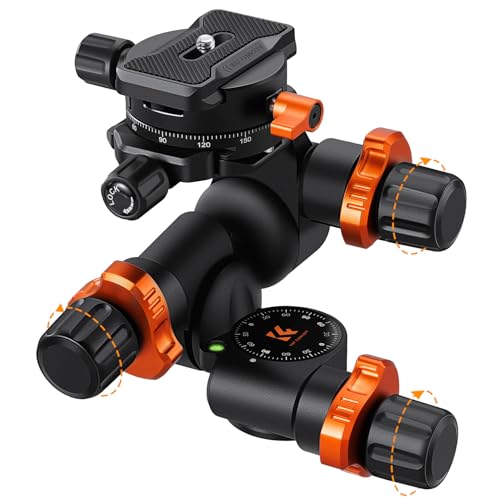
A geared head is the most directly documented option for precise composition. The Benro GD3WH uses geared adjustments, marked scales, and a bubble level. The K&F Concept GD-3W Pro adds 0.1-degree micro-adjustment, four bubble levels, and three angle scales. The NEEWER TH15 provides retractable controls that switch between approximate and precise adjustments. These features suit architecture, macro, product, and still-life work where small framing changes matter.
A ball head is faster to reposition because one primary ball mechanism can change several angles at once. The ARTCISE KB55 adds a drag or friction control, a large 55mm sphere, and dual drop notches. The CAVIX H-46 uses a low-profile 46mm ball with three adjustment knobs and a bubble level. Ball heads are appropriate when you want flexible camera placement without turning several geared axes, although they generally provide less independent axis control than the geared designs listed here.
Fluid heads are the more natural fit for video movement. The NEEWER GM001 documents fluid drag, counterbalanced tilt, a scaled pan base, and a side-mountable handle. The K&F Concept FH-03 uses hydraulic technology and a removable telescopic handle. SmallRig’s CH10 lists fixed internal damping in an especially compact body, while the INNOREL F20 documents damped movement, pan and tilt scales, and a repositionable handle. These products differ in capacity and portability, so match the head to the complete camera, lens, and accessory load.
The K&F Concept gimbal head is a separate design choice. Its vertical and horizontal arms rotate 360 degrees, and its lens platform is intended to position the center of gravity of a camera and lens system. That makes it relevant when balanced lens support is more important than the compactness of a conventional ball or fluid head.
Match capacity to the complete setup
Capacity should be considered against the entire mounted system rather than the camera body alone. The ARTCISE KB55 and CAVIX H-46 list maximum capacities of 88 and 44 pounds respectively. The K&F Concept gimbal head lists 44 pounds, while the Benro, K&F geared, NEEWER TH15, and NEEWER GM001 listings each specify 13.2 pounds. The K&F FH-03 and INNOREL F20 list 11 pounds, and SmallRig’s CH10 lists 6.6 pounds.
These figures are not interchangeable measures of operating feel, and the supplied evidence does not establish real-world performance under any particular load. They are useful for screening compatibility. Include the camera, lens, battery, cage, monitor, microphone, and any other mounted equipment when comparing the documented capacity with your setup.
Consider movement range and locking style
For broad angle changes, look at both pan and tilt specifications. The NEEWER GM001 lists 360-degree panning and tilt from minus 70 to plus 90 degrees. The K&F FH-03 lists 360-degree pan and plus-or-minus 90-degree tilt. The INNOREL F20 also lists 360-degree rotation and minus-90 to plus-90-degree tilt. SmallRig’s CH10 reaches 360 degrees with a plus-90 to minus-55-degree tilt range.
The geared models offer a different kind of control. The K&F GD-3W Pro lists 360-degree rotation at both the panning base and clamp, while the TH15 combines 360-degree pan with specified front and lateral tilt ranges. The ARTCISE KB55 and CAVIX H-46 use ball movement for flexible positioning, with drop notches or vertical tilt support for portrait orientation. A wider documented range can be helpful, but the best professional tripod heads should also provide a locking or damping approach suited to the way you work.
Check the mounting interface
Arca-Swiss-style or Arca-type plates appear across many selected products, including the Benro GD3WH, K&F geared head, NEEWER TH15, K&F FH-03, SmallRig CH10, INNOREL F20, and CAVIX H-46. This can simplify movement between compatible supports, but the supplied listings use slightly different descriptions, so verify the exact plate and clamp standard for your existing equipment.
Base connections also matter. The K&F GD-3W Pro, NEEWER TH15, K&F FH-03, INNOREL F20, and CAVIX H-46 document 3/8-inch tripod connections, with some also listing 1/4-inch compatibility or adapters. The NEEWER GM001 lists a 3/8-inch bottom socket and 1/4-inch and 3/8-inch top mounting screws. These details are useful when moving a head among tripods, monopods, sliders, or other supports.
Balance portability with construction
Listed weight varies considerably. The K&F FH-03 is described as weighing 1.06 pounds, while SmallRig’s CH10 is listed at 286g. The NEEWER GM001 lists 1.5 pounds, the Benro GD3WH 1.92 pounds, and the K&F geared head 2.5 pounds. The K&F gimbal head lists 3.15 pounds. Lighter heads are easier to carry, but capacity and control design still need to fit the equipment.
Construction evidence includes aluminum alloy on the Benro, K&F geared, K&F gimbal, NEEWER GM001, SmallRig CH10, and INNOREL F20. The ARTCISE KB55 and CAVIX H-46 specify CNC-machined or all-metal construction. Treat these as documented build details rather than proof of long-term durability, since this guide does not include hands-on testing.
Final recommendation
ARTCISE KB55 Low-Profile Ball Head ranks first overall in this specification-based comparison under the published weighted criteria.
The final choice among the best professional tripod heads depends on the documented features that match your intended use.
The Benro GD3WH Precision Geared Head is the highest-scoring returned product and the first overall specification-based choice. Its geared control, marked scales, bubble level, Arca-Swiss-style plate, and 13.2-pound capacity form the most complete precision-oriented specification set in this comparison. For technical framing, the K&F Concept GD-3W Pro and NEEWER TH15 provide similarly detailed geared adjustment features.
For heavier systems, the ARTCISE KB55, CAVIX H-46, and K&F Concept gimbal head document substantially higher capacities, with different movement approaches. Video users should focus on the NEEWER GM001, K&F FH-03, SmallRig CH10, and INNOREL F20, selecting according to damping, tilt range, mounting interface, and total system weight. Together, these are top professional tripod heads for distinct photo and video workflows rather than interchangeable designs.
Frequently Asked Questions
Among the best professional tripod heads, what type of head is best for precise architectural framing?
A geared head is the clearest match among the selected products. The Benro GD3WH lists geared adjustments, marked scales, and a bubble level. The K&F Concept GD-3W Pro specifies 0.1-degree micro-adjustment, four bubble levels, and angle scales, while the NEEWER TH15 documents fine adjustment through retractable controls. These features are designed for controlled framing changes, although this article does not report hands-on accuracy testing.
Are fluid heads suitable for still photography?
They can be useful when smooth pan and tilt movement or broad angle changes are important. The K&F FH-03, NEEWER GM001, SmallRig CH10, and INNOREL F20 all document fluid or damped movement and wide pan-tilt ranges. A geared or ball design may be more suitable when the primary need is exact static composition, while a fluid head is more directly aligned with controlled movement during video work.
How much capacity should a tripod head have?
Start by totaling the camera, lens, cage, monitor, microphone, battery, and other mounted equipment. The selected heads range from SmallRig CH10’s stated 6.6 pounds to ARTCISE KB55’s stated 88 pounds. Capacity figures come from supplied listing evidence and should be treated as a compatibility reference, not as a substitute for checking the manufacturer’s complete operating guidance.
Do these tripod heads use Arca-Swiss mounting?
Several do. The Benro GD3WH lists an Arca-Swiss-style plate; the K&F geared head, NEEWER TH15, K&F FH-03, SmallRig CH10, INNOREL F20, and CAVIX H-46 list Arca-type or Arca-Swiss-compatible mounting. Because the wording varies by product, confirm the exact plate and clamp interface before combining a head with an existing support system.
Which selected head is easiest to carry?
The SmallRig CH10 lists a 286g weight, and the K&F FH-03 is described as weighing 1.06 pounds. Both are compact fluid designs. The choice between them depends on the documented load requirement: SmallRig lists 3kg, while K&F lists 5kg. The NEEWER GM001 and Benro GD3WH provide higher listed capacities but weigh more.