Buying Guide
The best retractable usb cables are defined less by the word “retractable” than by the connection standard, charging ceiling, adjustment system, and data limitations behind that design. The products above fall into three practical groups: USB-C-to-USB-C cables, USB-A-to-USB-C cables, and multi-connector cables. Choosing the right group first prevents a cable from fitting physically while failing to deliver the charging or data function you need.
Match the cable to the charger
Start at the power-source end. USB-C-to-USB-C models such as Baseus, SOOPII, VisionSync, and the two Cable Matters USB-C options are the clearest choices for USB-C wall chargers, power banks, tablets, and laptops. Their stated power levels range from 60W to 240W. A higher number does not force a device to draw that much power, but the charger, device, and cable must all support the intended charging arrangement.
USB-A-to-USB-C models are better suited to older wall adapters, car ports, computers, and other USB-A sources. The iHoto and Cable Matters USB-A models document up to 15W, while AHFYCIH lists 18W, 15W, and 10W charging scenarios depending on the paired charger. These are useful for phones and accessories, but they are not substitutes for high-wattage USB-C laptop charging.
Check the connector layout
A dedicated USB-C cable has fewer connection combinations but a simpler path. This can be preferable when every device in your bag uses USB-C. Multi-connector models add Lightning, Micro-USB, USB-A, or multiple ends. CAFELE documents six charging combinations, while YTLUSN documents USB-C-to-C, USB-C-to-Lightning, USB-A-to-Lightning, and USB-A-to-C paths.
Multi-cables are useful for shared cars, families, and travel groups, but inspect the output for each connector. CAFELE lists 100W for USB-C-to-C, 50W for USB-A-to-C, and lower output for some adapters. YTLUSN similarly varies by connection. The total design may be versatile without every port offering the same charging or data capability.
Evaluate length adjustment
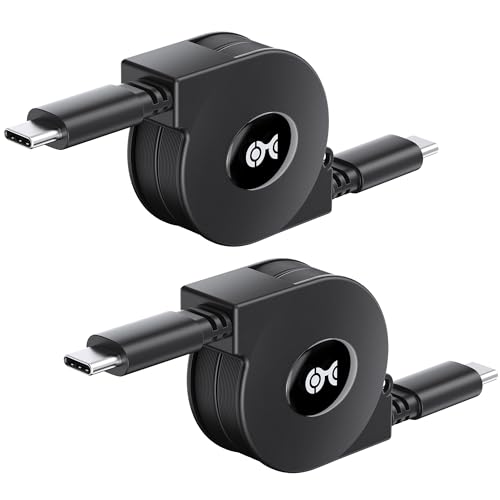
Retractable construction is most useful when the cable can be shortened for storage and extended only as far as necessary. Baseus documents four preset lengths and allows adjustment from either side. SOOPII and VisionSync document five preset lengths with single- or double-pull operation. Other products use a ratchet or pull-and-release mechanism.
A maximum length around three to four feet suits desks, car consoles, and travel trays. A shorter cable can be tidier near a power bank, while a longer range can help reach a phone mounted farther from a car port. Consider how the cable will be pulled: a two-sided mechanism may be convenient when both connected devices are accessible, while a one-sided pull may suit a confined setup better.
Understand data and display limits
Many retractable cables in this comparison document USB 2.0 data at approximately 480Mbps. That is suitable for basic file transfers and, where specifically stated, some CarPlay or Android Auto use. It is not the same as a high-speed video cable. Baseus explicitly states that its USB-C cable does not support video transmission, and the other USB-C models should not be assumed to support display output unless the listing says so.
Multi-connector designs may restrict data to one specific connector. The YTLUSN listing states CarPlay and Android Auto support, while the multi-cable evidence for some Lightning-based products limits data or CarPlay to the Lightning connection. Read the port-specific notes rather than treating every connector as interchangeable.
Consider portability and construction
The main storage advantage is the reel or compact case, which keeps loose cable length from collecting in a bag or vehicle. SOOPII and VisionSync document magnetic recessed slots for keeping the USB-C ends flush with the case. Baseus lists a 50g weight, and VisionSync lists 43g plus an 18mm thickness. These details are useful when pocket or pouch space matters.
Construction claims also vary. Cable Matters lists gold-plated connectors, molded strain relief, and a ratchet function. CAFELE lists an aluminum alloy reel, while VisionSync lists flat TPE material and a stated pull-test claim. These are specification signals, not independent test results, so they should be treated as documented design information rather than a guarantee of service life.
Choose a cable for the setting
For laptop-focused USB-C travel, Baseus, SOOPII, or VisionSync provide the most specification-aligned documented power specifications. For a mixed-device household, CAFELE or YTLUSN reduces the need to carry separate connector types. For a USB-A car or older charger, iHoto, AHFYCIH, or the USB-A Cable Matters model is more appropriate. If you mainly need a compact spare for USB-C charging and basic syncing, either USB-C Cable Matters option is easier to match.
The top retractable usb cables are not identical because their connection standards serve different setups. Verify the source port, device port, required wattage, and need for data or vehicle connectivity before selecting a model.
Final recommendation
Among the top retractable usb cables, the ranked products differ under documented retraction and length control, charging capability, connector versatility, data and vehicle-connectivity support, and portability and documented build features.
CAFELE 100W 6-in-1 Retractable Charging Cable ranks first overall in this specification-based comparison under the published weighted criteria.
Baseus 100W Retractable USB-C Cable is the first overall specification-based choice among these best retractable usb cables because it balances high USB-C charging, four-stage adjustment, two-sided extension, light weight, and broad USB-C compatibility. SOOPII and VisionSync are stronger alternatives when the highest documented USB-C power or magnetic compact storage matters.
For mixed connectors, CAFELE is the most capable documented choice, while YTLUSN is particularly practical for cars and shared devices because it adds several connection paths and a phone stand. USB-A users should look to iHoto, AHFYCIH, or Cable Matters USB-A to USB-C rather than expecting USB-C PD performance from an older source port. These recommendations are based on supplied specifications and listing features, not hands-on testing or customer sentiment.
Frequently Asked Questions
Are retractable USB cables suitable for laptops?
Some are. Baseus documents 100W USB-C Power Delivery, while SOOPII and VisionSync document up to 240W. Cable Matters USB-C models document up to 60W. Laptop compatibility still depends on the laptop, charger, and power profile, so check all three components. USB-A models in this comparison are better suited to lower-power phone and accessory charging.
Do these cables support video output?
Do not assume that a retractable cable supports displays. Baseus explicitly says its USB-C cable does not support video transmission, and the other listings primarily document charging and USB 2.0 data. If display output is essential, use only a cable whose specifications explicitly identify that capability.
Which best retractable usb cables work with older USB-A chargers?
The iHoto, AHFYCIH, and Cable Matters USB-A-to-USB-C models are designed around a USB-A input and USB-C device connection. Their documented charging levels are lower than the high-power USB-C-to-USB-C models. YTLUSN and CAFELE can also cover USB-A combinations, but their output and data support vary by connector.
Are multi-connector retractable cables good for travel?
They can be convenient when one bag includes USB-C, Lightning, and Micro-USB devices. CAFELE and YTLUSN document several connection combinations, and both use adjustable retractable storage. The trade-off is that individual connectors may have different charging or data limits, so check the port-specific specifications before relying on one cable for every task.
What data speed should I expect?
Several selected cables document USB 2.0 transfer at 480Mbps. That is appropriate for basic syncing and file movement, but it is not a guarantee of high-speed storage performance or video support. Some multi-connector cables restrict data to a particular connector, so review those limitations before purchase.