Buying Guide
Choosing among the best small safety vests starts with the work environment, required compliance, and the wearer’s measurements. The supplied listings cover mesh and knit designs, several pocket layouts, fluorescent trims, and ANSI/ISEA claims. They do not use a universal measurement system, so a size label alone cannot confirm fit.
Start with the required safety standard
If a workplace specifies a standard or class, match that requirement to the product listing rather than relying on color alone. Several selected vests state ANSI/ISEA 107 Class 2 or Class 2 Type R compliance, including the Neopelta, TCCFCCT, XIAKE, Ekkosafety, and Tydon Guardian models. The Gasoline listing says it meets ANSI/ISEA standards but does not identify a class in the supplied evidence.
The listings also include limitations. The JKSafety BX320 and JKSafety JK168 note that they are not designed for anti-static or FR standards. A high-visibility vest should not be treated as specialized protective clothing unless the listing and workplace requirements say it qualifies.
Compare reflective coverage
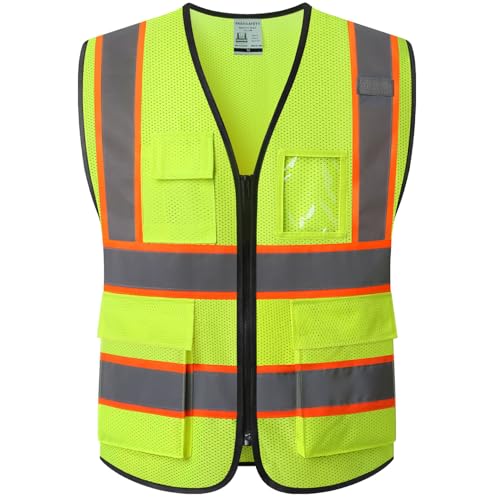
Look for more than a bright base color. The most specification-aligned descriptions specify 2-inch reflective strips across several body areas, such as the shoulders, chest, waist, back, or lower body. This layout may provide visibility from more directions than a narrow front-only strip. Extended fluorescent trims, documented on the JKSafety BX331 and BX320, add another visible design element.
These are listing specifications, not results from testing in darkness, rain, traffic, or other real-world conditions.
Match fabric to the activity
Polyester mesh appears throughout the selected group and is described as lightweight, breathable, or quick-drying on multiple listings. Mesh may suit active outdoor work or warm conditions because it is designed to allow airflow. The Tydon Guardian provides a knit alternative with lightweight polyester knit fabric.
A front zipper simplifies putting a vest on and taking it off, while a sleeveless cut leaves the arms unobstructed. These details do not establish identical comfort for every wearer. Layering, weather, movement, and personal fit can change how a vest feels.
Decide how much storage you need
Pocket count is useful, but layout matters too. The TCCFCCT offers 11 pockets, including inner, phone, pen, and ID compartments. The XIAKE 9-pocket vest and JKSafety BX320 provide several compartments for tools and credentials. The Neopelta adds cargo pockets, interior pockets, a tablet pocket, and microphone tabs.
For lighter tasks, a five-pocket model may be less cumbersome. The Gasoline, Ekkosafety, Tydon Guardian, and JKSafety BX310 listings describe five-pocket layouts. Check whether closures use hook-and-loop fasteners, whether compartments expand, and whether the listing identifies a purpose such as a radio pocket or ID window. Do not assume a pocket can carry heavy equipment when no capacity is stated.
Check fit carefully
Two direct small-format choices are included: the Gasoline vest is specified in Small, and the TCCFCCT listing specifies Women’s X-Small. Most other selected records are shown in Large, although product families may offer other sizes outside the supplied record. Confirm current availability and measurements before ordering.
The XIAKE listing advises buyers who prefer a loose fit to order one or two sizes up. Neopelta says to order one size larger when wearing the vest over a jacket. Those notes show why a vest worn over outerwear may need different sizing from one worn over a shirt.
Consider care and construction details
Machine-washable claims appear on several listings, including XIAKE, Tydon Guardian, and JKSafety models. Reinforced stitching, zipper reinforcement, pocket reinforcement, and edge binding are construction details that may matter for repeated work use. Listing language cannot confirm a measured lifespan, so follow care instructions and replace a vest when its reflective material, closures, or fabric no longer meet workplace needs.
Final recommendation
Neopelta Heavy Duty ANSI Safety Vest ranks first overall in this specification-based comparison under the published weighted criteria.
JKSafety BX331 Extended-Trim Safety Vest is the highest-scoring returned product and the first overall specification-based choice among the best small safety vests. It combines stated ANSI compliance, 2-inch reflective strips, extended fluorescent trims, lightweight mesh, and expandable pockets. Neopelta is a better fit for buyers prioritizing heavy-duty storage, while TCCFCCT is the most directly documented women’s XS option.
For a clearly labeled Small, the Gasoline vest deserves attention where five pockets and broad reflective coverage are sufficient. Buyers comparing the top small safety vests should verify the current size chart, required workplace standard, and whether anti-static or FR protection is needed. No listing here should be treated as tested protective performance.
Frequently Asked Questions
What should I look for in the best small safety vests?
Prioritize the required ANSI/ISEA class, reflective coverage, actual garment measurements, fabric, closure, and pocket layout. A bright color alone does not establish compliance. Check whether the vest must be worn over a jacket and whether specialized protection is required.
Which selected vest has an explicitly small size?
The Gasoline Class 2 vest is listed in Small. The TCCFCCT listing is specified as Women’s X-Small, making it another direct compact-fit option. The other selected records are generally shown in Large, so confirm smaller-size availability separately.
Are all high-visibility vests suitable for construction work?
No. Intended use and documented standards vary. Several products state ANSI/ISEA 107 Class 2 or Class 2 Type R compliance, but buyers should compare those claims with employer requirements. A vest not designed for FR or anti-static protection should not be used where those properties are mandatory.
Is mesh better than knit fabric for a safety vest?
Neither is universally better. Selected mesh vests are described as breathable and lightweight, while Tydon Guardian documents breathable polyester knit. Choose based on conditions, layering, and fit. The supplied evidence does not establish comparative comfort or performance testing.
How many pockets does a small safety vest need?
It depends on what you carry. Five pockets may cover a phone, ID, pen, and small items. Eleven pockets provide more organization but may add bulk when filled. Review pocket types and closures, not just the count, and do not assume a compartment is suitable for heavy tools without a stated capacity.