Buying Guide
Choosing among the best student scientific calculators starts with the student’s course requirements rather than the longest function list. A middle school learner may need fractions, roots, trigonometry, and a readable display, while a college student may also need statistics, regression, complex numbers, conversions, or calculus-oriented tools. The listings here support a comparison by documented specifications and features; they do not establish hands-on performance.
Match the calculator to the course level
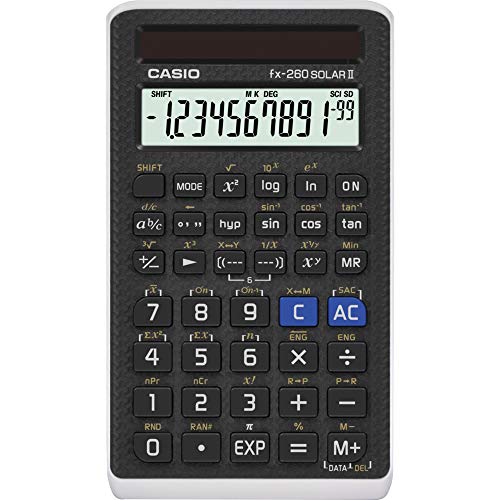
For Pre-Algebra, Algebra, and Geometry, the Texas Instruments TI-34 MultiView and Casio fx-260 Solar II have clearly documented student-focused positioning. The TI-34 emphasizes a four-line display, advanced fractions, previous-entry review, and menus. The fx-260 Solar II takes a more compact approach and lists trigonometric operations, permutations, combinations, factorials, and fraction support.
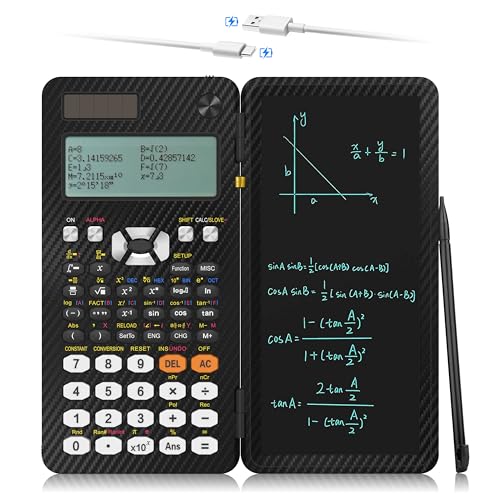
For broader high school or introductory college work, the Texas Instruments TI-30XS MultiView, Texas Instruments TI-36X Pro, Rudnia 552-Function Scientific Calculator, and NEWYES 0402 Scientific Calculator document more extensive workflows. The TI-30XS adds an x-y table, scientific notation output, and a four-line display. The TI-36X Pro adds conversion tools and selectable degree or radian modes. Rudnia lists 552 functions, while NEWYES lists 401.
Consider how much of the expression you can see
Display format affects how easily a student can review an entry. Two-line calculators such as the Texas Instruments TI-30XIIS and NEWYES 0402 show the entry and result together. That is useful for checking a misplaced number without requiring a separate review step.
Four-line designs provide more room for multi-step work. The Texas Instruments TI-30XS MultiView, Texas Instruments TI-34 MultiView, and Rudnia 552-Function Scientific Calculator each document four-line viewing. The TI-30XS also supports textbook-style stacked fractions and symbols, and the TI-34 includes MathPrint formatting. Rudnia’s listing describes a 10+2-digit, textbook-style display.
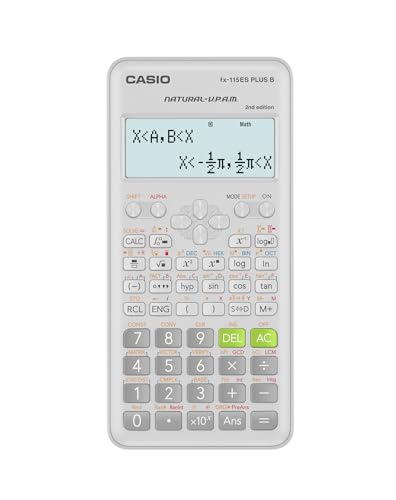
Textbook-style entry is a separate consideration from line count. The Casio FX-9910CW and Casio FX-115ESPLSB-WA-IT specifically document Natural Textbook Display, while the Texas Instruments TI-36X Pro and Texas Instruments TI-30XS describe MathPrint. These formats may be more familiar to students who are learning from printed equations.
Decide whether graphing is actually needed
Most products in this comparison are non-graphing scientific calculators. The CATIGA CS-229 is different: its listing explicitly documents function plotting, graph analysis, and simultaneous graph-and-formula viewing. It also lists complex numbers, statistics, linear regression, standard deviation, and variable solving.
That extra capability can be useful for algebra, calculus, and graph exploration, but it may not be allowed in every classroom or examination. A student should check the relevant syllabus or test policy before choosing a graphing-capable design. If graphing is not required, a non-graphing model may provide a simpler workflow and fewer policy concerns.
Check exam rules before purchase
Exam eligibility should be treated as a separate requirement. The Texas Instruments TI-30XIIS and Texas Instruments TI-34 MultiView listings state approval for SAT, ACT, and AP exams. The other selected listings provide different types of school or course information, but they do not all state approval for a specific test.
Do not infer approval from a calculator’s function count, brand, display type, or student-oriented title. Confirm the current rules for the exact exam and calculator model. Some policies distinguish between scientific and graphing calculators, and policies can change.
Compare power and carrying needs
Dual-power designs can be convenient for classroom and study use. The Texas Instruments TI-30XIIS is listed as solar and battery powered. The Casio fx-260 Solar II uses Solar Plus technology with battery backup. Rudnia and NEWYES also document solar power with battery support. These designs may reduce dependence on a particular lighting condition while preserving a backup power source.
Portability varies substantially. The Casio fx-260 Solar II is specifically described as compact and lightweight, and its listed dimensions are smaller than many alternatives. The Texas Instruments TI-30XIIS, Texas Instruments TI-34 MultiView, and Texas Instruments TI-30XS MultiView provide more display-oriented features but occupy different listed dimensions. A student carrying the calculator daily should compare the supplied measurements with the available pencil case or backpack space.
Protective covers are another practical feature. The NEWYES 0402 includes a dust cover, while the CATIGA CS-229 listing mentions a protective case. The Texas Instruments TI-30XIIS and TI-34 MultiView listings do not provide the same cover detail, so buyers should not assume identical storage protection across models.
How this comparison was scored
The editorial criteria emphasize display and entry clarity, scientific function breadth, student course fit, exam and workflow support, and power and portability. Weights favor function breadth and course fit because those determine whether the calculator can handle the student’s actual work. Display clarity follows closely because expression review is important in multi-step calculations. Exam support and portability complete the comparison.
This is a specification-based ranking using the supplied public listing fields. It is not a hands-on test, and it does not summarize customer opinions. Volatile marketplace information was not used as a published product attribute or scoring criterion.
Final Recommendation
Texas Instruments TI-36X Pro ranks first overall in this specification-based comparison under the published weighted criteria.
The final choice among the best student scientific calculators depends on the documented features that match your intended use.
Texas Instruments TI-36X Pro is the first overall specification-based choice for students who need broad non-graphing scientific coverage. Its MultiView display, MathPrint formatting, conversions, and documented fit from Algebra 1 through calculus make it a versatile option in this selection.
Students in earlier grades may prefer the Texas Instruments TI-34 MultiView for its guided menus and previous-entry review, or the Casio fx-260 Solar II for its compact solar-powered design. The Texas Instruments TI-30XIIS is a clear exam-oriented basic choice because its listing names SAT, ACT, and AP approval.
For display-focused learners, the Texas Instruments TI-30XS MultiView, Casio FX-9910CW, and Casio FX-115ESPLSB-WA-IT emphasize readable textbook-style entry. Rudnia and NEWYES offer broad documented function lists, while CATIGA CS-229 is the choice when graph plotting is specifically needed and permitted. These are the top student scientific calculators here by documented feature fit, not by customer sentiment or hands-on testing.
Frequently Asked Questions
What should students look for in the best student scientific calculators?
Start with the required course functions, display format, exam rules, and power design. Fractions, trigonometry, statistics, regression, complex numbers, conversions, and graphing are not interchangeable requirements. A calculator with a long function list may still be a poor fit if its display or permitted-use status does not match the student’s course.
Which selected calculator is best for middle school math?
The Texas Instruments TI-34 MultiView and Casio fx-260 Solar II are the most clearly documented middle-school-oriented options in this comparison. The TI-34 provides four-line viewing, advanced fractions, MathPrint, menus, and previous-entry review. The fx-260 Solar II emphasizes compact portability and lists Pre-Algebra, Algebra, Geometry, and related subjects.
Are graphing calculators allowed on exams?
Not necessarily. The CATIGA CS-229 explicitly includes graphing functions, but exam and classroom policies vary. Check the current rules for the specific test or course before buying. Do not assume that a student-oriented product title means graphing functions are permitted.
Is a four-line display better than a two-line display?
It depends on the workflow. A four-line display can show more of a multi-step calculation at once, as documented for the Texas Instruments TI-30XS MultiView, Texas Instruments TI-34 MultiView, and Rudnia model. A two-line display can still show the entry and result together, as documented for the Texas Instruments TI-30XIIS and NEWYES 0402, while often keeping the interface straightforward.
Should students choose solar and battery power?
Dual power can be useful when lighting varies or when a student wants a backup power source. The Texas Instruments TI-30XIIS, Casio fx-260 Solar II, Rudnia, and NEWYES listings document solar power with battery support. Buyers should still check the exact battery type and replacement details for the selected model.