Buying Guide
The best study index cards are not defined by one universal feature. A good choice depends on how much you write, whether you separate subjects by color, how often the cards travel, and whether you need loose cards or a system that keeps a deck together. The selected products cover conventional white cards, heavyweight colored stock, bulk classroom packs, and bound formats with rings or perforations.
Choose the card size first
A 3 x 5 card is the dominant format in this comparison. It is small enough for pockets, pencil cases, binders, and backpacks while still leaving room for a definition, formula, vocabulary term, short outline, or question-and-answer pair. Oxford, Amazon Basics, YIZUUN, Nichela, MSKKSM, BGUP, Lovppy, and EHME all document a 3 x 5 size.
The Koogel spiral-bound option is slightly different: its listed dimensions are 4.9 x 3.4 inches. That is close to the familiar index-card footprint, but shoppers who need an exact 3 x 5 fit should favor one of the precisely specified alternatives. The larger Koogel format can still be useful when the main priority is keeping cards grouped in a bound set.
A 4 x 6 option is also documented by Koogel in a separate spiral set, but it is not included in this top 10 because the selected products offer a more directly comparable mix of standard-size cards. Larger cards can hold more detailed outlines, but they take up more room and may be less convenient for rapid review.
Match ruling to your study method
Single-sided ruling is a versatile default. It helps keep definitions, summaries, and lecture notes aligned, while the blank reverse can be used for diagrams, examples, answers, or memory cues. The Amazon Basics white cards, Amazon Basics neon cards, Oxford Heavyweight cards, Nichela, MSKKSM, and BGUP listings document this ruled-front or ruled-one-side approach.
Double-sided ruling makes sense when you plan to fill both surfaces with text. Lovppy specifically describes ruling on both sides, which can be useful for vocabulary lists, language practice, or dense formula decks. Oxford’s 500-card set documents a ruled front and blank back, giving it a more traditional flashcard layout.
Line spacing also matters when handwriting size varies. Clear lines can help keep compact notes legible, but a blank side remains important if your study method uses sketches, charts, or worked examples. Do not assume that every card in this category has the same line spacing; check the listing when that detail affects your writing style.
Paper weight is especially relevant when you use highlighters, gel pens, markers, or cards that will be handled repeatedly. Oxford Heavyweight documents support for chunky markers, gel pens, inks, and highlighters, making it the clearest option for varied writing tools. YIZUUN specifies 180gsm cardstock, EHME specifies 180gsm heavy cardstock, Nichela specifies 160gsm paper, and Koogel specifies 150gsm paper.
BGUP lists 140gsm paper and describes the cards as suitable for pencils, pens, markers, and highlighters. These specifications provide useful signals about construction, but they do not prove that a particular ink will never show through. Paper behavior can vary by pen, pressure, and amount of ink, so treat bleed-through language as listing evidence rather than a hands-on result.
The basic Amazon Basics neon and Oxford 500-card options are still reasonable when color, quantity, or conventional note-taking matters more than a heavyweight specification. Standard stock is often easier to carry in large quantities and may be sufficient for pencil or ordinary pen use.
Use color deliberately
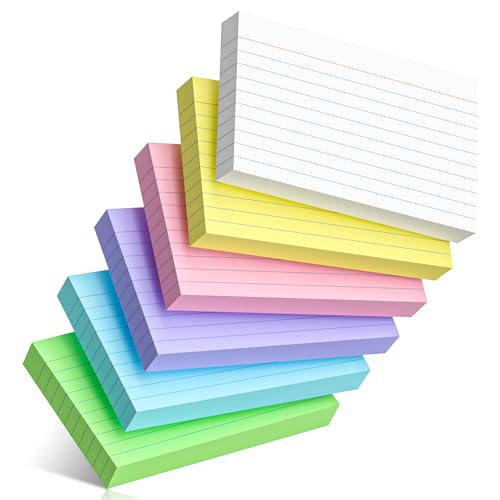
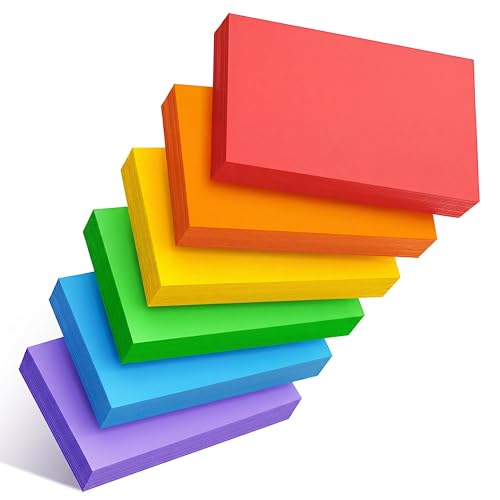
Color can reduce sorting time when each shade has a clear purpose. Assign one color to each course, topic, exam section, or type of prompt. Amazon Basics neon cards use four assorted neon colors, while YIZUUN uses four colors and EHME uses six vintage colors. Nichela documents a multi-color six-pack format, and Lovppy supplies ten different colors.
Bright colors are easy to spot in a backpack or on a desk. Muted or vintage colors may be more comfortable for people who prefer a less vivid visual system. White cards remain the simplest option when you want maximum contrast, consistent printing, or no color-based sorting requirement.
Color is most useful when paired with a repeatable rule. A mixed-color pack without a system can become visually busy rather than organized. If your notes are already separated by folders or digital subjects, white cards may be the more efficient choice.
Loose cards are best when you want to shuffle, remove mastered prompts, or spread a deck across a desk. Traditional white and colored packs in this comparison use that flexible format. They also make it easy to add new cards without reorganizing a bound set.
Ring-bound cards solve a different problem: they keep a collection together during transport. Lovppy includes 11 binder rings with punched cards, while AILZFE documents a key-ring design. These formats are useful for vocabulary or formula sets that you want to carry as a unit. Their trade-off is that flipping, removing, and reshuffling may take more handling than with loose cards.
Koogel’s spiral-bound products add perforated tear lines and protective PVC covers. That design supports a hybrid workflow: keep cards attached while writing, then tear out selected cards for review or filing. The covers may be helpful in a bag, but the bound structure is less minimal than a plain stack.
Buy enough cards, but not more than you can use
Pack size should reflect the length of your course and whether multiple people will share the supply. Oxford’s 100-card pack is suitable for a focused unit or a small set of prompts. YIZUUN offers 200 cards, EHME 216, Nichela and Amazon Basics neon 300, and Oxford’s larger pack 500. These quantities cover a broad range of individual study projects.
Lovppy reaches 1,000 cards, while BGUP provides 2,400 in separate packs. Those larger options make sense for long-term study, several courses, classroom use, or shared household supplies. A large quantity is not automatically more useful if you only need one exam deck; storage and sorting become part of the decision.
Final recommendation
Lovppy 1000 Colored Index Cards with Rings ranks first overall in this specification-based comparison under the published weighted criteria.
The final choice among the best study index cards depends on the documented features that match your intended use.
Oxford Heavyweight Ruled Index Cards 3 x 5 is the highest-scoring returned product and the first overall specification-based choice. Its standard size, heavyweight paper, one-sided ruling, and documented compatibility with several writing tools make it the most balanced option for general studying.
For a ring-organized system, Lovppy is the stronger fit because it combines 1,000 cards, ten colors, double-sided ruling, and included binder rings. Choose YIZUUN, Nichela, or EHME if color coding and heavier stock matter more than binding. Oxford’s 500-card set and BGUP are better aligned with high-volume white-card needs, while Amazon Basics neon is a straightforward choice for bright visual sorting.
Among the top study index cards, the right pick is the one whose physical format matches your review habit. Prioritize a blank reverse for diagrams, double-sided ruling for dense writing, heavier stock for repeated handling, or rings and perforations when keeping a deck together matters most.
Frequently Asked Questions
Are 3 x 5 cards a practical size for studying?
Yes. The 3 x 5 format is compact enough for pockets, binders, and backpacks while providing room for short definitions, formulas, prompts, and answers. It is the documented size for most products in this comparison. A slightly larger or close-format bound card may be preferable for longer outlines, but it will take up more space.
Should study cards be ruled on one side or both sides?
Choose one-sided ruling when you want a traditional question-and-answer layout, diagrams, or answers on a blank reverse. Choose double-sided ruling when you expect to fill both surfaces with writing. Lovppy documents ruling on both sides; Oxford, Amazon Basics, Nichela, MSKKSM, and BGUP document ruled-front or ruled-one-side designs.
Are heavyweight index cards better for markers and gel pens?
They may be a better match because several selected products specifically document heavier paper or support for those tools. Oxford Heavyweight lists markers, gel pens, inks, and highlighters; YIZUUN and EHME specify 180gsm stock; Nichela specifies 160gsm. These details do not replace testing a particular pen, especially if bleed-through is a concern.
Do colored cards improve studying?
Color can help organize subjects, priorities, or prompt types when you assign colors consistently. It is an organizational aid rather than proof of better learning. White cards may be preferable when you want a uniform appearance, maximum contrast, or a simple deck without sorting rules.
What are the best study index cards for carrying around?
For loose cards, a standard 3 x 5 pack is easy to place in a pocket, binder, or backpack. For a deck that should stay together, Lovppy’s ring-bound design or Koogel’s spiral-bound, perforated format offers more structure. The trade-off is that bound cards may be less convenient to shuffle or rearrange than loose cards.