Buying Guide
The best 8-ohm audio component amplifiers are not all designed for the same system. Some are compact two-channel units for bookshelf speakers, while others are monoblocks, rack-installation amplifiers, or four- and six-channel models. The right choice depends on how many speakers you need to drive, how your sources connect, and whether you need expansion features such as bridging, triggers, or a pre-out.
Start with the speaker impedance
An 8-ohm speaker should be matched to an amplifier with documented 8-ohm operation. Several products here state that directly. The Outlaw Audio Model 2220 specifies 200 watts RMS into an 8-ohm load, and the Monoprice Unity specifies 50 watts per channel into 8 ohms or 120 watts when bridged into one 8-ohm load. The OSD Audio Nero HTX-6150 lists 100 watts at 8 ohms across six channels.
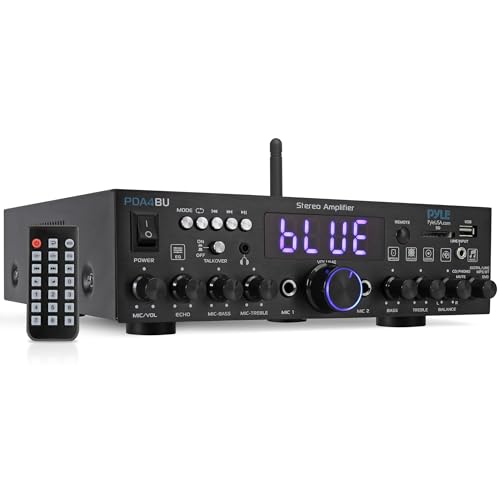
Other listings use a compatibility range. The Fosi Audio V3, AIYIMA A07 Pro, Fosi Audio TB10D, and PROZOR amplifier all describe support that includes 8-ohm passive speakers. That is useful confirmation, but do not automatically compare a maximum 4-ohm figure with an 8-ohm RMS figure. The AIYIMA listing, for example, presents its 300W x2 maximum under a 4-ohm load, while the Pyle PDA4BU gives a specific 8-ohm RMS figure of 20 watts per channel.
Choose the channel layout
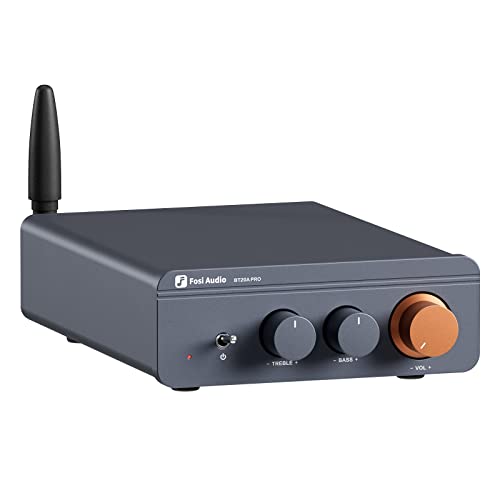
Two-channel amplifiers remain the simplest option for a conventional stereo pair. The Fosi Audio V3, AIYIMA A07 Pro, Fosi Audio BT20A Pro, Fosi Audio TB10D, and Fosi Audio TB10A all use compact stereo formats. These are appropriate when the installation has one left speaker and one right speaker and does not require multiple independent zones.
A monoblock is different: the Outlaw Audio Model 2220 provides one channel. It is a strong fit when a system dedicates one amplifier to each speaker, but a stereo setup generally needs two monoblocks. Multi-channel designs can reduce the number of boxes in a distributed system. The PROZOR has four channels for up to four passive speakers, while the OSD Audio Nero has six channels and documented bridge configurations.
Bridging can increase output for a single load, but it changes how the amplifier must be wired and used. The Monoprice Unity and OSD Audio Nero document bridging options, so they are worth considering for installations that may change over time. Confirm the manufacturer’s wiring instructions before using any bridge mode.
For wireless listening, the AIYIMA A07 Pro, Fosi Audio BT20A Pro, PROZOR, and Pyle PDA4BU list Bluetooth. Bluetooth can simplify a phone- or tablet-based setup, but it does not replace every wired connection. The A07 Pro also has AUX and a 3.5mm line output, while the BT20A Pro focuses on Bluetooth and its amplifier inputs.
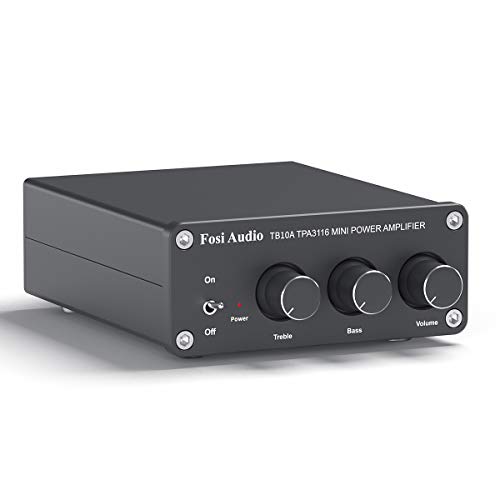
For traditional analog sources, the Fosi Audio TB10D and TB10A provide straightforward wired connections. The Outlaw Audio Model 2220 adds both RCA and balanced XLR inputs, which may be useful in a more advanced signal chain. The Monoprice Unity adds buffered loop output for connecting another amplifier.
The Pyle PDA4BU is the most source-heavy option in this selection. Its documented connections include optical, phono, coaxial, USB/SD, AUX, RCA, Bluetooth, and microphone inputs, plus FM. That makes it especially practical when a system combines older and newer sources or includes karaoke equipment.
Consider tone controls and expansion outputs
Bass and treble controls are documented on the AIYIMA A07 Pro, Fosi Audio BT20A Pro, Fosi Audio TB10D, Fosi Audio TB10A, and Pyle PDA4BU. These controls allow basic adjustment without adding a separate preamp, although they do not replace room correction or a dedicated equalizer.
The Fosi Audio V3, AIYIMA A07 Pro, and AIYIMA A07 Premium provide a pre-out or line-output path for powered equipment or a subwoofer-oriented system. The V3 listing says its pre-out level follows the volume control. The A07 Pro describes a controlled 3.5mm line output. The OSD Audio Nero also documents dedicated bridging and crossover controls for two channels, giving it a stronger role in systems that include passive subwoofers.
Check cooling, protection, and installation details
Compact Class D construction can be helpful where shelf space is limited. The Fosi Audio V3 documents top and bottom vents and a whole-body heatsink. The OSD Audio Nero is fan-cooled, while the Fosi Audio TB10D and TB10A list protection features. The TB10A specifically identifies thermal, overload, short-circuit, and DC protection.
Installation features matter just as much as amplifier output in a permanent system. The Monoprice Unity includes rack-mount ears, trigger input and output, gain adjustment, and thermal and short-circuit protection. The OSD Audio Nero includes a 12V trigger and individual channel LEDs. The PROZOR includes a waterproof mounting box, but its listing recommends a sheltered location with ports facing downward. Treat that placement guidance as part of the installation requirement rather than assuming the enclosure is suitable for unrestricted exposure.
Read power claims carefully
Listing terminology varies. “Maximum,” “RMS,” channel count, impedance, frequency range, and power-supply voltage are not interchangeable. The Outlaw Audio Model 2220 offers the clearest apples-to-apples 8-ohm RMS statement in this group. In contrast, several compact amplifiers advertise higher maximum output at 4 ohms. Those numbers can still be useful for system planning, but they should not be presented as equivalent 8-ohm performance.
Before buying, verify the speaker’s nominal impedance, the amplifier’s stated operating range, and the input type you actually need. Also allow space for ventilation, use the included or specified power supply, and follow any bridging or outdoor-placement instructions.
Final Recommendation
OSD Audio Nero HTX-6150 ranks first overall in this specification-based comparison under the published weighted criteria.
Outlaw Audio Model 2220 is the first overall specification-based choice among these best 8-ohm audio component amplifiers because it provides the clearest high-power 8-ohm RMS rating and both XLR and RCA inputs. It is best for a dedicated single-channel architecture rather than a basic all-in-one stereo setup.
For a multi-room or home theater installation, the OSD Audio Nero HTX-6150 is the more flexible selection because it supplies six channels, bridging options, 8-ohm output documentation, a 12V trigger, and channel monitoring. The Monoprice Unity is a strong rack-oriented alternative with clear stereo and bridged 8-ohm ratings.
Among compact stereo models, the Fosi Audio V3, AIYIMA A07 Pro, and Fosi Audio BT20A Pro cover different priorities: compact power and pre-out flexibility, Bluetooth with tone controls and line output, or wireless tone-adjustable operation. The Fosi Audio TB10D and TB10A keep the design simpler, while the PROZOR is better suited to four-speaker covered outdoor layouts. For the widest mix of legacy, digital, microphone, and wireless sources, the Pyle PDA4BU is one of the top 8-ohm audio component amplifiers to consider, provided its lower documented output fits your speakers.
Frequently Asked Questions
What should I verify before choosing the best 8-ohm audio component amplifiers?
Verify that the listing documents 8-ohm operation or a range that includes 8 ohms, then check whether its power figure is RMS or maximum and which impedance it uses. Also confirm the number of channels, source inputs, ventilation needs, and whether the amplifier is intended for passive speakers.
Is a monoblock suitable for a normal stereo pair?
The Outlaw Audio Model 2220 is a one-channel monoblock. It can suit a stereo system when two units are used, with one amplifier assigned to each speaker. A two-channel amplifier such as the Fosi Audio V3 or Fosi Audio TB10D is simpler when one chassis should power both speakers.
Do I need Bluetooth in an 8-ohm amplifier?
No. Bluetooth is useful for direct phone or tablet streaming, but it is not required for driving 8-ohm passive speakers. The Fosi Audio TB10A and Fosi Audio TB10D illustrate simpler wired approaches, while the AIYIMA A07 Pro, Fosi Audio BT20A Pro, PROZOR, and Pyle PDA4BU add documented wireless connectivity.
When is a multi-channel amplifier a better choice?
A multi-channel model makes sense when you have more than one stereo pair, a distributed audio layout, or a system that may use bridge modes. The OSD Audio Nero has six channels, and the PROZOR has four channels. For a single left-right pair, a two-channel amplifier may be easier to install and manage.
Are the largest advertised wattage numbers directly comparable?
No. The supplied listings use different conditions, including 4-ohm versus 8-ohm loads and maximum versus RMS language. Compare figures only when the impedance, measurement type, channel count, and power-supply conditions match. The Outlaw Audio Model 2220 and Monoprice Unity provide especially clear 8-ohm figures, while several compact models specify larger headline numbers at 4 ohms.