Buying Guide
Choosing among the best 100-inch projector screens starts with the room rather than the diagonal measurement. A 100-inch 16:9 image commonly has a viewing area close to 87 inches wide and 49 inches high, but the case, frame, stand, or mounting hardware can add substantially to the required space. Check the complete product dimensions and leave room for installation, power, seating, and projector placement.
Fixed-frame screens for dedicated rooms
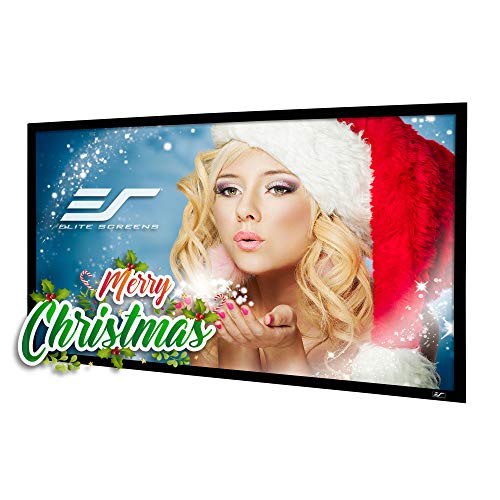
Fixed-frame screens are intended to remain mounted on a wall. The Silver Ticket STR Series uses a heavy-duty aluminum frame wrapped in black velvet, while the Elite Screens SF100HW2 uses a 2.75-inch velvet-finished aluminum frame. These borders can help absorb projector overshoot around the image area, and both products document a flat, assembled frame design.
The Silver Ticket model lists a 1.1-gain white surface and a 160-degree viewing angle. The Elite Screens model lists 1.3-gain CineWhite UHD-B material and a 180-degree viewing angle. The Valerion fixed-frame model also lists 1.3 gain and a 170-degree half-gain viewing angle. A wider stated viewing angle is useful when viewers sit across a broad seating area, but projector placement and room geometry still matter.
Fixed frames are usually the simplest format to evaluate for a permanent cinema wall because the image area stays in one position. They are less suitable when the wall must serve another purpose or when the screen needs to disappear after use. Confirm whether the chosen frame is compatible with the projector’s throw type before installation. The Silver Ticket listing specifically warns that some UST projectors are not compatible with its STR frame, while the Valerion and Elite Screens fixed-frame listings document broader throw compatibility.
Manual pull-down screens
Manual screens retract into a case and can free the wall when projection is finished. The Elite Screens M100H uses a 2-inch interval auto-lock mechanism, allowing different height settings. It also lists a 1.1-gain MaxWhite 2 surface, a 180-degree viewing angle, and a 100-inch 16:9 image area.
This format can work well in a multipurpose room, office, or classroom where a permanent frame would be intrusive. Measure the case height and width, not just the image area. The M100H listing gives an overall size of 62.6 inches high by 93.5 inches wide, which is larger than the viewable image.
Motorized retractable screens
Motorized screens are useful when remote operation and hidden storage are priorities. The Aoxun model includes a radio-frequency remote and wall-mounted control panel, and its listing describes wall or ceiling installation. The YODOLLA model also supports both mounting positions and adds an auto-lock mechanism for variable stopping points.
The Aoxun screen uses a four-layer, black-backed PVC matte surface with 1.2 gain and a 160-degree viewing angle. YODOLLA lists a three-layer PVC matte surface with the same gain and viewing angle. Both require thoughtful cable and control placement, even when the screen itself is retractable. The SilverMagic ALR screen is another motorized option, but its tab-tensioned design is especially relevant when maintaining a flat surface and using a UST projector are central requirements.
Portable screens with stands
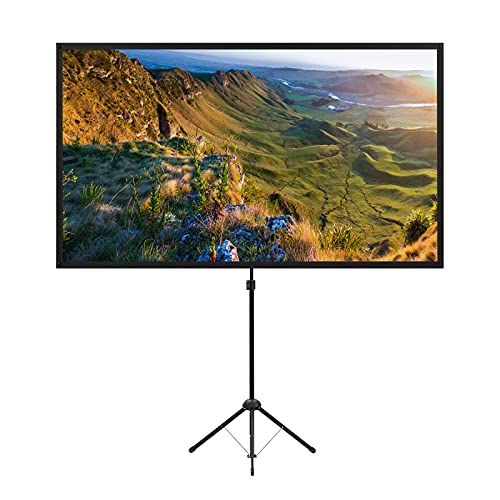
Tripod and stand-based screens are the most flexible for rooms that change function or outdoor viewing. The Vamvo model lists a two-minute tool-free setup, a foldable design, front and rear projection, a 7.28-pound weight, and outdoor grounding accessories. The excelimage model uses four spring-tensioned tubes, a foldable aluminum tripod, and a carry bag.
The HYZ model takes a different approach by supporting both tripod and wall-mounted use. Its stand adjusts from 64 to 85 inches, and the package includes a storage tube and carrying bag. These designs need floor space and a reasonably stable surface. Outdoor users should use the supplied ropes, spikes, or other stabilization accessories as directed by the listing rather than treating a tripod as freestanding in all conditions.
Floor-rising screens
A floor-rising design stores in a case at floor level and rises when needed. LIHONG lists a nano white fiberglass surface, a 178-degree viewing angle, an aluminum case, and a double-point scissor support frame. It also clearly states that the screen is suitable only for standard or long-throw projectors. That limitation should be checked before choosing it for a compact projector positioned close to the screen.
Match gain and surface material to the projector
Gain describes how the listing characterizes reflected brightness relative to a reference surface, but it should not be considered in isolation. The selected models list gains from 1.1 to 1.5, with white, matte-white, PVC, fiberglass, and gray materials represented. A wide viewing angle can support seating spread, while a gray surface such as SilverMagic’s is described as helping contrast under ambient light.
Also check whether the surface is black-backed, wrinkle-free, washable, or tensioned. Black backing is listed on several retractable and portable models and is described as reducing light penetration. Tensioning appears in the Silver Ticket frame, SilverMagic tab system, excelimage tripod, and LIHONG support structure, but the mechanisms differ and should not be treated as interchangeable.
Verify installation measurements
Before ordering, compare the listed viewable area with the overall dimensions. Fixed frames need a clear wall section; retractable products need case clearance and suitable mounting points; stands need floor space; and motorized models need power access. If portability matters, check the listed weight and whether a bag, case, or storage tube is included. Finally, verify the projector’s throw category, aspect ratio, and any front-or-rear projection requirement against the individual listing.
Final Recommendation
Silver Ticket STR Series 100-inch Fixed Frame ranks first overall in this specification-based comparison under the published weighted criteria.
Silver Ticket STR Series is the first overall specification-based choice among the best 100-inch projector screens because it documents a robust fixed-frame design, broad format support, a wide viewing angle, and clear image-area dimensions. The Elite Screens SF100HW2 and Valerion are strong alternatives for fixed installations with their 1.3-gain surfaces and broad stated viewing angles.
For retractable operation, Aoxun and YODOLLA offer motorized wall-or-ceiling formats, while SilverMagic is the specialized pick for a tab-tensioned gray surface and stated UST compatibility. HYZ, Vamvo, and excelimage cover different portable stand needs, from two-in-one mounting to outdoor stabilization. LIHONG is the focused floor-rising choice for standard-throw projectors. Together, these top 100-inch projector screens cover the main installation types without treating one design as suitable for every room.
Frequently Asked Questions
What size image does a 100-inch 16:9 screen provide?
A 100-inch diagonal 16:9 screen typically lists a viewing area close to 87 inches wide by 49 inches high. Exact figures vary slightly by model, and the overall frame, case, or stand will be larger. Elite Screens M100H, Aoxun, YODOLLA, and LIHONG provide examples of published image or product dimensions.
Which of the best 100-inch projector screens works with a UST projector?
Check the individual listing rather than assuming compatibility from the screen format. Valerion, Elite Screens SF100HW2, and SilverMagic document UST support. Silver Ticket STR Series specifically notes that some UST projectors are not compatible with that frame.
Are fixed-frame or retractable screens better for a multipurpose room?
A retractable manual or motorized screen can clear the wall after viewing, making it suitable for rooms used for other activities. A fixed frame stays visible but provides a dedicated, consistently positioned projection surface. The right choice depends on wall use, mounting space, and whether remote operation is important.
Can a portable screen be used outdoors?
Several selected models are listed for outdoor use, including Vamvo, excelimage, HYZ, and LIHONG. Outdoor setups need attention to wind and ground stability. Vamvo lists grounding spikes and wind ropes, while HYZ uses an adjustable aluminum stand. Follow the supplied setup guidance and allow enough space around the stand.
Does a higher gain specification always mean a better screen?
No. Gain should be considered alongside viewing angle, material, projector brightness, seating position, and room lighting. The selected listings show that 1.1-, 1.2-, 1.3-, and 1.5-gain surfaces can appear across different fixed, retractable, and portable designs.