Buying Guide
The best front projector screens should be chosen by matching the screen design to the projector location, viewing environment, and storage plan. A screen for a permanent media room has different requirements from one carried to a backyard or classroom. The products above include fixed motorized, freestanding, folding, and screen-only designs, so compare the complete installation approach rather than the diagonal measurement alone.
Start with the projection direction
Front projection places the projector and audience on the same side of the surface. It is the most familiar arrangement for home theaters, classrooms, and outdoor movie setups. Every selected screen supports front projection, but several also support rear projection. Rear projection can keep the projector behind the screen and out of the audience’s walking area, although it requires enough room behind the material.
The Elite Screens Yard Master 2 DUAL, KODAK dual screen, Akia Screens model, Vamvo 150-inch and 120-inch screens, lejiada, NIERBO, and TOWOND all document dual-direction projection. The AWOL VISION screen also supports front and rear projection. By contrast, YODOLLA documents a motorized front-oriented installation but does not state rear projection support in the supplied listing. Choose dual projection when you may change the room layout; choose a front-only configuration when your installation is already defined.
Compare surface material and gain
Surface construction affects how the screen is intended to distribute projected light. Listed gain values range from 0.8 on the Elite Screens material to 1.6 on the NIERBO canvas. The AWOL VISION screen lists 1.3 dB gain, while YODOLLA lists 1.2 gain and Akia lists 1.1 gain. These numbers should be read as specification descriptors, not as a guarantee of image performance in every room.
The Elite Screens surface is PVC and is described as supporting 4K Ultra HD, HDR, and active 3D. Akia specifies SilkWhite dual material with 4K, 8K, and active 3D readiness. YODOLLA uses a three-layer PVC matte surface. The portable stand models generally use polyester fabric, while NIERBO uses canvas. Fabric screens are convenient to fold, but a tight installation or the supplied tensioning method remains important because folding can introduce creases.
Decide between a stand, frame, or hanging surface
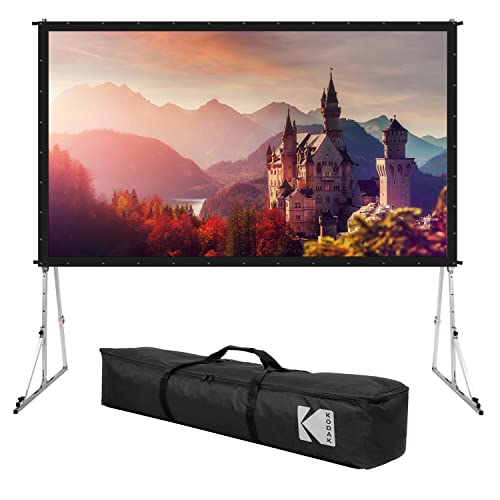
A freestanding screen is usually the most self-contained option. The Elite Screens, AWOL VISION, KODAK, Vamvo, lejiada, and TOWOND products include frame or stand components. These designs are useful when the wall cannot be used or when the screen must move between locations. Check the packed dimensions and weight before selecting one for frequent transport.
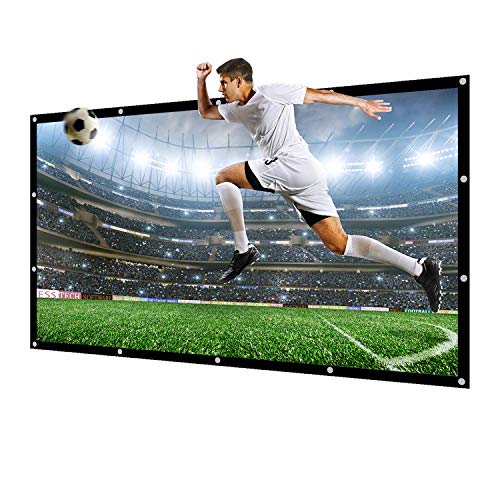
A hanging or screen-only model can be more adaptable when you already have a wall, frame, poles, or other supports. Akia uses metal grommets and rigging cords, while NIERBO lists 16 reinforced eyelets for tensioning. These products can fit unusual locations, but the support structure is part of the installation and is not included as a complete stand kit.
YODOLLA takes the opposite approach with a motorized roll-up enclosure. Its wall- or ceiling-mounted design can keep the screen stored when it is not being used. It needs a suitable mounting surface and power connection, so it is better suited to a defined room than to mobile viewing.
Match size to the room
A larger diagonal is not automatically a better fit. The selected screens range from 120 inches to 180 inches, and the listing measurements show that the surrounding frame or support footprint can be substantially larger than the visible image. Measure the available wall width, floor depth, ceiling height, and audience distance before selecting a format.
The 120-inch models from Elite Screens, Akia, Vamvo, and TOWOND are easier starting points for rooms or yards with limited width. The 150-inch KODAK, Vamvo, lejiada, and YODOLLA designs need more space. AWOL VISION and NIERBO reach 180 inches, making them appropriate only when the installation area can accommodate a very broad surface. Also confirm that the screen’s aspect ratio matches the content you normally show. Several selected models specify 16:9, which suits widescreen movies and many modern presentations.
Plan for outdoor stability
Outdoor screens need more than a fabric surface. Stands, ropes, stakes, and a stable base all affect how the screen can be installed. The Elite Screens Yard Master 2 DUAL includes ground stakes, rigging cord, and support rings. KODAK includes an outdoor stability kit, while the Vamvo models list ground stakes and ropes. The lejiada screen specifically includes windproof ropes and stakes and explains that its large surface can act like a sail.
These components support setup, but they do not remove the need to assess the ground and weather conditions. A 150-inch or 180-inch screen has a much larger exposed area than a 120-inch model. For soft ground, use the supplied securing points as directed; for indoor use, confirm that the tripod or frame has enough clearance around it.
Check storage and maintenance details
Foldable screens are easier to store than rigid installations, but the storage method still matters. AWOL VISION uses rolling packaging with handles. KODAK, Vamvo, lejiada, and TOWOND include carry bags. Akia and NIERBO fold for transport but rely on external supports. The Elite Screens kit also includes a padded carrying bag.
Surface care varies by material. Akia states that its surface can be spot cleaned with water and a soft cotton cloth. AWOL VISION describes cleaning with mild soap and water, while Vamvo lists damp-cloth cleaning and crease treatment. NIERBO says its canvas can be washed and ironed. Follow the supplied material guidance and allow fabric to dry before storage.
Final Recommendation
Elite Screens Yard Master 2 DUAL 120-Inch ranks first overall in this specification-based comparison under the published weighted criteria.
The Elite Screens Yard Master 2 DUAL is the first overall specification-based choice among these best front projector screens because it combines a 120-inch 16:9 format, dual projection, a tensioned aluminum frame, broad format readiness, and included outdoor hardware. It is a particularly complete option when one screen must serve indoor and outdoor locations.
Choose AWOL VISION when a 180-inch format and rolling transport design matter most. KODAK is a strong fit when you want a fast-fold screen with a stand, case, and outdoor kit. For a permanent room, YODOLLA’s motorized wall- or ceiling-mounted design is the clearest match. Akia and NIERBO are better suited to buyers who already have a support structure, while the Vamvo, lejiada, and TOWOND kits provide portable stands for different size and stability needs. Together, these are top front projector screens for distinct installation situations rather than interchangeable products.
Frequently Asked Questions
What are the best front projector screens for outdoor movies?
The Elite Screens Yard Master 2 DUAL, AWOL VISION, KODAK, Vamvo, lejiada, and TOWOND models all document portable designs for indoor or outdoor use. Prioritize a complete stand or frame, carry case, stakes, and ropes. Larger formats need more ground space and more careful securing, especially when exposed to wind.
Is a 120-inch or 150-inch projector screen better?
That depends on the available width and viewing distance. The 120-inch Elite Screens, Akia, Vamvo, and TOWOND models require less space than the 150-inch KODAK, Vamvo, lejiada, and YODOLLA screens. Measure the visible area and the complete frame or stand footprint before choosing.
Can these projector screens use rear projection?
Many can. Elite Screens, AWOL VISION, KODAK, Akia, Vamvo, lejiada, NIERBO, and TOWOND document front and rear projection support. YODOLLA’s supplied listing does not state rear projection support, so treat it as a front-projection installation unless the manufacturer provides different documentation.
Do portable fabric screens need to be stretched?
They may. Akia uses grommets and rigging cords, NIERBO uses reinforced eyelets, and several stand models use frames, straps, or tensioning components. These features are intended to help create a flatter surface, but the exact setup depends on the support design and how the screen was stored.
What should I measure before installing a screen?
Measure wall width, floor depth, ceiling height, projector throw distance, and clearance around the stand or frame. Also account for the screen’s overall dimensions rather than only its diagonal. This is especially important for 150-inch and 180-inch models, whose frames and supports can extend beyond the viewing area.