Buying Guide
The best 115v water pumps are not interchangeable. A pump for an RV pressure system has different priorities from a pump for a flooded basement, irrigation line, or deep well. Start by identifying whether you need demand pressure, water transfer, or submersible well service. Then compare the listed flow, pressure or lift, control method, installation requirements, and protection features.
Match the pump design to the job
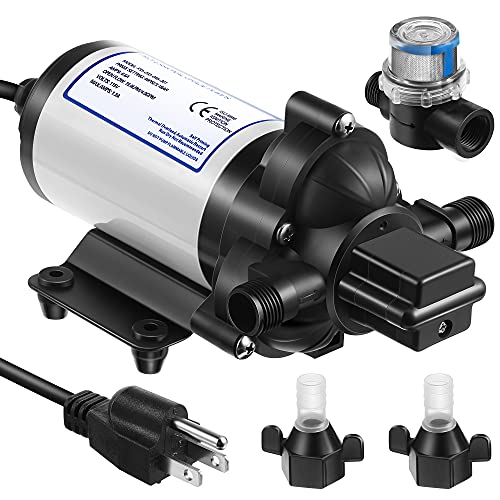
Diaphragm demand pumps are the main choice for pressurized plumbing. The SEAFLO 55 Series, KENCIT T33, WASSERMANN pump, and Dreyoo pump all use automatic pressure-switch operation or describe automatic start-stop behavior. These designs start when a faucet or discharge valve opens and stop when it closes. They suit RVs, boats, kitchens, bathrooms, garden systems, and similar installations where water pressure is needed on demand.
The SEAFLO 33 Series is different because it combines a diaphragm pump with a 0.2-gallon accumulator tank. That tank is designed to maintain pressure and reduce cycling. It can be useful where frequent starts are undesirable, but the assembled system needs more room than a standalone pump.
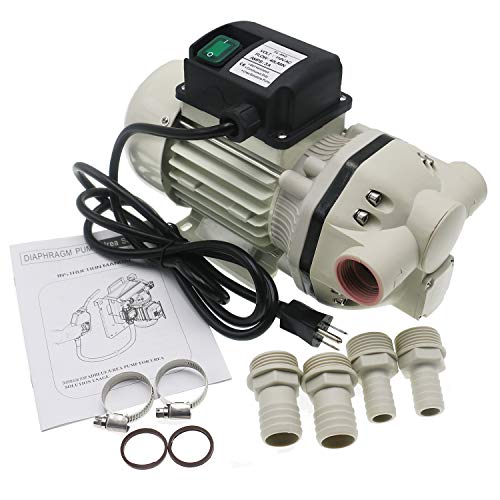
Transfer pumps are intended for moving water from one place to another, not for supplying a pressurized fixture network. The TecHome and VEVOR 360 GPH models are portable, non-submersible utility pumps with suction accessories. They are better suited to aquariums, pools, rain barrels, flooded areas, and garden transfer. The VEVOR listing specifically limits continuous operation to 30 minutes and requires cooling afterward.
For a well casing, use a purpose-built submersible model. The VEVOR deep-well pump is listed for four-inch-or-larger casings and documents a 207-foot maximum head. Its long body and submersible construction make it unsuitable as a general portable pump, but those same features fit a deep-water installation.
Compare flow, pressure, and lift
Flow describes how much water a pump can move, while pressure or head describes the resistance and elevation it can overcome. The SEAFLO 55 Series lists 5.0 GPM and 60 PSI shut-off pressure, making it the most specification-aligned match for multiple fixtures in this comparison. The NC Pump-540B lists 10.6 GPM but only 23 PSI, so its specification profile points more toward high-volume irrigation and spraying than high-pressure domestic boosting.
For RV and marine plumbing, 4.0 GPM at 45 PSI appears repeatedly among the selected products. KENCIT, WASSERMANN, and Dreyoo sit in this group. Their differences are more about self-priming height, protection, included fittings, and application details than headline flow. The SEAFLO 33 Series lists 3.3 GPM and a 35-to-45 PSI operating range, with the accumulator providing a different pressure-management approach.
Transfer pumps use different measurements. TecHome is rated at 330 GPH, while the VEVOR transfer pump lists 360 GPH. Both also provide head or lift figures. Do not compare those gallons-per-hour numbers directly with GPM without converting units, and remember that maximum figures may vary with hose length, elevation, fittings, and water conditions.
Check controls and priming requirements
Automatic pressure switches are convenient for fixture-based systems, but the NC Pump-540B explicitly lacks one and requires manual power control. Transfer pumps also use manual operation. The TecHome has an on/off switch, while the VEVOR transfer pump requires priming before use and must not run dry.
Self-priming height is especially important when the pump sits above the tank or water source. KENCIT documents up to 9.8 feet, and the VEVOR submersible pump avoids a suction-lift issue by operating in the well. The SEAFLO models list self-priming up to 6 feet. If the listing does not provide a priming height, measure the proposed installation carefully instead of assuming that every self-priming pump has the same reach.
Review protection and construction
Run-dry and thermal protection can matter in systems where the water supply may be interrupted. SEAFLO 55, SEAFLO 33, KENCIT, and Dreyoo document run-dry capability or protection. The VEVOR well pump lists overheat protection, while the VEVOR transfer pump gives a specific short-time duty limit. These are not equivalent features: a run-dry claim does not mean a portable transfer pump can operate without water, and a duty-cycle limit should be followed.
Construction details also vary. SEAFLO 55 lists corrosion-resistant materials for marine exposure, the accumulator system lists corrosion-resistant EPDM valves and a Santoprene diaphragm, and the VEVOR well pump uses stainless steel with IP68 waterproofing. Dreyoo lists an aluminum mounting base, while the portable transfer pumps use metal or aluminum-alloy bodies. Select materials according to water type and installation environment rather than appearance.
Plan the connections and available space
Verify voltage, outlet access, hose or pipe size, mounting orientation, and clearance before ordering. SEAFLO lists 1/2-inch MNPT connections, while WASSERMANN and Dreyoo include fittings or strainers. The portable transfer pumps use garden-hose-style connections and include suction accessories. The VEVOR well pump uses a 1-1/4-inch NPT discharge and requires a compatible casing.
Also consider size and portability. A compact diaphragm pump can fit a service compartment, while the SEAFLO accumulator system is taller because of its tank. The Grundfos SCALA2 is an all-in-one domestic booster with a control panel, but its 22-pound weight and larger dimensions make it a fixed installation rather than a carry-around utility pump.
Final Recommendation
SEAFLO 55 Series 115V AC Automatic Demand Pump ranks first overall in this specification-based comparison under the published weighted criteria.
SEAFLO 55 Series 115V AC Automatic Demand Pump is the highest-scoring first overall specification-based choice among the best 115v water pumps listed here. Its 5.0 GPM flow, 60 PSI shut-off pressure, four-fixture support, potable-water testing, self-priming, and protection features give it the most complete profile for demanding RV, marine, and off-grid freshwater distribution.
Choose the Grundfos SCALA2 when domestic pressure boosting and integrated controls matter most. Choose the VEVOR deep-well model for a compatible deep-well installation, or the NC Pump-540B when high listed flow is more important than automatic control. For portable drainage, the VEVOR 360 GPH pump has the most specification-aligned listed transfer figures, while TecHome is a practical low-suction option.
Among the top 115v water pumps, the SEAFLO 33 Series is the most distinctive choice for reducing cycling because its accumulator tank is included. KENCIT, WASSERMANN, and Dreyoo are sensible 4.0 GPM diaphragm alternatives, with differences in priming, accessories, and protection. Confirm the required duty cycle and connection arrangement before selecting any pump.
Frequently Asked Questions
What should I check before buying the best 115v water pumps?
Confirm that the pump is intended for your water source and application, then check the listed 115V requirement, flow, pressure or head, suction lift, connection size, control method, and duty limitations. Also verify whether the unit is designed for clean water, potable water, irrigation, or a well installation.
Is a 4.0 GPM diaphragm pump suitable for an RV?
A 4.0 GPM pump can be suitable for an RV when its 115V supply, 45 PSI setting, connection arrangement, and installation space match the system. KENCIT, WASSERMANN, and Dreyoo each list RV applications, but their documented features differ, so compare priming and protection details as well as flow.
Do transfer pumps work like automatic pressure pumps?
No. TecHome and the VEVOR 360 GPH model are portable transfer pumps with manual operation and suction accessories. They are intended to move clean water for drainage or transfer. Automatic diaphragm pumps such as SEAFLO 55 use pressure-switch control for fixture-based water delivery.
When should I choose a submersible well pump?
Choose a submersible well pump when the installation involves a compatible well casing and requires water to be lifted from depth. The VEVOR deep-well model is listed for four-inch-or-larger casings, 115V power, 37 GPM maximum flow, and 207 feet of maximum head. It is not a substitute for a portable transfer pump.
Why does an accumulator tank matter?
An accumulator stores a small amount of pressurized water between demand events. The SEAFLO 33 Series lists a 0.2-gallon tank designed to reduce cycling, support steadier flow, and quiet operation. It adds installation bulk, but may be useful in an RV, marine, home, or off-grid pressure system where repeated starts are a concern.