Buying Guide
The best high-performance electric fuel pumps should be matched to the whole fuel system, not selected by a flow number alone. Start with the engine’s fuel type, injection method, required pressure, voltage, tank or frame location, and available plumbing. The listings in this comparison cover different designs: high-pressure in-tank pumps, external inline pumps, and low-pressure pumps intended for carbureted engines.
Match the pump to EFI or carburetion
EFI systems generally require substantially more pressure than carburetors, so a low-pressure pump such as the Holley 12-801-1 RED is not a direct substitute for a 255 or 340 LPH in-tank EFI upgrade. Holley lists a 7 psi maximum, while the EVIL ENERGY 255 LPH in-tank pump lists operation from 15 to 90 psi. The Holley is therefore a sensible choice only when the carbureted system, regulator, and fuel demand match its published range.
For carbureted applications, the Xyarna 110 GPH pump also deserves attention because its listing includes a regulator and mounting bracket. However, its pressure range is not supplied, so confirm that detail before installation. Flow and pressure are related but not interchangeable specifications: a pump’s free-flow figure does not show how much fuel it delivers at the pressure your engine requires.
Compare flow at operating pressure
A pump rated at 300 or 340 LPH may not deliver that amount at high pressure. The EVIL ENERGY 300 LPH kit gives several useful reference points: 200 LPH at 75 psi, 255 LPH at 43 psi, and 300 LPH at 43 psi and 13.5V. CarBole provides a similar set of figures, while the EVIL ENERGY 255 LPH in-tank model lists 255 LPH at 43 psi and 190 LPH at 80 psi.
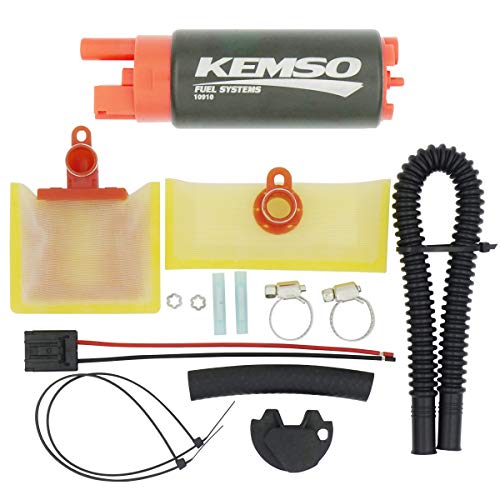
These figures are more useful than a maximum-flow label because they show how output changes with pressure and voltage. The DTMAP pump lists 340 LPH at 13.5V and a 43–90 psi range. KEMSO lists a 340LPH class and a 125.8 psi bypass-valve setting, but the final system still depends on the regulator, lines, injectors, voltage supply, and fuel type. Avoid treating any published horsepower claim as a universal guarantee.
Choose in-tank or external installation
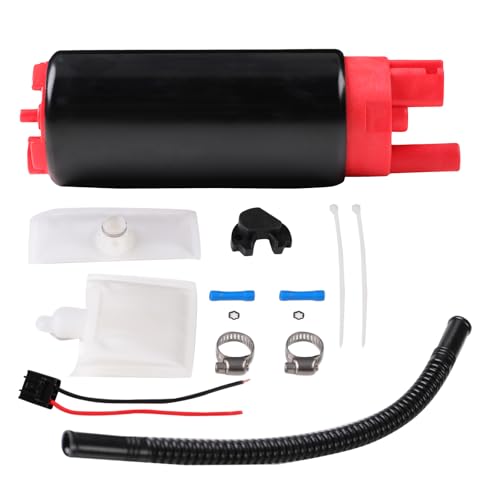
In-tank pumps such as the DTMAP, KEMSO, EVIL ENERGY 255 LPH, and Achilioson models use the tank environment as part of the installation. The DTMAP listing specifically describes in-tank cooling and a GSS342-style fitment. Achilioson also targets GSS342-style applications. Before ordering, compare pump diameter, inlet direction, outlet connection, wiring plug, hanger dimensions, and hose requirements with the existing module.
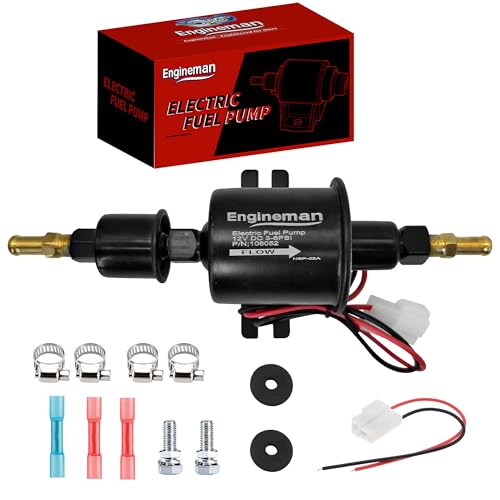
External inline pumps mount outside the tank and can be useful for custom fuel systems, swaps, or frame-mounted layouts. The EVIL ENERGY 300 LPH kit and CarBole pump both recommend mounting below the tank so fuel can gravity-feed the pump. That placement, along with a pre-filter where specified, should be considered part of the installation plan. External pumps also require secure brackets, protected wiring, suitable hose, and leak testing.
Verify fuel compatibility
Fuel compatibility is one of the clearest differences among the candidates. Aeromotive documents gasoline and E85 use for both EFI and carbureted applications. KEMSO also lists gasoline or E85. The EVIL ENERGY 300 LPH kit documents gasoline, diesel, E85, ethanol, and more. By contrast, the EVIL ENERGY in-tank and external 255 LPH pumps are gasoline-only, while DTMAP and Achilioson are also listed for gasoline-only use.
CarBole documents gasoline and diesel compatibility but does not recommend alcohol or E85 fuels. The Holley and Xyarna listings do not provide enough fuel-type detail to assume compatibility with E85 or diesel. Use the manufacturer’s stated fuel range as the boundary, and confirm seals, hoses, filters, and tank materials for the chosen fuel.
Plan the electrical and plumbing requirements
All selected products are electric 12V designs or are described for 12V systems, but current draw and wiring requirements still vary. Holley lists a 2-amp motor draw and recommends a relay kit with a 7.5-amp fuse. Xyarna makes the same relay-kit and fuse recommendation. The wiring should be sized and protected for the actual pump load, with sound grounds and connections.
Plumbing is equally important. Aeromotive uses ORB-10 ports, CarBole lists 10AN inlet and 6AN outlet connections, and the EVIL ENERGY kit includes 6AN PTFE line and aluminum fittings. These are not automatically interchangeable with factory hoses. Confirm adapter sizes, flow direction, filter placement, regulator location, and return-line needs before selecting a pump.
Consider the complete system demand
A larger pump is not automatically better. The correct choice depends on injector size, engine power, forced-induction level, fuel pressure, voltage under load, line size, regulator capacity, and whether the system is return-style or returnless. Aeromotive provides detailed engine-support ranges in the supplied evidence, while the DTMAP, KEMSO, and Achilioson listings emphasize high-flow performance but require system-level verification.
The top high-performance electric fuel pumps in this comparison are best treated as documented starting points. Check the vehicle or hanger fitment, then confirm pressure-at-flow data and fuel compatibility. Professional installation is especially appropriate for in-tank work, high-pressure EFI systems, and any modification that requires fuel-line or wiring changes.
Final Recommendation
EVIL ENERGY 300 LPH External Kit ranks first overall in this specification-based comparison under the published weighted criteria.
The final choice among the best high-performance electric fuel pumps depends on the documented features that match your intended use.
Aeromotive A1000 11101 is the highest-scoring returned product and the first overall specification-based choice. Its documented support for EFI and carbureted systems, gasoline and E85 compatibility, and broad engine-application ranges give it a strong specification profile, provided the required regulator and ORB-10 plumbing are handled correctly.
For a more complete external installation package, the EVIL ENERGY 300 LPH kit includes PTFE line and fittings, while CarBole offers detailed flow data and several connection components. The DTMAP and KEMSO 340LPH pumps are starting points for high-output in-tank gasoline builds, and the EVIL ENERGY 255 LPH in-tank pump is a focused option when its dimensions and gasoline-only limitation fit the vehicle.
Among the top high-performance electric fuel pumps for carbureted systems, Holley and Xyarna are targeted choices because their listings emphasize low-pressure operation and carbureted use. Choose between them only after confirming the required pressure, regulator arrangement, relay, fuse, and flow demand.
Frequently Asked Questions
Compare flow at the intended fuel pressure, not only the pump’s maximum or free-flow rating. Then verify voltage, fuel type, injector demand, regulator capacity, wiring, and physical fitment. The DTMAP, EVIL ENERGY 255 LPH, KEMSO, and Achilioson listings all require some form of fitment or system verification.
Are external inline pumps better than in-tank pumps?
Neither format is universally better. External pumps can suit custom frame-mounted systems and may include useful plumbing hardware, as seen with CarBole and the EVIL ENERGY 300 LPH kit. In-tank pumps can fit factory-style hangers and may use surrounding fuel for cooling, as described for DTMAP. Choose the format your tank, hanger, plumbing, and installation plan support.
Can a 340 LPH pump be used with any fuel?
No. Fuel compatibility is product-specific. KEMSO lists gasoline and E85, while DTMAP and Achilioson list gasoline-only use. A high flow rating does not establish compatibility with diesel, ethanol, or methanol. Confirm the listing and the suitability of the connected hose, seals, filter, and regulator.
Do I need a regulator with an electric fuel pump?
The answer depends on the fuel-system design and the pump. Aeromotive specifically notes that pressure control requires a compatible regulator, which is not included. Xyarna’s package is described as including a regulator. Confirm whether the vehicle uses a return-style or returnless system and follow the pump and regulator requirements before installation.
Why does flow decrease at higher pressure?
Electric fuel pumps commonly deliver less volume as operating pressure rises. The supplied listings demonstrate this directly: EVIL ENERGY lists 255 LPH at 43 psi but 190 LPH at 80 psi, while its external kit lists 200 LPH at 75 psi and 300 LPH at lower pressure. Use pressure-specific figures whenever they are provided instead of relying on the headline flow number.