Buying Guide
The best adjustable neutral density camera lens filters should be compared by the control they provide, not simply by the darkest number printed on the frame. Variable ND filters use a rotating design to reduce incoming light across a range, letting a photographer or filmmaker keep a preferred aperture or shutter speed as outdoor brightness changes. The candidates here include standard variable ND designs, lever-controlled models, and hybrid filters that add circular polarization.
Start with the lens thread size
Filter diameter is the first compatibility check. A filter marked 58mm is intended for a lens with a 58mm front filter thread; it is not a universal 58mm accessory for every lens. The selected products cover 67mm, 72mm, 77mm, 95mm, and other sizes, so read the number beside the diameter symbol on the lens barrel or beneath its cap.
Some models document a larger front accessory size. The K&F CONCEPT 72mm Nano-X model requires a 77mm lens cap, while the K&F CONCEPT 95mm model requires a 105mm cap. Several 58mm options use a 62mm front size. These details matter when fitting a cap, hood, or other front-mounted accessory.
Match the density range to the scene
A 1-to-5-stop filter, such as the K&F CONCEPT 67mm Variable ND2-32 and CPL, is designed for moderate reduction and adds polarization. That range can be useful when you need to manage reflections while making a smaller exposure change. The Haida 72mm VND+CPL extends from 3 to 7 stops, placing it between moderate and strong control.
For a broader general-purpose range, look at models that reach 8 or 9 stops. The NEEWER 58mm True Colors model covers approximately 1 to 8.6 stops, while the NEEWER 58mm ND2-400 and Tiffen 77mm options document 1-to-9 and 2-to-8-stop ranges respectively. These ranges can support wider apertures in bright conditions or slower shutter speeds for moving subjects.
The K&F CONCEPT 58mm Variable ND2-2000 and NEEWER 77mm Variable ND8-2000 reach 11 stops. Such ranges provide more substantial light reduction, but the NEEWER model starts at ND8 rather than ND2. The 7artisans dual-range design separates 2-to-5 and 6-to-9 stops, which may make the intended range easier to identify during setup.
Check adjustment control
Marked positions help you return to a similar setting. The NEEWER 77mm and NEEWER 58mm True Colors models document hard stops, which limit rotation at the ends and give the ring defined boundaries. The Tiffen 77mm uses a rotating ring for continuous selection across its stated range.
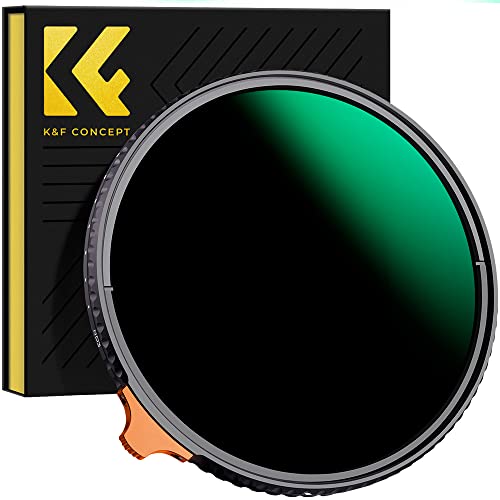
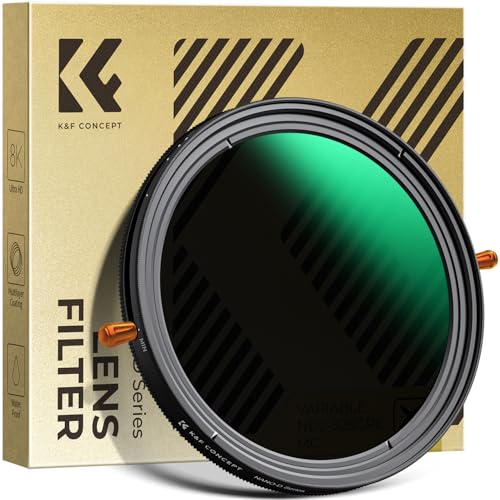
Lever or pusher designs provide a separate grip point. The K&F CONCEPT 72mm Nano-X and K&F CONCEPT 95mm models use a putter-style control, and the K&F CONCEPT 67mm hybrid uses a pusher. The 7artisans model uses a metal twist handle. These controls can be especially relevant for video work where a small, deliberate adjustment is preferable to gripping the filter’s outer ring.
Consider hybrid functions carefully
A variable ND and CPL combination can reduce the number of filters you carry while adding control over reflections from water, glass, and foliage. The K&F CONCEPT 67mm and Haida 72mm models document this combined design. The NEEWER 43mm model also combines ND2-ND32 control with CPL functionality, although it is not included in this final selection because the ten selected products provide broader overall specification coverage.
Polarization is not the same as neutral density. A CPL changes the appearance of reflections and can affect sky contrast depending on the angle to the sun; the ND function controls the amount of light. Choose a hybrid filter when both effects are relevant, rather than assuming the CPL replaces a wider-density variable ND.
Review glass and coating details
Optical glass and surface treatments are recurring differentiators in this category. The selected listings identify AGC optical glass for several K&F CONCEPT models, B270 optical glass for 7artisans, ColorCore glass for Tiffen, and HD optical glass for NEEWER. Coating descriptions include antireflection, hydrophobic, oil-proof, water-repellent, dustproof, fingerprint-resistant, and scratch-resistant layers.
These descriptions indicate construction and maintenance features; they do not replace a hands-on optical test. A coated surface may be easier to maintain, while antireflection layers are intended to reduce reflections. Keep the wording in perspective and use the documented glass and coating information as one part of the comparison.
Understand variable-ND limitations
Several listings warn that a dark X pattern, cross mark, or similar artifact may occur at high density settings. The NEEWER 77mm, NEEWER 58mm ND2-400, K&F CONCEPT 58mm ND2-2000, and other models connect this possibility with the interaction between the variable filter and particular lenses, apertures, or focal lengths. The NEEWER 58mm listing advises reducing the ND level if the pattern appears.
A variable filter is also not identical to a fixed ND filter. The NEEWER 58mm ND2-400 listing specifically points users seeking substantial long-exposure reduction toward fixed ND64 or ND1000 filters. If your workflow repeatedly needs one exact density, a fixed filter may be more predictable; if conditions change frequently, variable adjustment is the defining convenience.
Choose the frame for your lens
Slim frames can help manage clearance and vignetting, particularly with wider lenses. The K&F CONCEPT 58mm, K&F CONCEPT 72mm, and K&F CONCEPT 95mm models document 7.4mm frames, while the 7artisans model lists 9.4mm thickness and describes use on a 16mm full-frame lens. The NEEWER 58mm ND2-400 uses a wider 62mm front frame intended to prevent dark corners.
These are product-listing claims rather than independent measurements. Actual results can vary with lens design, focal length, stacking, and the way the filter is mounted. Avoid stacking extra front filters when a listing warns about vignetting or a cross pattern, and verify the lens thread before ordering.
How this comparison was made
This is a specification-based comparison using the supplied public listing data, not a hands-on test and not a summary of customer opinions. Products were evaluated on adjustable light range, adjustment control, optical glass and coatings, frame design, and compatibility clarity. Every selected product is an independently grouped parent product, and no two returned entries share a non-empty parent group.
Final Recommendation
NEEWER 77mm True Color Variable ND8-2000 ranks first overall in this specification-based comparison under the published weighted criteria.
NEEWER 77mm True Color Variable ND8-2000 is the first overall specification-based choice among the best adjustable neutral density camera lens filters. Its 3-to-11-stop range, marked hard stops, multicoated glass, and slim frame give it the broadest documented combination of exposure control and adjustment structure in this selection.
For 58mm lenses, K&F CONCEPT 58mm Variable ND2-2000 is the more expansive range option, while NEEWER 58mm True Colors Variable ND2-ND400 emphasizes hard-stop control. The K&F CONCEPT 72mm Nano-X and K&F CONCEPT 95mm models stand out for putter-style adjustment, and Tiffen 77mm remains a straightforward choice for a conventional rotating-ring design.
If reflection control is central to the scene, compare the top adjustable neutral density camera lens filters with hybrid options such as the K&F CONCEPT 67mm Variable ND2-32 and CPL or Haida 72mm VND+CPL. For a two-range layout, the 7artisans True Color VND provides separate moderate and strong adjustment sections. Always confirm the thread diameter, front-cap requirement, and the stated density range before selecting a filter.
Frequently Asked Questions
What are the best adjustable neutral density camera lens filters for video?
The NEEWER 77mm, K&F CONCEPT 72mm Nano-X, and K&F CONCEPT 95mm models document marked or lever-style controls that can help with deliberate adjustments. The Tiffen 77mm uses a rotating ring and is also explicitly described for video. Choose based on your lens thread and the density range needed for the scene.
Can a variable ND filter create an X pattern?
Yes. Several supplied listings explain that a dark X pattern or cross can appear at high settings on certain lens and focal-length combinations. The effect is associated with the operating principle of variable filters. Reducing the ND setting may help, and checking the image while adjusting is advisable.
Should I choose a hybrid ND and CPL filter?
Choose a hybrid when you need both light reduction and control over reflections from nonmetallic surfaces. The K&F CONCEPT 67mm and Haida 72mm products document both functions. A hybrid has a narrower ND range than some full-range filters, so compare the stated stops with your intended use.
How do I know which filter size fits my camera lens?
Read the diameter number beside the symbol on the lens barrel or beneath the lens cap. A 72mm lens thread requires a 72mm filter, while a 77mm lens thread requires a 77mm filter. Also check the front accessory size because some selected filters require a larger lens cap than their mounting thread.