Buying Guide
Choosing among the best variable neutral density filters for camera lenses starts with matching the filter’s thread size and density range to the way you shoot. A VND uses a rotating optical assembly to reduce incoming light without changing filters. That can help maintain a chosen shutter speed for video or permit a wider aperture in bright conditions. The useful range is not the only consideration: adjustment stops, optical glass, coatings, frame thickness, and warnings about X patterns or vignetting all affect how practical a listing may be.
Confirm the lens thread size
A filter size refers to the diameter of the lens’s front filter thread, not the focal length. The selected products cover 55mm, 58mm, 62mm, 67mm, 72mm, 77mm, and 82mm threads. Read the diameter marking beside the circle symbol on the lens barrel or beneath the lens cap. A 67mm filter will not directly fit a 62mm thread without an appropriate step ring, and the supplied listings do not include a universal mounting solution.
Front accessory sizing can differ from the lens thread. The Hoya 62mm model accepts a 67mm cap, while the K&F CONCEPT 72mm and 58mm models specify 77mm and 62mm caps respectively. The PolarPro 82mm listing says a custom lens cap is included but that lens hoods and standard lens caps do not work with it. These details matter when the filter remains mounted between shoots.
Match density to the intended shot
The stop range describes how much light the filter is designed to remove. Lower ranges such as 1-5 stops, documented by the K&F CONCEPT 58mm and 67mm models, are suited to moderate exposure changes, wider apertures, and video shutter control in changing light. A 2-5-stop range, as found on the PolarPro filter, is similarly focused but adds a cinema-oriented hard-stop system.
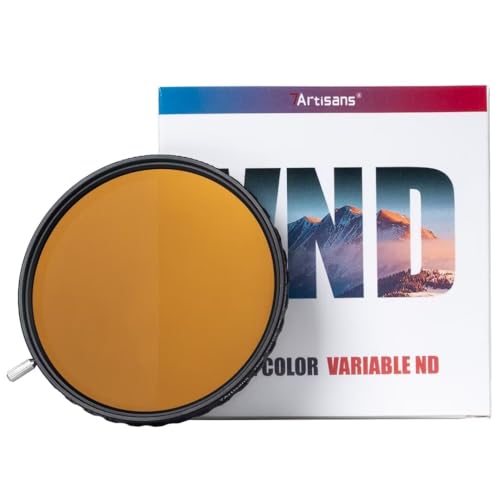
Midrange options extend farther. Hoya covers 1.5-9 stops, while the Tiffen model covers 2-8 stops. The 7artisans options divide the use case: one is limited to 2-5 stops and the other concentrates on 6-9 stops. This split can be easier to interpret than one extremely broad dial if your shooting conditions usually fall into one part of the range.
For stronger daylight reduction, the NEEWER 77mm reaches 3-11 stops, and the K&F CONCEPT 72mm reaches 1.5-10 stops. The NEEWER 67mm system uses a 1-5-stop VND with a magnetic ND32 stage, extending the documented system range to 6-9 stops. A broad range gives flexibility, but it also makes the manufacturer’s artifact warnings and stop-control design more important.
Look for hard stops and useful markings
A rotating ring is the basic control, but markings and physical limits make repeatable adjustments easier. PolarPro documents haptic hard stops, while NEEWER’s 58mm True Colors model specifies hard stops at both ends of a 1-8.6-stop range. The NEEWER 77mm model uses marked settings and limited hard stops. K&F CONCEPT’s 58mm and 67mm filters document self-locking or hard-stop designs, and its 72mm filter marks each stop from ND3 to ND1000.
By contrast, the Tiffen listing describes a smooth rotating ring without supplied hard-stop detail. That does not establish poor operation; it simply means the provided evidence offers less information about physical end points. If you change exposure while recording video, haptic limits or a pusher can be particularly useful because they provide a more deliberate adjustment interface.
Evaluate glass and coatings
Optical glass and coating descriptions help distinguish the construction documented in each listing. PolarPro specifies cinema-grade quartz glass and 16 layers of coating. Hoya identifies multi-coated optical glass, while Tiffen identifies ColorCore glass technology. Several K&F CONCEPT models specify AGC glass and multi-layer coatings, including 28 layers on the 72mm and 67mm selections. NEEWER’s selected products describe high-definition or multi-coated glass and nano-coating systems.
Coatings are described as reducing reflections or helping resist water, oil, dust, fingerprints, and scratches. These are construction features, not proof of a particular image result in every camera or lighting setup. A filter with more coating layers should not be treated as automatically suitable for every lens; thread fit, density range, and artifact limits remain essential.
Check X-pattern and vignetting notes
Variable filters can show uneven darkening or a cross-shaped pattern near the end of their adjustment range. The supplied evidence handles this in different ways. PolarPro documents a hard-stop system intended to eliminate cross-polarization and vignetting and states zero vignetting down to 16mm. The 7artisans selections claim no dark corner or X cross through a 16mm full-frame lens. K&F CONCEPT’s 58mm and 67mm models claim no X cross, while its 72mm model supports 16mm use but includes a lens- and focal-length-dependent caution.
The NEEWER 77mm listing warns that a dark X pattern may appear at maximum aperture. This is useful selection information, not necessarily a reason to reject the filter. You can choose a model with a narrower operating range, stop back from the maximum setting, or treat the upper end as conditional.
Consider single-purpose versus combination designs
A plain VND focuses on light reduction. A combination model can add another function. The PolarPro 82mm filter offers optional mist diffusion, and the K&F CONCEPT 55mm and 67mm models combine variable density with a circular polarizer. The selected 67mm K&F model is documented for reducing reflections from water and glass and for changing sky contrast, in addition to its 1-5-stop range.
Combination filters may simplify a kit, but the added function changes how the filter is used. If you need neutral density without a polarizing effect, a dedicated VND is more direct. If reflections and sky contrast are part of the shot, the integrated polarizer may be relevant. Always distinguish a documented design feature from a performance conclusion.
Final Recommendation
NEEWER HD True Colors VND 67mm ranks first overall in this specification-based comparison under the published weighted criteria.
PolarPro Peter McKinnon Mist VND 82mm is the first overall specification-based choice among these selections for its hard-stop system, quartz glass, 16-layer coatings, and stated wide-angle artifact control. It is especially well documented for video workflows, although its cap and hood limitations deserve attention.
The best variable neutral density filters for camera lenses are not interchangeable across every setup. Choose Hoya Variable Density II 62mm for a thin frame and adjustment knob, NEEWER HD True Colors VND 67mm for a staged 1-9-stop system, or the 7artisans 67mm models when your needs clearly fall into either the 2-5-stop or 6-9-stop segment. K&F CONCEPT’s 58mm and 67mm combination designs add polarizing functionality, while the 72mm model provides a broad range in a slim frame.
Among the top variable neutral density filters for camera lenses, the NEEWER 77mm stands out for its documented 3-11-stop span, and Tiffen remains a straightforward 2-8-stop option with ColorCore glass. Before selecting any model, verify the lens thread, review the maximum-density warning, and check whether the front cap or hood requirement fits your camera system.
Frequently Asked Questions
What are the best variable neutral density filters for camera lenses for video?
PolarPro Peter McKinnon Mist VND 82mm is the most video-focused selection because its listing documents haptic hard stops, precise exposure control, and a 2-5-stop range. Tiffen Variable ND 77mm is also explicitly positioned for filmmaking and uses a rotating ring across 2-8 stops. The right choice still depends on the lens thread and whether the additional mist function is wanted.
How do I choose the correct VND size?
Check the diameter marking on the front of the lens, usually shown beside a circle symbol. Select the filter with the same thread size, such as 58mm for a 58mm lens thread or 77mm for a 77mm thread. Do not use focal length as the sizing guide. Also inspect the listing for front-cap and hood requirements, since some filters use a larger front diameter or have accessory restrictions.
Is a 1-5-stop filter enough for outdoor photography?
It can be enough when the goal is a moderate exposure adjustment, such as opening the aperture or controlling video shutter speed in changing daylight. The K&F CONCEPT 58mm and 67mm selections document 1-5 stops. For stronger reduction, consider a model documenting 6-9, 1.5-10, or 3-11 stops. A wider range may also come with an X-pattern warning near its upper limit.
What is an X pattern on a variable ND filter?
An X pattern is a cross-shaped uneven darkening effect that may appear as a variable filter approaches a high-density setting. Several selected listings address it directly: K&F CONCEPT documents no-X designs on its 58mm and 67mm models, while NEEWER and K&F CONCEPT provide cautions about maximum or high settings. Hard stops can help keep adjustments within a defined range, but the supplied specifications should be treated as the operating guidance for each model.
Should I choose a VND with a polarizer?
Choose an integrated polarizer when reducing reflections or changing sky contrast is part of the intended use. The K&F CONCEPT True Color VND and Polarizer 67mm documents both a 1-5-stop VND and polarizing effect. A dedicated VND is more direct when you want neutral density without that additional optical function. Consider the filter’s thread, range, and adjustment design before selecting either type.