Buying Guide
The best barometric pressure weather stations turn a raw atmospheric pressure number into a usable local forecast. Because short-term weather changes are driven by pressure trends, the right station should log and visualize how pressure is moving, not just show a current value. Buyers looking at the top barometric pressure weather stations will notice that consoles vary widely in their sensor packages, displays, and power options, so it helps to match specifications to the placement and use case.
What Barometric Capability Really Means
A station’s barometric capability comes down to whether it shows a current pressure reading, logs pressure history, and translates that history into a forecast. La Crosse Technology’s 308-1451 ships with a 12-hour barometric pressure history graph, while the La Crosse 308-1417 adds a 24-hour pressure graph.
For buyers who want the most informative pressure picture, a digital console with a history chart tends to be more useful than a single-value dial, especially during the first 7 to 10 day calibration window many manufacturers recommend.
Sensor Coverage and Wireless Range
Barometric forecasting improves when the console also has accurate outdoor temperature and humidity data, so sensor coverage is a critical criterion. Several units in this guide ship with multiple sensors out of the box. The Urageuxy 8.3-inch display expands to eight channels for whole-property monitoring.
Wireless range matters when the sensor needs to sit away from the console. La Crosse Technology’s 308-1417 and Urageuxy’s color models each advertise 330 ft and 328 ft wireless ranges respectively, while the Urageuxy UC-WS0800 reaches up to 300 ft. Longer ranges give buyers more flexibility to place the sensor on a fence, in a greenhouse, or in an outbuilding without losing signal.
Sensor Suites Beyond Temperature and Humidity
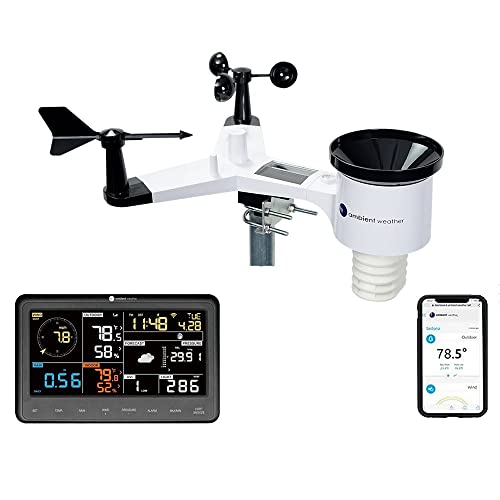
Pressure-driven forecasting becomes richer when other weather inputs are added. The Urageuxy 7-in-1 WiFi station combines a rain gauge, anemometer, UV sensor, light sensor, temperature, humidity, and barometric pressure into a single outdoor array and uploads to Weather Underground, PWS Weather, and Weather Cloud. The Asenron console adds a self-emptying rain gauge for maintenance-free rainfall tracking. For most home users, a temperature and humidity sensor is enough to anchor pressure trends, while buyers focused on outdoor activities may prefer the wider sensor suites.
Forecast Modeling and Calibration
Forecast quality depends on how the console interprets pressure data over time. Digital consoles typically advertise a 12 to 24 hour forecast window, while the Ambient Weather WS-2801A extends that to 24 to 48 hours. Many manufacturers, including Newentor, WYBQ, Asenron, and La Crosse Technology, recommend a 7 to 10 day calibration period after setup so the console can learn the local pressure baseline.
Display, Readability, and Comfort Data
A clear display makes pressure trends easier to interpret. The Urageuxy 8.3-inch color display and Asenron’s 7.5-inch LCD provide large, wide-angle viewing, while the La Crosse C85845-INT adds comfort-level color bars for indoor and outdoor humidity alongside dew point and heat index. The La Crosse 308-1451 and 308-1417 use more compact displays that prioritize pressure graphs over color. Analog stations use traditional dials framed in stainless steel, brushed brass, or wood, which fit decor-driven rooms but require more interpretation.
Power, Alerts, and Calibration
Battery-only mode typically limits backlight duration to about 10 seconds to save power. Alerts vary by model: the Urageuxy UC-WS0800 supports temperature, humidity, and absolute pressure alarms, the La Crosse 308-1417 supports temperature alerts, and the Kalawen console includes dual alarms and temperature alerts. For buyers who want notifications rather than a silent forecast, alert capability is worth checking against the listed specifications.
Analog Versus Digital Stations
They are well-suited to decor-driven rooms, offices, and greenhouses but require manual calibration and provide fewer data points than digital consoles. Digital consoles are the better fit for users who want trend graphs, atomic time, multi-channel sensors, and Wi-Fi uploads.
Final Recommendation
Urageuxy 7-in-1 WiFi Weather Station with Outdoor Sensor Array ranks first overall in this specification-based comparison under the published weighted criteria.
The final choice among the best barometric pressure weather stations depends on the documented features that match your intended use.
The Urageuxy 7-in-1 WiFi Wireless Weather Station earns the first overall specification-based choice because it combines a dedicated barometric pressure sensor with rain, wind, UV, light, temperature, and humidity in one outdoor array, uploads data to Weather Underground and PWS Weather, and presents the readings on a clear VA color display. The La Crosse Technology 308-1451 stands out as the most specification-aligned pick among the top barometric pressure weather stations that emphasize a 12-hour pressure history graph in a compact, atomic-time console.
Frequently Asked Questions
Among the best barometric pressure weather stations, what makes a weather station good for tracking barometric pressure?
A station with a dedicated barometer sensor, pressure trend graphing or history, and a documented calibration period tends to deliver the most useful pressure picture. Models such as the La Crosse 308-1451 and 308-1417 display 12 and 24 hour pressure graphs respectively, while the Urageuxy 7-in-1 and Asenron consoles pair pressure with rain and wind inputs.
How long does a barometric pressure weather station need to calibrate?
Many digital consoles recommend a 7 to 10 day calibration window after setup so the unit can learn local pressure patterns. The Newentor Q3, WYBQ PT20A, La Crosse C85845-INT, and Asenron all reference this window in their setup guidance.
Can one wireless sensor cover a large home or property?
A single sensor typically covers one outdoor location, but consoles such as the Urageuxy 8.3-inch display and Urageuxy UC-WS0800 support up to eight channels, and the Kalawen console ships with three sensors. Wireless range on models like the La Crosse 308-1417 reaches 330 ft, which helps place the sensor away from the console.
Do analog barometer stations forecast weather accurately?
They can indicate short-term pressure changes but do not provide the automated forecasting that digital consoles offer.
Which features matter most in the barometric pressure weather stations for 2026?
The barometric pressure weather stations in this guide pair a pressure sensor with trend visualization, multiple sensor channels, atomic time, and durable construction.