Buying Guide
Short instrument cables are usually chosen for pedalboard interconnections, where a conventional guitar lead would leave unnecessary slack. The best 6-inch instrument cables should therefore be judged less by length alone and more by connector geometry, cable shape, shielding, and how many connections are needed. Public listings describe these products as 1/4-inch patch cables, with most using right-angle plugs at both ends.
Start with the connector layout
Right-angle connectors are the dominant design in this comparison because they help pedals sit close together and can reduce upward cable loops. The BOSS BIC-PC specifies an angled/angled arrangement, as do the Fender models and several multi-packs. The Amazon Basics, TIMESETL, and SONICAKE listings specifically identify right-angle-to-right-angle or right-angle TS configurations.
A straight-to-angled layout can be more adaptable when one device has a side-facing jack or when a cable must leave a pedalboard edge. Check the jack position on each pedal before choosing a uniform angle-to-angle set.
Compare cable profiles and routing
Flat ribbon cables can help route leads through crowded spaces. Ernie Ball identifies its design as a flat ribbon format, while the Jim Dunlop MXR model emphasizes low-profile metal ends. TIMESETL uses a low-profile pancake design and supplies a 6mm cord diameter. These details may matter when several pedals are mounted close together.
Round jackets remain useful where a cable must bend around a pedal or follow a less regular path. MXR lists a highly flexible extra-thick PVC jacket, and Fender lists an 8mm PVC or tweed jacket depending on the model. A thicker jacket can offer a more substantial physical package, but it may occupy more room than a flat or low-profile alternative.
Look at conductor and shielding details
The listings use different ways to describe signal construction. MXR and Jim Dunlop specify 20-AWG oxygen-free copper wire. Fender Deluxe lists a 20-gauge conductor, while Fender Professional lists 22 gauge. TIMESETL and SONICAKE identify 24-AWG oxygen-free copper. These specifications are useful for comparison, but they do not by themselves establish a measured sound advantage.
Shielding is similarly important as a documented design feature, not a promise of a particular test result. MXR combines an oxygen-free copper spiral shield with a conductive PVC electrostatic shield. Fender Deluxe lists 95% oxygen-free braided shielding, Fender Professional lists 95% oxygen-free spiral shielding, and D’Addario’s selected cable lists 90% spiral shielding. Ernie Ball describes shielding intended to preserve signal with low handling noise.
Match pack size to the board
Pack utility can be more important than choosing a single premium-feeling cable. A two-pack may be enough for one or two adjacent pedals, while a three- or four-pack provides more consistent wiring across a small board. The Amazon Basics, TIMESETL, and SONICAKE selections each list six cables, making them better suited to larger or expanding pedal layouts. Pig Hog lists four, while MXR, Jim Dunlop, and Ernie Ball list three.
Do not assume that a larger pack is automatically the better purchase. Extra cables can remain unused, and identical lengths may not fit every pedal arrangement. Count the connections you actually need, then allow a small margin for future additions.
Consider physical protection
Look for strain relief, connector casing, jacket material, and any stated warranty or guarantee. MXR lists heat-shrink strain-relief tubing, Jim Dunlop describes mechanically sealed metal ends, and Fender Deluxe lists custom molded ends with strain relief. Ernie Ball includes built-in strain relief in its low-profile connectors. The BOSS listing emphasizes a woven jacket and heavy-duty braided shielding.
These features describe construction choices rather than confirmed field life. A short cable still benefits from avoiding sharp bends, pulling by the cable itself, or leaving connectors under side load. Route each lead with enough room for the plug and avoid forcing two adjacent connectors into the same limited space.
Choose for the application
For a balanced specification profile, MXR and Jim Dunlop provide detailed conductor, shielding, jacket, and connector information. Ernie Ball is particularly focused on flat routing. Fender Deluxe emphasizes jacket and connector refinement, while BOSS offers a clearly documented single-cable angled/angled format. For quantity, Amazon Basics, TIMESETL, and SONICAKE provide six-lead sets with right-angle designs.
The top 6-inch instrument cables are not necessarily interchangeable in every rig. Verify whether your pedals use standard 1/4-inch TS connections, whether you need right-angle plugs on both ends, and whether the included quantity matches your board. If the listing does not state a detail such as plug plating, conductor gauge, or exact shielding coverage, treat that information as unknown rather than assuming it.
Final recommendation
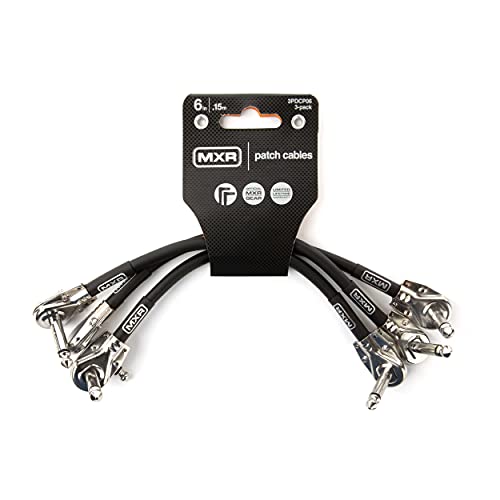
MXR Patch Cable 6 in 3-Pack ranks first overall in this specification-based comparison under the published weighted criteria.
MXR Patch Cable 6 in 3-Pack is the highest-scoring returned product and the first overall specification-based choice among the best 6-inch instrument cables. Its 20-AWG oxygen-free copper, polyethylene insulation, dual shielding description, flexible extra-thick PVC jacket, and heat-shrink strain relief form the most complete all-around evidence profile in this comparison.
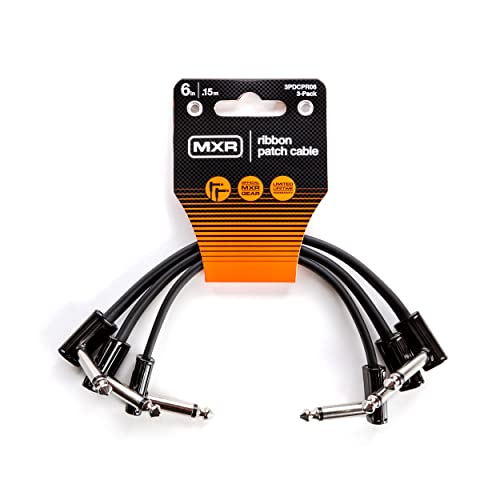
Ernie Ball Flat Ribbon Patch Cable 3-Pack is the better fit for a low-profile layout, while Jim Dunlop MXR Ribbon Patch Cable 6-Inch 3-Pack offers a similar space-conscious approach with strong shielding and mechanically sealed ends. Fender Deluxe is a compelling choice when jacket construction, molded strain relief, and included ties matter. BOSS is a focused single-lead option with an explicitly angled/angled format.
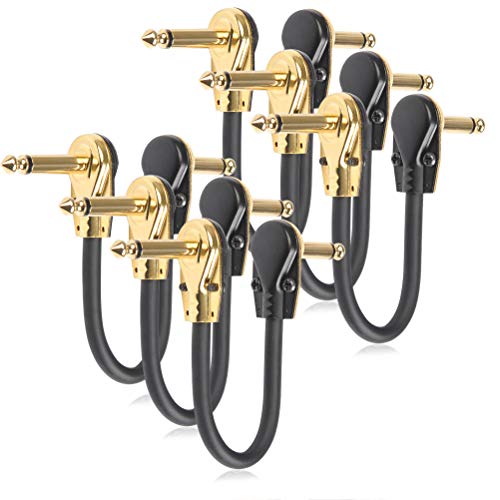
For larger pedalboards, Amazon Basics, TIMESETL, and SONICAKE offer six-cable coverage. TIMESETL stands out for its stated pancake design and detailed 24-AWG, multilayer-shielding specifications; SONICAKE adds broader listed 1/4-inch audio compatibility. Pig Hog is a practical four-pack with low-profile right-angle connectors, and Fender Professional balances an anti-kink-oriented jacket with documented spiral shielding.
The top 6-inch instrument cables should be selected by fit first, then by the construction details that matter to your setup. Confirm plug orientation and count before ordering, and use the published specifications as a comparison tool rather than as a substitute for testing your own rig.
Frequently Asked Questions
Among the best 6-inch instrument cables, what are 6-inch instrument cables mainly used for?
They are primarily short patch cables for connecting effects pedals on a pedalboard. The selected listings also describe some broader uses, including amplifiers, mixers, keyboards, microphones, and other 1/4-inch audio equipment. Confirm that the equipment uses compatible 1/4-inch TS connections before substituting a patch cable for a longer instrument lead.
Are right-angle plugs useful on a pedalboard?
Usually, yes. Right-angle plugs can support close pedal placement and reduce excess cable loops. Amazon Basics, TIMESETL, and SONICAKE explicitly document right-angle-to-right-angle or right-angle TS designs. The correct choice still depends on where each pedal’s jacks are located and how much clearance the enclosure provides.
Should I choose a flat ribbon or round cable?
Choose a flat ribbon or low-profile design when routing space is tight; Ernie Ball, Jim Dunlop MXR, and TIMESETL document designs intended to reduce clutter or fit crowded boards. A round PVC or tweed jacket may be preferable when you need flexible routing around the sides of pedals. Neither format is universally correct.
Does a higher conductor gauge prove better sound?
No. Gauge is one specification among several and should not be treated as a measured performance result. The listings identify different conductor sizes, including 20-AWG, 22-AWG, and 24-AWG designs. Compare conductor material, insulation, shielding, connector construction, and fit together, while remembering that this guide is not a hands-on test.
How many short cables should I buy?
Count the pedal-to-pedal connections on your board and add only the margin you expect to use. Two- and three-packs suit smaller layouts, while Pig Hog’s four-pack and the six-packs from Amazon Basics, TIMESETL, and SONICAKE provide more coverage. Unused cables are not harmful, but buying a much larger pack can leave you with unnecessary duplicates.