Buying Guide
The best analog lab oscilloscopes in this comparison are modern digital instruments with analog measurement inputs. That distinction matters: the listings do not document traditional CRT analog oscilloscopes. Instead, they cover bench, USB, tablet, and handheld designs that capture analog waveforms digitally.
Match bandwidth to the signal
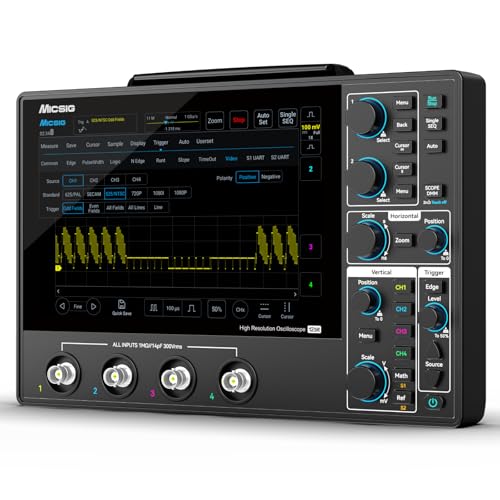
Bandwidth is the first filter. The UNI-T UPO2204HD, Micsig MHO14-200N, and Keysight MSOX2024A each list 200MHz bandwidth, while the UNI-T MSO1154HD-S lists 150MHz. These models provide the widest stated analog bandwidth in the selection. The RIGOL DHO802 lists 70MHz, and both Digilent platforms list more than 50MHz or more than 30MHz depending on the adapter and configuration.
The handheld choices are more specialized. ANKONG lists 110MHz, while GOYERRNES lists 250kHz. A lower-bandwidth tool can still be appropriate for maintenance, education, and low-frequency signals, but it should not be treated as a substitute for a wider-bandwidth bench scope.
Consider resolution, sample rate, and memory together
Resolution affects the number of vertical quantization levels shown in a captured waveform. The UPO2204HD, MSO1154HD-S, and Micsig MHO14-200N list 12-bit resolution. Analog Discovery 3 lists 14-bit resolution, although its analog bandwidth is lower than the leading bench models.
Sample rate and memory work together. High sample rates help preserve detail during fast transitions, while deeper memory supports longer captures. The UPO2204HD and MSO1154HD-S list 2.5GSa/s and 100Mpts memory. Micsig lists 1GSa/s and 110Mpts. RIGOL lists 1.25GSa/s and up to 25Mpts. By contrast, ANKONG lists 500MS/s and 12kpts storage, which is a more limited capture arrangement.
Decide how many analog channels you need
Two channels are sufficient for many comparisons, timing checks, and input-versus-output measurements. The RIGOL DHO802 and both Digilent products use two analog inputs or channels. Four analog channels provide more room for control, power, and response signals at the same time; that configuration is documented for the UPO2204HD, MSO1154HD-S, and Micsig MHO14-200N.
Mixed-signal work adds another question: do you need digital inputs? The MSO1154HD-S lists sixteen digital channels, while the Keysight MSOX2024A lists eight. The Digilent ADP2230 and Analog Discovery 3 also list sixteen digital I/O channels. These platforms may be more useful than a simple two-channel scope when checking buses or digital control lines alongside analog signals.
Choose a workflow that fits your bench
Touchscreen operation is documented for the UPO2204HD, MSO1154HD-S, Micsig, and RIGOL models. The UPO2204HD has the largest listed display at 10.1 inches, while the Micsig lists an eight-inch display. RIGOL lists a seven-inch touch display, and the MSO1154HD-S lists a seven-inch color touchscreen.
For protocol-heavy work, the UPO2204HD and MSO1154HD-S list broad serial decoding. RIGOL lists CAN, RS232/UART, I2C, SPI, and four-bit parallel decode. Digilent’s platforms emphasize computer-based software, scripting, SDK support, waveform generation, and additional analysis instruments rather than a self-contained bench interface.
A bench scope is usually the most natural choice for a permanent laboratory station. The UPO2204HD, MSO1154HD-S, Keysight MSOX2024A, and RIGOL DHO802 fit that use case. A USB platform such as Analog Discovery 3 or the ADP2230 saves space and adds software-driven functions, but it depends on a connected computer.
The Micsig MHO14-200N is a tablet-style alternative with a listed 16,000mAh battery, USB, LAN, HDMI, and SCPI support. Handheld instruments such as the OWON HDS242 and ANKONG 1C15 are better aligned with field diagnostics. The GOYERRNES model is the simplest option here for low-frequency, portable measurements.
Final recommendation
UNI-T UPO2204HD 200MHz 4-Channel Oscilloscope ranks first overall in this specification-based comparison under the published weighted criteria.
UNI-T UPO2204HD is the highest-scoring returned product and the first overall specification-based choice among these best analog lab oscilloscopes. Its 12-bit resolution, four analog channels, 2.5GSa/s sampling, 100Mpts memory, 10.1-inch touchscreen, and extensive protocol support give it the broadest documented bench capability.
The UNI-T MSO1154HD-S is the stronger fit when sixteen digital channels and a built-in AWG matter most. Choose the Micsig MHO14-200N when portability is central, or the Keysight MSOX2024A when a professional mixed-signal configuration and 4Mpts memory are priorities. For computer-based teaching and prototyping, the Digilent Analog Discovery 3 and ADP2230 offer distinctive software, digital I/O, and power-supply functions. Among the top analog lab oscilloscopes for basic field work, the OWON HDS242 adds a multimeter, while ANKONG and GOYERRNES keep the scope format compact.
Frequently Asked Questions
What are the best analog lab oscilloscopes for mixed-signal debugging?
The UNI-T MSO1154HD-S is the most flexible selected option because its listing documents four analog and sixteen digital channels, 12-bit resolution, 100Mpts memory, protocol decoding, and an AWG. Keysight MSOX2024A, Digilent Analog Discovery 3, and Digilent Analog Discovery Pro ADP2230 also list digital-channel capabilities.
Is a handheld scope suitable for laboratory work?
It can be suitable when the work involves portability, basic maintenance, education, or field diagnostics. Micsig MHO14-200N offers four analog channels, 200MHz bandwidth, 12-bit resolution, and a battery. ANKONG 1C15 offers one channel with a higher listed 110MHz bandwidth. These designs generally provide less channel or storage flexibility than the leading bench models.
Which selected scope has the deepest documented memory?
Micsig lists 110Mpts memory, while UNI-T UPO2204HD and UNI-T MSO1154HD-S each list 100Mpts. Keysight MSOX2024A lists up to 4Mpts, and RIGOL DHO802 lists up to 25Mpts. Memory depth should be considered alongside sample rate, resolution, and the length of the signal event you need to capture.
Are USB oscilloscopes useful without a built-in display?
USB platforms can be useful when a computer-based workflow is acceptable. Analog Discovery 3 and Analog Discovery Pro ADP2230 list software instruments, digital I/O, waveform generation, and power-supply functions. They are compact and programmable, but their operating workflow depends more heavily on connected software than a self-contained bench oscilloscope.
What should beginners prioritize?
Beginners should start with the signals they expect to measure, then choose adequate bandwidth, two or more analog channels, clear controls, and suitable triggering. RIGOL DHO802 documents a seven-inch touchscreen and automatic waveform search, while GOYERRNES lists auto, normal, and single trigger modes in a compact format. More advanced protocol and mixed-signal features are useful only when the project requires them.