Buying Guide
This guide compares the best professional audio interfaces using documented converter resolution & sample rate, preamplifier quality & design, input/output flexibility, monitoring & latency control, build quality & host connectivity, and software & expansion ecosystem.
Start With Your Real I/O Count
Before weighing preamps and converters, list the number of microphones, instruments, and outputs your sessions need. Solo vocalists and guitarists often run well on a two-input design like the Focusrite Scarlett Solo 3rd Gen or the Audient iD4 MKII, while drum sessions and small band work usually require four preamps such as those on the Behringer U-PHORIA UMC404HD or four analog inputs like the MOTU M4. Counting inputs and outputs first prevents overpaying for unused channels or, worse, outgrowing a unit too quickly.
Match Converters To Your Workflow
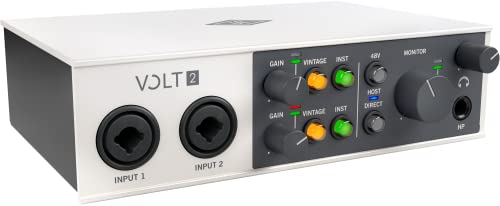
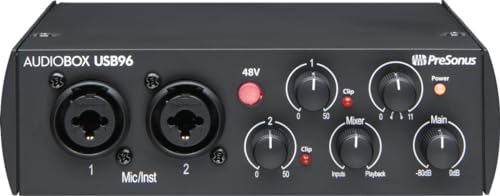
Sample rate and bit depth decide how much detail your recordings retain. Several models on this list reach 24-bit/192 kHz, including the Focusrite Scarlett Solo 3rd Gen, Universal Audio Volt 2, MOTU M2, and both Behringer U-PHORIA units. The Solid State Logic SSL 2 MKII goes further with 32-bit/192 kHz AD/DA converters, while the PreSonus AudioBox 96 stops at 24-bit/96 kHz. Choosing higher conversion depth is most useful when you intend to capture delicate acoustic sources or plan heavy post-processing.
Look Closely At Preamplifier Design
The preamp shapes the character of every microphone recording. The Audient iD14 MKII and iD4 MKII use Class-A preamps derived from the ASP8024 HE console, while the Universal Audio Volt 2 borrows the 610-style topology and adds Vintage mode for harmonic coloration. The Solid State Logic SSL 2 MKII offers Legacy 4K analog enhancement for a recognizable console flavor, the PreSonus AudioBox 96 uses two Class-A mic preamps, and the Behringer U-PHORIA UMC404HD and UMC202HD both feature MIDAS-designed preamps. Pick a preamp style that complements the kind of sources you record most often.
Prioritize Monitoring And Latency Control
Low-latency monitoring is critical when tracking performers. The PreSonus AudioBox 96 provides a documented mixer control for zero-latency blends, the Universal Audio Volt 2, Solid State Logic SSL 2 MKII, MOTU M4, and MOTU M2 include hardware monitoring paths, and the Behringer U-PHORIA UMC202HD adds a Direct Monitor switch. The Audient iD14 MKII and iD4 MKII stand out with monitor mix and monitor panning functions that let artists customize their cue mix.
Consider Connectivity And Build
Host connection affects speed, cable clutter, and mobile use. USB-C designs like the MOTU M4, MOTU M2, Audient iD14 MKII, and Audient iD4 MKII offer modern connectivity, while USB 2.0 models such as the PreSonus AudioBox 96, Focusrite Scarlett Solo 3rd Gen, and Behringer U-PHORIA units remain widely compatible. The Universal Audio Volt 2 supports iOS devices with documented adapters, and the Audient MKII models include all-metal chassis with a 3-year warranty for long-term durability.
Evaluate The Software Bundle
Bundled software can shorten your path to a finished mix. The Focusrite Scarlett Solo 3rd Gen includes Pro Tools Intro, Ableton Live Lite, Cubase LE, and the Hitmaker Expansion. The PreSonus AudioBox 96 ships with Studio One Artist, Ableton Live Lite, and the Studio Magic Plug-In suite. The Universal Audio Volt 2 integrates with LUNA and UAD plug-ins. The Solid State Logic SSL 2 MKII includes the SSL Production Pack.
Factor In Extras Like MIDI And Loopback
If you use hardware controllers or stream content, look for MIDI I/O and loopback functionality. The Behringer U-PHORIA UMC404HD, Solid State Logic SSL 2 MKII, and PreSonus AudioBox 96 all provide 5-pin MIDI. The MOTU M4 documents stereo loopback for capturing system audio alongside your inputs, which simplifies podcast and streaming routing.
Final Recommendation
Solid State Logic SSL 2 MKII USB Audio Interface ranks first overall in this specification-based comparison under the published weighted criteria.
The final choice among the best professional audio interfaces depends on the documented features that match your intended use.
Among the top professional audio interfaces reviewed here, the Solid State Logic SSL 2 MKII stands out as the first overall specification-based choice thanks to its documented 32-bit/192 kHz converters, dual mic preamps with Legacy 4K enhancement, and MIDI I/O on 5-pin DIN jacks. For producers who want expanded analog routing, the MOTU M4 offers four analog inputs and outputs with hardware monitoring, loopback, and a full-color LCD. Engineers who value console heritage will appreciate the Audient iD14 MKII for its Class-A preamps, monitor panning, and dual headphone outputs. Together, these specifications describe a strong shortlist of top professional audio interfaces for project studios in 2026.
Frequently Asked Questions
What sample rate should I look for in the best professional audio interfaces?
Most modern desktop units support at least 24-bit/96 kHz, while many of the best professional audio interfaces reach 24-bit/192 kHz. The Solid State Logic SSL 2 MKII is documented to support 32-bit/192 kHz conversion, which is the highest among the products reviewed here.
How many mic preamps do I actually need?
If you only record one voice or instrument at a time, a single preamp like the one in the Audient iD4 MKII is sufficient. For band recording or stereo drum overheads, four preamps such as those on the Behringer U-PHORIA UMC404HD make sense.
Do I need MIDI I/O on my audio interface?
If you plan to connect hardware synthesizers, drum machines, or MIDI controllers, MIDI I/O is useful. The Behringer U-PHORIA UMC404HD, PreSonus AudioBox 96, and Solid State Logic SSL 2 MKII all include 5-pin MIDI jacks for this purpose.
Is USB-C better than USB 2.0 for these interfaces?
USB-C connections on units like the MOTU M2, MOTU M4, Audient iD14 MKII, and Audient iD4 MKII offer modern throughput and simpler cabling. USB 2.0 models remain compatible with a wide range of computers and can still deliver excellent results for many project studios.
Which interface is best for streaming or podcasting?
For content creators who need loopback and simple routing, the MOTU M4 documents stereo loopback alongside its four analog inputs. The Focusrite Scarlett Solo 3rd Gen offers a compact single-mic design that pairs well with voice-driven sessions.