Buying Guide
Picking from the best handheld lab oscilloscopes is easier when you match specifications to the way you actually work. Field service, automotive diagnostics, electronics education, and bench prototyping each reward different combinations of bandwidth, channels, display size, and integrated instrumentation. The picks in this guide all qualify as handheld lab oscilloscopes, but they lean toward different priorities, so use the criteria below to find the right one for your bench or toolbox.
Match Bandwidth and Sampling to Your Signals
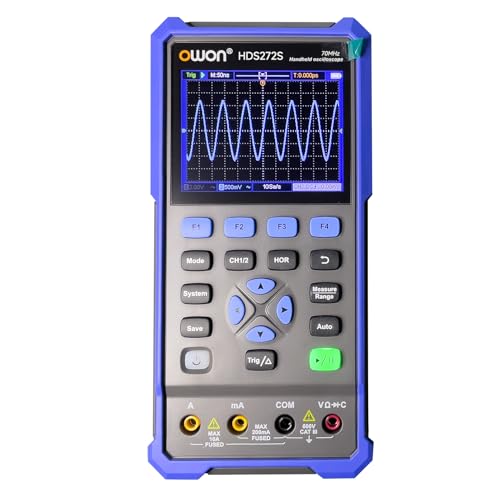
Bandwidth defines the highest frequency a scope can measure accurately, while sampling rate determines how finely it digitizes those signals. For audio, hobby microcontrollers, and most low-frequency digital buses, 25MHz to 50MHz is usually sufficient. Automotive sensors, switch-mode power supplies, and faster digital logic often demand 70MHz to 120MHz. Two of the picks in this roundup, the HANMATEK HO102S at 100MHz and the MakerHawk DSO2512G and SKYCENX SK120MPro both at 120MHz, push into territory once reserved for benchtop scopes. Pair bandwidth with sampling rate. A scope advertised as 100MHz but sampled at 250MSa/s will struggle with single-shot captures of fast edges, whereas the OWON HDS272S documents 1GSa/s real-time sampling for sharper transient detail.
Channel Count, Memory Depth, and Capture Detail
Most bench and field oscilloscope work uses two channels so you can compare a control signal with a response. Every pick in this top 10 is dual-channel except where noted. Record depth matters when capturing long bursts, slow serial buses, or rare glitches. The HANMATEK HO102S and OWON HDS272S both specify 8K record depth, while several 50MHz units settle around 1Kpts to 128KB. A deeper memory allows you to zoom into specific time windows after the capture without losing detail.
Integrated Multimeters and Signal Generators
The top handheld lab oscilloscopes often bundle a digital multimeter and a DDS signal generator so you can carry one instrument instead of three. If you routinely measure DC levels, continuity, or temperature alongside waveforms, choose a 3-in-1 like the FNIRSI 2C53T, OWON HDS272S, or HANMATEK HO102S. If you need stimulus waveforms, look at documented generator frequency: the OWON HDS272S leads with a 25MHz DDS, while most 3-in-1 picks top out between 50kHz and 2MHz. Pure 2-in-1 units such as the FNIRSI DS215H and SKYCENX SK120MPro keep the chassis smaller by dropping the DMM, which may suit users who already own a dedicated meter.
Display Size, Touch Controls, and Outdoor Readability
A scope you cannot read in bright sunlight is a scope you will not use in the field. The Siglent SHS810X offers the largest screen in this roundup at 5.6 inches with 640x480 resolution, while several BSIDE and FNIRSI models use 3.98-inch or 4.3-inch touch displays for quicker menu navigation. Smaller 2.4-inch or 2.8-inch LCDs, like those on the SKYCENX SK120MPro or FNIRSI DSO-510, keep the chassis pocketable but can feel cramped when reviewing multi-cycle captures.
Portability, Battery Life, and Build Quality
Handheld oscilloscopes live or die on battery runtime and ruggedness. The BSIDE 3-in-1 and BSIDE O9 document 5000mAh batteries with multi-hour runtimes, while the Siglent SHS810X uses a UL2054-certified 6900mAh pack. The SKYCENX SK120MPro ships with a 2000mAh battery rated for 8-hour standby and Type-C charging for shorter sessions, and its lighter footprint helps tight tool kits. Look for silicone boots, EVA cases, and documented input protection up to 400V when you plan to carry a scope into a shop or industrial environment.
Trigger Modes and Measurement Features
Trigger flexibility separates quick signal capture from constant fiddling. AUTO, Normal, and Single trigger modes are standard across the picks, while the Siglent SHS810X adds intelligent triggers such as Pulse Width, Window, Runt, Interval, Dropout, and Pattern for capturing complex digital events. Features like FFT, math functions, cursor measurement, persistence mode, and XY mode, all documented on the FNIRSI DS215H, extend a scope beyond simple voltage-versus-time viewing and support deeper analysis in the lab. The SKYCENX SK120MPro adds 12 measurement parameters plus a 2500-trace storage library for field review.
Final Recommendation
HANMATEK HO102S 3-in-1 100MHz Handheld Oscilloscope ranks first overall in this specification-based comparison under the published weighted criteria.
The final choice among the best handheld lab oscilloscopes depends on the documented features that match your intended use.
After weighing bandwidth, sampling rate, channels, integrated instrumentation, display quality, and battery life, the HANMATEK HO102S stands out as the first overall specification-based choice. Its 100MHz bandwidth, 8K record depth, 3-in-1 integration, and 10,000 wfms/s refresh rate deliver bench-style capability in a handheld form factor. For users who need the absolute highest real-time sampling rate, the OWON HDS272S is the most specification-aligned runner-up, while the Siglent SHS810X is the right pick when advanced triggering and a large 5.6-inch display matter most. If you want a balanced 50MHz 3-in-1 with a 20,000-count DMM and flexible AC clamp support, the BSIDE O9 delivers strong everyday versatility, and the FNIRSI 2C53T remains the most balanced 3-in-1 for students and hobbyists. Creators chasing maximum bandwidth in a handheld form should look at the MakerHawk DSO2512G and SKYCENX SK120MPro, which both document 120MHz front ends in compact chassis. Together, these options represent the top handheld lab oscilloscopes available in the US in 2026.
Frequently Asked Questions
What bandwidth do I need in one of the best handheld lab oscilloscopes?
Match the scope’s bandwidth to the highest frequency you expect to measure. Audio and simple microcontroller work typically requires 25MHz to 50MHz, automotive sensors and switch-mode supplies often need 70MHz to 100MHz, and faster digital or RF-adjacent circuits benefit from 120MHz or more. Picks like the MakerHawk DSO2512G, SKYCENX SK120MPro, and Siglent SHS810X cover these higher ranges.
Are handheld lab oscilloscopes accurate enough for professional diagnostics?
Yes, when you choose a model with documented sampling rate and bandwidth that exceed your signal needs. Units such as the OWON HDS272S specify 1GSa/s real-time sampling and 70MHz bandwidth, while the HANMATEK HO102S adds 8K record depth and 10,000 wfms/s refresh, both sufficient for many professional troubleshooting tasks.
Do I really need an integrated multimeter or signal generator?
If you measure DC voltage, continuity, resistance, or temperature alongside waveforms, a 3-in-1 model like the FNIRSI 2C53T or HANMATEK HO102S reduces the number of tools you carry. If you often stimulate circuits with known waveforms, look for documented generator output such as the 25MHz DDS in the OWON HDS272S or the 1kHz to 1MHz range in the SKYCENX SK120MPro.
How important is display size on a handheld oscilloscope?
Display size affects how many cycles or menu items you can see at once. The Siglent SHS810X uses a 5.6-inch TFT-LCD for the most detail, while BSIDE and FNIRSI 3.98-inch or 4.3-inch touch screens balance readability with one-handed use. Smaller 2.4-inch or 2.8-inch displays like the one on the SKYCENX SK120MPro keep the chassis compact but may require more scrolling.
Which handheld scope is best for automotive work?
For automotive diagnostics, prioritize dual channels, 70MHz or higher bandwidth, flexible coil support, and a robust battery. The Hantek 2C72, BSIDE 3-in-1 with flexible coil support, and BSIDE O9 all fit that profile, with the BSIDE units adding 2000A flexible current clamp capability and a 5000mAh battery for long roadside sessions.