Buying Guide
Choosing the best channel lab oscilloscopes for your bench starts with the signals you measure today and the headroom you want tomorrow. A 4-channel scope remains the most flexible format because it lets you watch multiple rails, clocks, and sensors simultaneously, which is critical for power integrity and embedded work. This specification-based comparison walks through the technical considerations that matter most when narrowing down a shortlist.
Bandwidth and Sample Rate
Bandwidth defines the highest analog frequency the scope can measure accurately, while sample rate determines how well it digitizes fast edges. For most digital and embedded work, a bandwidth near three to five times your fastest signal edge is a sensible starting point. Among the best channel lab oscilloscopes listed, the RIGOL MHO934 leads with 350 MHz bandwidth and 4 GSa/s sampling, while entry-tier scopes such as the RIGOL DHO804 focus on lower bandwidth with higher vertical resolution. Choosing a sample rate at least four times your bandwidth helps preserve waveform detail at full channels.
Vertical Resolution and Signal Detail
Vertical resolution controls how finely a scope can distinguish small voltage differences. Traditional 8-bit scopes offer 256 quantization levels, while 12-bit models provide 4096 levels, dramatically improving power-rail and sensor measurements. The Siglent SDS1104X HD, RIGOL DHO1204, and RIGOL MHO934 all use 12-bit ADCs, which is a major advantage when you are measuring ripple, low-amplitude analog signals, or sensor outputs. Even at lower bandwidths, 12-bit resolution can reveal details an 8-bit scope would miss entirely.
Memory Depth
Memory depth determines how long a scope can capture at full sample rate before dropping its resolution. Deep memory is essential when you need to look at slow serial bus traffic or watch for events that occur seconds apart. The Siglent SDS1104X HD reaches 100 Mpts per channel, while the Hantek DPO7204U pushes 2 G memory depth for extended captures. For most lab tasks, choosing a scope with at least 25 to 50 Mpts helps preserve timing resolution across long records.
Triggering and Protocol Decode
Modern oscilloscopes combine analog triggers with serial bus triggering and decoding. Intelligent trigger types such as runt, window, and pulse width help capture rare glitches, while protocol decode turns waveforms into readable bus traffic. The Siglent SDS1204X-E stands out with eight intelligent trigger types, while the RIGOL DHO924 includes standard 16-channel mixed-signal capability for digital timing. Selecting a scope that natively decodes the protocols you use, such as I2C, SPI, CAN, or UART, eliminates the need for external software.
Capture Rate and Display Quality
Waveform capture rate, measured in waveforms per second, determines how likely a scope is to catch rare anomalies. A higher capture rate combined with intensity-graded or color temperature display helps visualize transient events more clearly. Larger touch screens, such as the 10.1-inch displays on the RIGOL DHO1204 and Siglent SDS1104X HD, also make navigation through long captures easier.
Connectivity and Remote Control
Bench and lab integration often depends on how a scope talks to the rest of your test setup. Standard interfaces typically include USB Host and Device, LAN with LXI, and HDMI output for external monitors. Higher-end instruments like the RIGOL MHO934 add Wi-Fi and Bluetooth for wireless remote control, while most listed scopes support SCPI commands for automation. Choosing a scope with Web Control allows browser-based access without installing dedicated software, which is useful in shared lab environments.
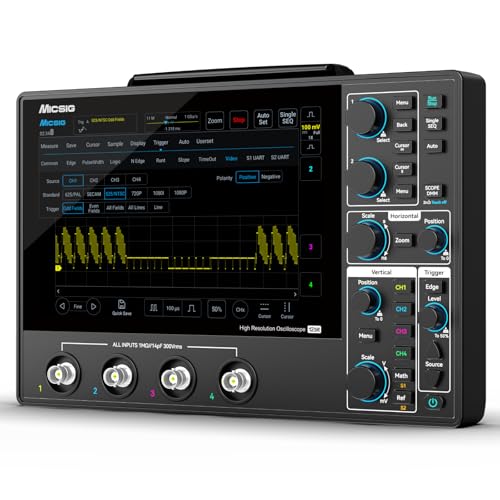
Form factor affects how a scope fits on your bench or in your bag. Traditional bench scopes such as the RIGOL DHO1204 and Siglent SDS1204X-E offer stable, fixed installations with full probe sets included. Portable tablet scopes like the Micsig MHO14-200N provide battery-powered operation for field diagnostics or traveling between sites. Consider whether you need a stationary workhorse, a portable instrument, or a mix of both when comparing the top channel lab oscilloscopes for your lab.
Probes and Accessories
The probe set shipped with a scope can influence its out-of-box readiness. For mixed-signal work, remember that digital channels on the RIGOL DHO924 and RIGOL MHO934 require an optional logic analyzer probe, which should be factored into the total setup.
Final recommendation
RIGOL MHO934 350 MHz Portable 4+16 Ch ranks first overall in this specification-based comparison under the published weighted criteria.
The final choice among the best channel lab oscilloscopes depends on the documented features that match your intended use.
If you want the highest-scoring specification-based choice from this comparison, the RIGOL MHO934 stands out as the first overall pick, thanks to its 350 MHz bandwidth, 4 GSa/s sampling, 12-bit ADC, and portable form factor. Engineers needing maximum bandwidth in a portable instrument should evaluate the RIGOL MHO934 closely, while those wanting mixed-signal debug at 250 MHz should consider the RIGOL DHO924. For 200 MHz bench work with deep memory and 12-bit precision, the RIGOL DHO1204 and Siglent SDS1104X HD are strong candidates, while the Hantek DPO7204U and Micsig MHO14-200N round out the top channel lab oscilloscopes for engineers focused on integrated instruments or field portability.
Frequently Asked Questions
What bandwidth do I need in one of the best channel lab oscilloscopes?
For most digital and embedded work, a scope bandwidth of three to five times your fastest signal frequency is recommended. The scopes in this list range from 50 MHz to 350 MHz, letting you match bandwidth to your specific signals rather than overpaying for unused headroom.
Why is 12-bit resolution important in the best channel lab oscilloscopes?
12-bit vertical resolution provides 4096 quantization levels, which is sixteen times the detail of an 8-bit scope. This is critical for power-rail ripple analysis, low-amplitude sensor signals, and any measurement where small voltage differences matter.
How does memory depth affect choosing one of the best channel lab oscilloscopes?
Deeper memory lets the scope sample at full rate over longer time spans without losing detail. If you regularly capture long serial bus activity or look for slow events, prioritize scopes such as the Siglent SDS1104X HD, RIGOL DHO1204, or Hantek DPO7204U, all of which offer generous memory depth for their class.
Are portable scopes as capable as benchtop options among the best channel lab oscilloscopes?
Portable tablet scopes like the Micsig MHO14-200N now offer 200 MHz bandwidth, 12-bit resolution, and four analog channels in a battery-powered chassis. While benchtop models may offer more screen real estate and probe kits, portable scopes deliver strong specifications for field diagnostics and travel-heavy engineers.
If your work involves embedded systems, serial communication, or automotive electronics, built-in protocol decoding saves significant time. Scopes such as the RIGOL DHO1204, Siglent SDS1104X HD, and RIGOL MHO934 support common protocols including I2C, SPI, UART, CAN, and LIN, making them strong fits for those workflows.