Buying Guide
The best autofocus digital cameras in this comparison are compact fixed-lens models aimed at beginners, travelers, families, and entry-level creators. Their listings commonly combine automatic focus with high stated photo resolutions, 4K or higher video modes, small LCD screens, and bundled accessories. Because this is a specification-based guide, the scores reflect documented features rather than hands-on image quality or customer sentiment.
Start with the autofocus description
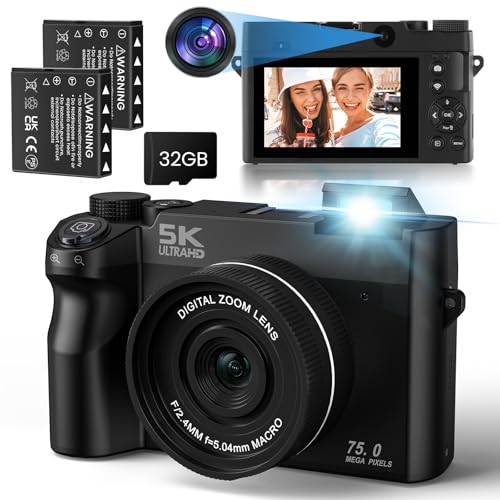
Autofocus is the defining requirement here, but the listings describe it in different ways. Several cameras specify a half-press shutter action that locks focus, including the Krlun, Founissa, JGIPL, and Duluvulu models. Others use broader language such as fast, smart, or beginner-friendly autofocus. That wording can help explain the intended operation, but it does not establish tracking speed, low-light accuracy, or performance with fast-moving subjects. Buyers who regularly photograph sports or wildlife should therefore treat these compact cameras as basic point-and-shoot options unless more advanced focusing specifications are supplied.
Compare video and photo claims carefully
The selected products list photo resolutions from 48MP to 96MP and video modes from 4K to 8K. Higher numbers can be useful when you want more stated capture resolution, but they do not by themselves prove better real-world image quality. The source data does not provide sensor size, lens aperture, optical zoom, or independent image tests. For simple travel memories, family photos, and social clips, a dependable autofocus mode and easy controls may matter more than the largest headline resolution.
AUREAPIX and LOUM list 8K video, while Founissa lists 5K. The remaining selections document 4K video. LOUM also specifies that its 8K mode records at 15 frames per second, an important detail for buyers comparing video modes. Check the camera’s manual and storage requirements before relying on a high-resolution mode for long recordings.
Choose the right screen design
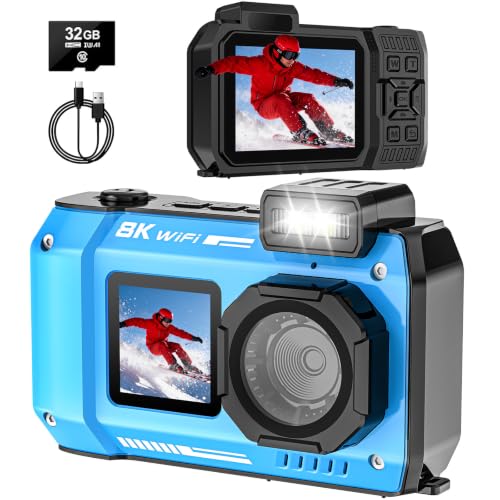
A 180-degree flip screen is useful for selfies, vlogging, and recording yourself without a separate monitor. AUREAPIX, Krlun, Nisumkey, FACLAM, TESFOT, and Duluvulu document this design. Founissa and LOUM take a different approach with dual-screen or front-and-rear viewing arrangements. LOUM adds touch-screen operation, while Founissa emphasizes two screens for self-recording.
Screen size varies across the group. AUREAPIX lists a 3.5-inch screen, while several flip-screen cameras list 3.0-inch or 2.8-inch displays. A larger display may make framing easier, but it can also affect the compactness of the body. Consider whether you will mostly frame from behind the camera or face the screen while recording.
Look for connectivity and creator functions
WiFi is the most useful documented feature for people who want to move photos to a phone without a cable. FACLAM also lists remote control, and TESFOT lists remote control and live preview. Wireless features can simplify sharing, but the supplied evidence does not identify app compatibility beyond the AUREAPIX listing’s mention of iOS and Android support.
Webcam functionality appears on several models, including AUREAPIX, Founissa, Nisumkey, YOODEE, JGIPL, and Duluvulu. This may suit video calls, livestreaming, or online teaching. Other creator-oriented features include slow motion, time-lapse, pause recording, continuous shooting, filters, and built-in lighting. Treat these as convenience tools rather than evidence of professional video performance.
Assess portability and the included kit
Compact dimensions are a recurring strength. Nisumkey lists a weight of the current price, YOODEE lists about the current price, and Founissa lists 0.the current price. Other products are described as compact or ultra-compact without a complete weight specification. A lower listed weight can be helpful for travel, but battery type, grip, screen design, and accessories also affect what is comfortable to carry.
Many selections include a 32GB card and two rechargeable batteries. Founissa lists a 64GB card, while Krlun includes a camera bag and other starter accessories. Some packages include a pouch, lanyard, card reader, or cleaning cloth. Included accessories can reduce setup friction, but confirm card compatibility and charging requirements before purchase. The source listings do not establish long-term battery endurance for every product.
Understand zoom and stabilization limitations
Most selected cameras list 16X or higher digital zoom. Digital zoom can enlarge the displayed view, but the supplied evidence does not support treating it as equivalent to optical zoom.
These terms indicate a listed assistance feature, not a measured stabilization result. Built-in flash or fill light is also available on several models, including AUREAPIX, YOODEE, JGIPL, and Nisumkey. Buyers should still check whether a particular camera supports an external microphone, tripod, or other accessory required for their setup.
Final Recommendation
AUREAPIX 8K 96MP WiFi Autofocus Camera ranks first overall in this specification-based comparison under the published weighted criteria.
AUREAPIX is the highest-scoring returned product and the first overall specification-based choice among the best autofocus digital cameras. Its combination of 8K video, 96MP stills, WiFi, a 3.5-inch flip screen, webcam functionality, HDR, and 20X digital zoom gives creators the broadest documented feature set here. LOUM is a close alternative for dual-camera framing and a touch screen, while Krlun is a sensible starter-kit choice for beginners.
For lightweight travel, Nisumkey is notable for its listed 0.59-pound weight. FACLAM and TESFOT are better suited to shoppers who prioritize WiFi sharing and remote features. Founissa is attractive for dual-screen shooting and its 64GB card, while YOODEE and JGIPL emphasize dual-camera flexibility and practical assistance features. Duluvulu rounds out the top autofocus digital cameras with a broad set of everyday creative modes. None of these rankings represents hands-on testing; verify current specifications, compatibility, and included items before ordering.
Frequently Asked Questions
Among the best autofocus digital cameras, what should I prioritize when choosing an autofocus camera?
Start with clear autofocus documentation, then compare the screen, video mode, connectivity, and included kit. If you mainly take casual photos, easy controls and portability may be more useful than the highest stated resolution. If you record yourself, a flip screen or dual-screen design can be more important.
Are these cameras suitable for vlogging?
Several selected models document flip screens, dual cameras, webcam modes, WiFi, or creative video functions. AUREAPIX, LOUM, Founissa, FACLAM, and TESFOT are particularly feature-oriented for self-recording. The supplied evidence does not include microphone quality, autofocus tracking tests, or measured video performance, so creators should confirm those details separately.
Do these cameras have optical zoom?
The selected listings describe digital zoom, including 16X, 18X, or 20X options. The supplied evidence does not document optical zoom for these products. Digital zoom may reduce detail as magnification increases, so it should not be compared directly with an optical zoom lens.
Which option is easiest for a beginner?
Krlun, TESFOT, Nisumkey, and Duluvulu all document beginner-friendly or straightforward operation. Krlun adds a top mode dial and a broad starter kit, while TESFOT emphasizes intuitive buttons. Buyers should choose based on whether they prefer a flip screen, WiFi, lighter weight, or included accessories.
What accessories are commonly included?
Many selections include a memory card, rechargeable batteries, charging cable, and strap or pouch. Founissa lists a 64GB card, while Krlun lists a 32GB card, two batteries, a camera bag, and a USB cable. Included items can vary by listing, so check the package contents at the time of purchase.