Buying Guide
The best digital cameras with face detection are not all designed for the same job. Some are traditional compact point-and-shoot cameras, while others are built around vlogging, rotating lenses, or unusual environments such as swimming and snorkeling. Face detection can help the camera identify people in the frame, but the surrounding controls matter just as much: a flip screen can improve self-recording, a front display can help with group selfies, and optical zoom can provide a different framing advantage from digital zoom.
This guide uses the supplied product titles, feature descriptions, and technical specifications. It is not a hands-on test. The rankings emphasize documented capabilities rather than customer sentiment or volatile marketplace information.
Match face detection to your shooting style
For ordinary portraits and family snapshots, look for face detection paired with smile capture, anti-shake, scene modes, or a fill light. The Minolta MND30 and Minolta MND20 both list face detection and smile capture, while the SMARTKLIK DC228 adds a rear selfie reflector and multiple filters. These features are oriented toward straightforward point-and-shoot use rather than manual photography.
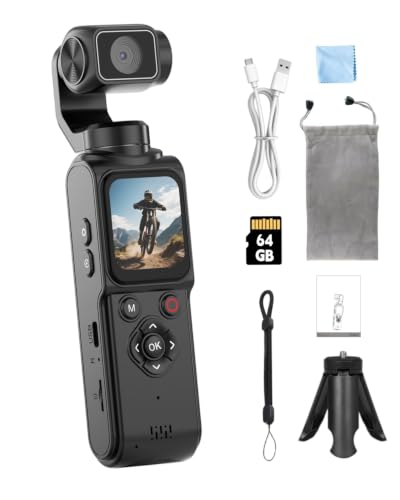
For moving solo subjects, face tracking is the more relevant specification. The Sixmou M105 describes AI-powered smart face tracking, and the TianfuSpanda camera lists face recognition locking with a one-touch auto-tracking function. The Okvwwxy model also describes face auto-detect, active tracking, and dynamic framing. These models are more closely aligned with vlogging, tutorials, and self-recorded video than a basic compact camera.
Consider photo and video claims together
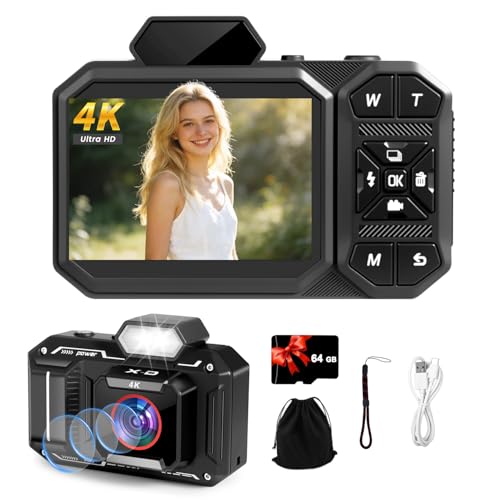
Stated megapixel figures vary widely across this group, but resolution alone does not describe the entire camera. The Minolta MNZ3X lists 72MP photos and 5K video, while the Sixmou M105 lists 75MP photos and 4K video. The TianfuSpanda and Okvwwxy models also list 4K/30fps recording. These are the leading choices if video detail and creator use are central to the purchase decision.
Other selected cameras use lower video specifications but still provide useful face-oriented functions. The Minolta MND30 and renewed Minolta MND20 list 2.7K video, and the SMARTKLIK DC228 lists 1080P video. A buyer who mainly takes still photos for family events may prefer the simpler controls of these models rather than paying attention only to the highest video number.
Be cautious when comparing stated photo resolution. The TianfuSpanda listing specifically identifies its 64MP still figure as interpolated, so it should not be treated as directly equivalent to every other resolution claim. The Bextgoo listing also presents a high-resolution still specification, but its practical advantage in a real shooting situation cannot be confirmed from listing data alone.
Choose the right screen and lens design
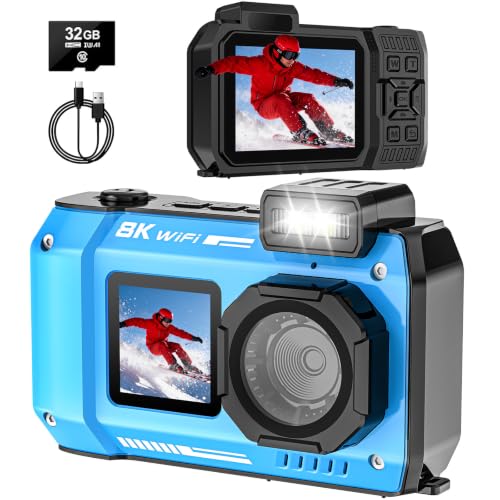
Screen configuration affects how easily you can compose a shot. The Minolta MNZ3X has a flip-out LCD, the Duluvulu DC101 lists a 180-degree flip screen, and the Minolta MND30 has a 180-degree rotating LCD. These designs can be useful for front-facing video, self-portraits, and low-angle framing. The Minolta MN40WP goes in a different direction with separate rear and front screens, which is helpful for selfies and group shots.
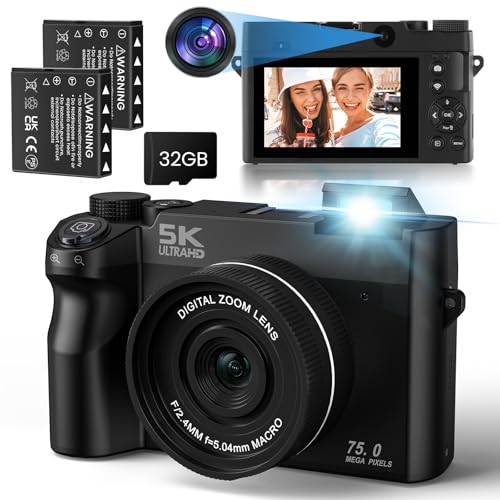
Lens terminology is also important. The Minolta MNZ3X is the standout for optical zoom because its listing specifies a 24-75mm optical zoom lens. Most other selected models describe digital zoom, including the 16X zoom found on several compact cameras. Digital zoom may be convenient when composing distant subjects, but the listings do not establish that it provides the same result as optical zoom.
The TianfuSpanda and Okvwwxy cameras use rotating-lens or mechanical-support designs instead of conventional optical zoom descriptions. Those designs are primarily useful for keeping a creator in frame during recording. They should be evaluated as vlogging mechanisms, not assumed to be substitutes for an optical zoom lens.
Check portability and included accessories
Compact cameras can be easier to share with children, teens, or casual users because the controls are intentionally simple. The SMARTKLIK DC228 is listed at the current price, while the Bextgoo model is listed at the current price. The renewed Minolta MND20 is listed at 8 ounces. These figures make the models attractive for carrying, although listing-based weight figures may not always describe the same configuration.
Included storage varies. The Bextgoo model lists a 64GB card, and several compact cameras include 32GB cards according to their titles or feature descriptions. The TianfuSpanda camera instead documents expandable storage up to 256GB. If you plan to record frequent 4K video, storage capacity and transfer method deserve attention before buying.
Battery details are most specification-aligned on the creator-oriented models. The Sixmou M105 lists up to 120 minutes of 4K recording and up to 240 minutes of continuous 1080P recording. For the selected products, treat all battery claims as supplied listing specifications rather than independently verified runtime.
Look for connectivity and creative modes
Wi-Fi is documented on the Minolta MNZ3X and Okvwwxy cameras, while the TianfuSpanda model lists Wi-Fi transfer through an app. These features can simplify moving files to a phone, but the listings do not establish transfer speed or app quality. USB webcam support appears on the TianfuSpanda and Duluvulu models, and the Sixmou M105 is aimed at social-video formats with horizontal and vertical recording.
Creative modes can make a basic camera more engaging for beginners. The Minolta MND30 lists nine scene modes, the renewed MND20 includes panorama, burst, color filters, and time-lapse, and the SMARTKLIK DC228 lists 20 filters. These additions may be useful for casual experimentation, but they do not replace optical controls or guarantee a particular image style.
Final recommendation
Minolta MNZ3X 72MP 5K Digital Camera ranks first overall in this specification-based comparison under the published weighted criteria.
The final choice among the best digital cameras with face detection depends on the documented features that match your intended use.
The Minolta MNZ3X is the highest-scoring returned product and the first overall specification-based choice. It brings together documented face, smile, and blink detection, 5K video, a 24-75mm optical zoom, Wi-Fi, a flip-out screen, and a microphone input. That combination gives it the broadest documented use across travel, portraits, events, and content creation.
The top digital cameras with face detection split into several useful categories. Choose the Sixmou M105 or TianfuSpanda model for face tracking and solo video, the Minolta MN40WP for water activities, or the Duluvulu DC101 for a flip-screen starter design. The Okvwwxy model is another strong pocket-vlogging option because it combines face auto-detection with a rotating support and Wi-Fi transfer.
For simpler family or beginner photography, the Minolta MND30, renewed Minolta MND20, Bextgoo D52USF, and SMARTKLIK DC228 provide face-related features alongside compact bodies and automatic shooting functions. The right choice depends less on a single resolution number and more on whether you need optical zoom, a flip screen, waterproofing, wireless transfer, or the lightest body.
Frequently Asked Questions
What are the best digital cameras with face detection for vlogging?
The Sixmou M105, TianfuSpanda 4K Vlogging Camera, and Okvwwxy 4K Pocket Vlogging Camera are the most specification-aligned fits from this comparison. Their listings specifically describe face tracking or face auto-detection, and they add creator-oriented features such as rotating lenses, webcam support, Wi-Fi transfer, or vertical recording. The Minolta MNZ3X is also a strong choice when optical zoom and a microphone input matter more than dedicated tracking.
Is face detection the same as face tracking?
No. Face detection generally identifies faces in the frame, while face tracking describes continued attention to a moving subject. The supplied listings use both terms. The Sixmou M105 and TianfuSpanda model explicitly describe tracking or recognition locking, whereas cameras such as the Minolta MND30 and SMARTKLIK DC228 primarily document face detection and smile capture. Buyers should rely on the exact function listed for the model they are considering.
Which selected camera is waterproof?
The Minolta MN40WP is the selected waterproof model. Its listing states that it is waterproof up to 10 feet deep and includes face detection, smile capture, anti-shake, and dual LCD screens. That makes it the clearest choice for swimming, snorkeling, beach trips, and other wet settings. The other cameras in this list should not be assumed to be waterproof because their supplied specifications do not document that protection.
Should I choose optical or digital zoom?
Optical zoom is explicitly documented on the Minolta MNZ3X, with a 24-75mm range. The other selected models generally list digital zoom, including 16X digital zoom on several compact cameras. Optical zoom changes the lens framing, while the supplied evidence does not establish equivalent image results for digital zoom. If distant subjects and flexible composition are priorities, the MNZ3X has the clearest zoom advantage in this comparison.
Which camera is easiest to carry?
The SMARTKLIK DC228 has the lowest listed weight among the selected models at the current price, while the renewed Minolta MND20 is listed at 8 ounces and the Bextgoo model at the current price. These compact options are suited to children, teens, travel, or everyday carrying. The listed weights may reflect different configurations, so confirm the package contents and final product specifications before purchasing.