Buying Guide
Choosing among the best digital cameras with smile detection starts with deciding who will use the camera and what kind of subjects they will photograph. The candidates here are compact point-and-shoot models, but their documented capabilities vary considerably. Some are designed around child-friendly simplicity, while others add flip screens, wireless transfer, manual focus, or optical zoom for more involved photography.
Confirm how smile capture works
Smile capture is the defining feature in this category. The listings describe it as an automatic shutter response when a smile is detected, often alongside face detection or face tracking. That can be useful for family portraits, group photos, and self-timer scenes because the camera is designed to react to a detected expression rather than relying only on a conventional shutter press.
However, smile capture should be treated as an assistance feature, not a guarantee that every expression will trigger a photo. Look for related portrait tools when they are documented. The Minolta MNZ3X adds blink detection, while the RYNFONEX model lists face detection, smile capture, and timed shooting. The dual-screen Gtonster and SMARTKLIK cameras also combine smile capture with front-facing composition support.
Compare resolution and video claims carefully
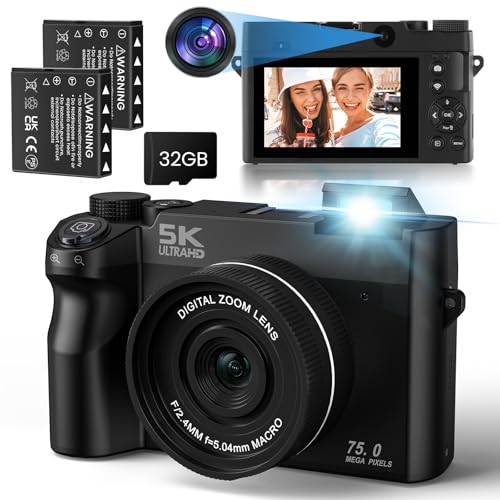
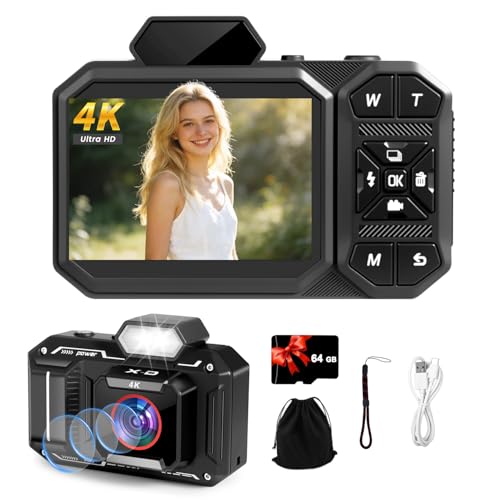
The listings use high megapixel numbers, but resolution alone does not establish image quality. For a specification-based comparison, it is more useful to note the complete recording package. The Minolta MNZ3X and XUMIUZIY models document 5K video and 75MP still photos. LAMA also lists 5K and 75MP, while NIKICAM and Bextgoo specify 4K video. Other selected models list 2.7K or 1080P video.
A 1080P camera such as CAMKORY can still make sense for a child’s first camera or uncomplicated family recording. A 2.7K or 4K model may be more suitable when video detail and creator use are priorities. The supplied listing for Bextgoo contains conflicting photo-resolution wording, so that specification deserves verification before purchase. Do not assume a larger stated megapixel figure automatically means better results in every lighting condition.
Decide whether optical or digital zoom matters
Zoom type is one of the clearest differences in this selection. Most compact models document digital zoom, commonly at 16x or 18x. Digital zoom enlarges the image electronically, while optical zoom changes the lens magnification. The Minolta MNZ3X lists a 24-75mm optical zoom, and XUMIUZIY lists an 18x optical zoom. Those two models are the better documented choices for distant subjects, travel scenes, or more deliberate composition.
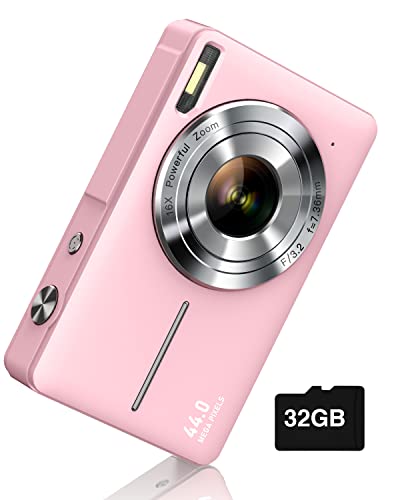
Digital zoom can still be convenient for casual use, especially in a small camera intended for children. It may help frame a stage, pet, or distant object, but the listing does not establish that the resulting image will retain the same detail as an optical-zoom system. If reach is important, prioritize the two selected cameras with optical zoom rather than comparing digital zoom numbers alone.
Look for autofocus and stabilization
Autofocus and anti-shake features address different parts of the shooting process. Autofocus helps the camera set focus on the subject; anti-shake or stabilization is intended to reduce the effect of hand movement. The RYNFONEX, Gtonster, NIKICAM, XUMIUZIY, and Bextgoo listings document useful combinations of these functions. XUMIUZIY specifically describes multi-axis stabilization, while NIKICAM lists both autofocus and manual focus.
For a child or beginner, simple automatic operation may be more important than advanced control. For a teen or adult using the camera for vlogging, manual focus can offer additional control. The ceye dual-screen camera lists anti-shake and face tracking but does not explicitly document autofocus, so it should not be treated as equivalent to the autofocus-equipped models.
Choose the right screen design
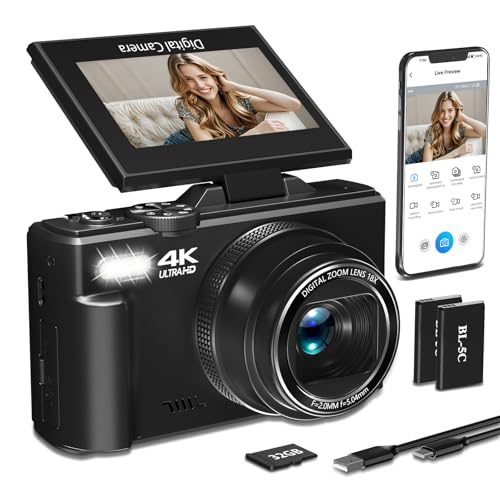
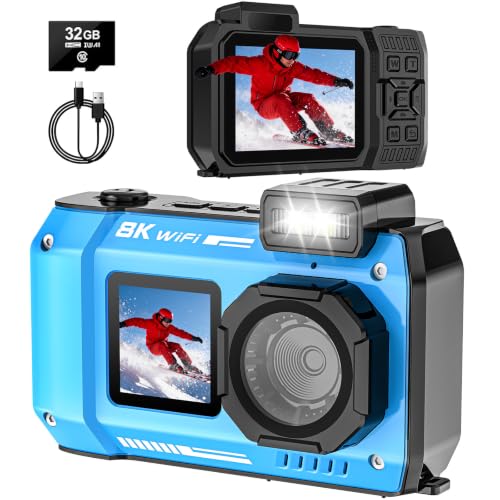
A standard rear screen is adequate for ordinary point-and-shoot photography. A front screen or flip screen is more useful when the photographer appears in the frame. Gtonster and SMARTKLIK use dual-screen designs. The ceye 2026 model lists a 2.4-inch rear display and a 1.4-inch front screen. LAMA, NIKICAM, and Bextgoo emphasize flip-screen or vlogging-oriented use, although the supplied Bextgoo evidence does not specify a flip screen and should not be assumed to have one.
Flip and dual-screen designs can make selfies, family videos, and webcam-style recording easier to frame. They can also add physical complexity and weight compared with a basic kids camera. Consider whether self-recording is a regular use or merely an occasional feature before paying more attention to screen design.
Evaluate connectivity and included accessories
USB-C appears in several listings and can support charging or file transfer. NIKICAM, Gtonster, LAMA, and Bextgoo document webcam or creator-oriented functions. NIKICAM and Minolta also list WiFi-related connectivity, which may be useful when transferring content to a phone or sharing it without relying only on a cable.
Included accessories can reduce setup friction. Selected models include memory cards, batteries, lanyards, pouches, cables, or tripod compatibility. CAMKORY includes two batteries and a broad accessory set, while RYNFONEX includes a pouch and tripod socket. Verify exactly what is included because package contents differ by model and listing.
Match the camera to the user
For a child’s first camera, CAMKORY offers a simple feature set, accessories, and documented beginner positioning. For portable dual-screen use, the ceye 2026 model is notably light on the supplied specification. For filters and selfies, SMARTKLIK is a practical fit. For travel reach, Minolta or XUMIUZIY are better documented because they list optical zoom. For vlogging, LAMA and NIKICAM provide the most extensive documented creator features among the selected products.
Final Recommendation
LAMA 5K UHD 75MP Digital Camera ranks first overall in this specification-based comparison under the published weighted criteria.
The Minolta MNZ3X is the highest-scoring returned product and the first overall specification-based choice among the best digital cameras with smile detection. Its 24-75mm optical zoom, smile and blink detection, 5K video, flip-out screen, WiFi, microphone input, and stabilization give it the broadest documented capability in this comparison.
The top digital cameras with smile detection are not all aimed at the same buyer. Choose LAMA for a compact creator kit with two batteries and a flip-up screen, NIKICAM for WiFi and manual-focus flexibility, or XUMIUZIY when optical zoom and stabilization are more important. Gtonster and SMARTKLIK are stronger selfie-oriented options because they document dual screens. For a child or beginner, CAMKORY keeps the feature set approachable while including useful accessories.
These recommendations use supplied public listing data rather than hands-on testing, customer sentiment, or volatile marketplace information. Before ordering, verify the current listing for availability, included accessories, warranty terms, and any specifications that matter most to your use.
Frequently Asked Questions
Do all of these best digital cameras with smile detection take photos automatically when someone smiles?
Each selected product listing explicitly documents smile capture or smile detection, generally describing an automatic response to detected smiles. The listings do not establish identical detection behavior, settings, or reliability in every lighting and expression scenario. Treat the feature as an automated shooting aid and review the manual for activation instructions.
Which selected camera has optical zoom instead of only digital zoom?
The Minolta MNZ3X lists a 24-75mm optical zoom, and XUMIUZIY lists an 18x optical zoom. Most of the other selected models document digital zoom. Optical zoom is the more relevant specification when you regularly photograph distant subjects and want lens-based magnification.
Which camera is best for selfies and vlogging?
Gtonster and SMARTKLIK document dual-screen designs, while LAMA and NIKICAM list flip-screen or creator-focused features. NIKICAM adds WiFi, webcam mode, autofocus, manual focus, and a tripod mount. LAMA lists webcam mode, a 180-degree flip-up screen, two batteries, and fill light. Choose based on whether wireless transfer, battery quantity, or self-framing matters most.
Are these cameras suitable for children?
Several selected models are explicitly positioned for children, teens, or beginners, including CAMKORY, SMARTKLIK, Gtonster, and the ceye camera. Their listings describe compact bodies, simple controls, lanyards, memory cards, or easy point-and-shoot operation. Adults should still supervise younger children and check the manufacturer’s safety and age guidance.
What should I verify before buying one of the top digital cameras with smile detection?
Check the exact video resolution, whether zoom is optical or digital, the included memory card and battery arrangement, charging connector, warranty, screen type, and connectivity. This is particularly important for listings with inconsistent or incomplete specification wording. Also confirm that the selected model, color, and accessory bundle match the current product page.