Buying Guide
Choosing among the best f-type digital coaxial cables starts with matching the cable to the connection, route, and environment. F-type coaxial cables are commonly used between televisions, antennas, cable boxes, satellite receivers, DVRs, modems, routers, and related equipment. The products compared here are not hands-on tested; the ranking is based on supplied specifications and feature descriptions.
Confirm the connector and device layout
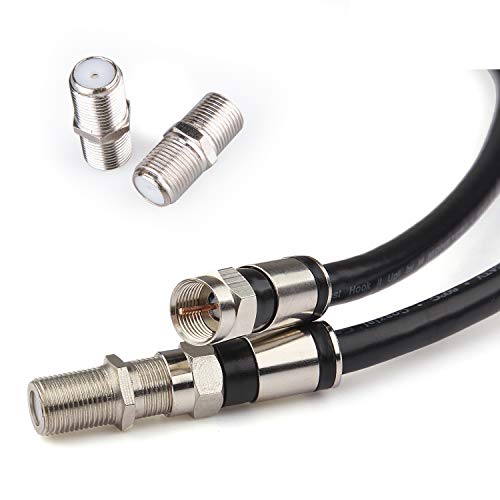
Most selections in this comparison use male F-type connectors at both ends, which is the usual arrangement for connecting two devices with female F-type ports. Before ordering, inspect the equipment and any wall plate, splitter, surge protector, or coupler in the path. A female-to-female coupler can join two male-ended cables, but it also creates another connection point.
Connector shape matters as much as connector type. The BlueRigger RG6 15FT 90°-to-90° Cable is designed around two right-angle ends, making it a strong fit where a television sits close to a wall. A straight connector can be preferable when there is open space behind the equipment, while an angled connector may reduce bending in a compact installation. The C2G Velocity Mini-Coax F-Type Cable takes a different approach with a slim cable profile intended for discreet routing.
Choose the right cable length
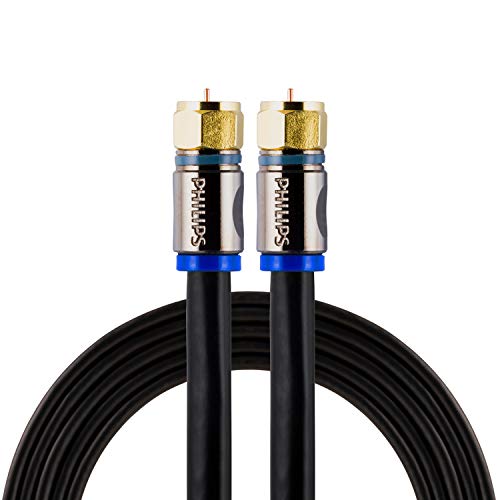
Measure the actual path rather than the straight-line distance. Leave enough slack for the connector to be attached without sharp bends, but avoid buying far more cable than the route needs. Short options such as the GE RG6 Quad-Shielded Coaxial Cable, Philips RG6 Quad-Shield Coaxial Cable, pibidi RG6 Cable, and GTOTd RG6 Coaxial Cable are suited to nearby equipment. Their six-foot lengths can help keep a TV stand or cabinet organized.
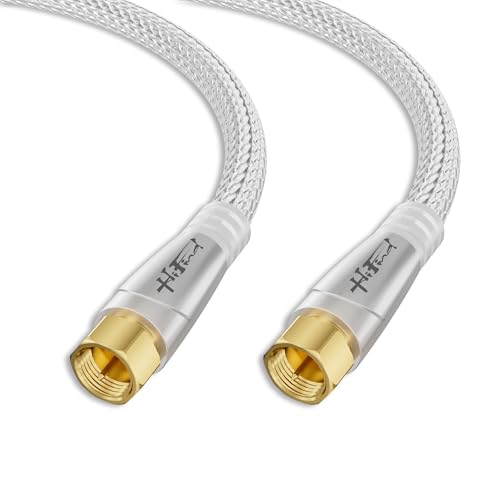
A 10- to 15-foot cable provides more placement flexibility. The Cables Direct Online 10FT White Quad-Shield RG6 Cable can suit a visible route where a white jacket is useful, while the G-PLUG 15FT RG6 Coaxial Cable and BlueRigger 15-foot cable cover longer paths around furniture or wall-mounted displays. For substantial distances, the Cables Direct Online RG6 Coaxial Cable, 75 Feet offers much more reach. Long cables need careful management so they do not form loops, become pinched, or hang from a connector.
Understand shielding descriptions
Shielding is included to help protect the coaxial signal from electromagnetic and radio-frequency interference. The listings use several descriptions: dual-layer, triple-layer, and quad-layer shielding. More layers are a useful specification signal, but the cable still needs to be routed sensibly and connected securely. Do not treat a shielding label as a guarantee of a particular result in every installation.
Quad-shielded models in this group include GE’s six-foot cable, the six-foot Philips cable, and the 10-foot white Cables Direct Online cable. The energeaster 25FT RG6 Coaxial Cable and BlueRigger RG6 15FT 90°-to-90° Cable document triple-layer or triple-shielded construction. GTOTd also lists three aluminum shielding layers. These descriptions help distinguish cables when a route passes near other electronic wiring.
Check impedance and conductor details
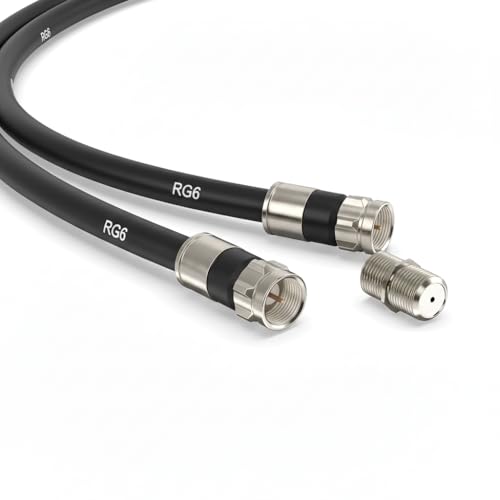
A 75-ohm design is repeatedly documented across the comparison and is appropriate for the listed TV, digital video, satellite, and broadband applications. RG6 is the dominant cable format here, while C2G uses a mini-coax format. The C2G listing specifically identifies a low-loss 75-ohm pure copper center conductor and foam dielectric. Other products identify solid-core, CCS, copper, or copper-plated conductor details, so buyers who care about conductor material should read the individual listing carefully.
The presence of a 4K, HD, 3GHz, or high-speed-internet statement describes the seller’s stated support or intended use; it does not replace checking the complete requirements of the connected service and equipment. For ordinary home connections, length, connector fit, routing, shielding, and environmental suitability are usually more practical selection points than a marketing phrase alone.
Match the cable to the environment
Indoor and outdoor suitability is not uniform. Philips’ 15-foot dual-shield cable is explicitly intended for indoor use and should not be used outdoors or for in-wall installations. By contrast, the Philips six-foot quad-shield model is flame-retardant and UL-rated for in-wall applications. GE’s six-foot model is also described as flame-retardant for in-wall use.
For exposed or protected outdoor routes, look for weather-related evidence rather than assuming every RG6 cable is suitable. The pibidi RG6 Cable, energeaster cable, G-PLUG cable, and 75-foot Cables Direct Online cable all document weather-sealed, weatherproof, or weather-resistant construction in their supplied features. Outdoor cable routing may still require appropriate building practices, entry-point sealing, and protection from physical damage; those installation details are not established by the cable listing alone.
Consider connector materials and strain relief
Compression connectors, corrosion-resistant finishes, O-rings, and reinforced strain relief can be useful construction details. GE lists gold-plated compression connectors, while BlueRigger specifies corrosion-resistant gold-plated connectors and a pure copper core. The pibidi model lists nickel-plated brass connectors, reinforced strain relief, and an anti-loose connector nut. These features describe construction and intended handling, not a guarantee that a connection will never loosen or corrode.
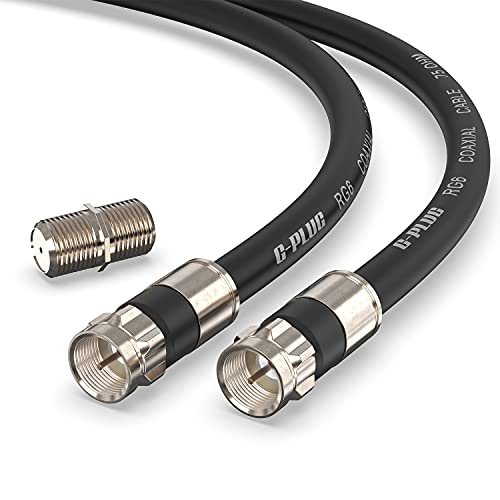
A coupler can be convenient when the planned route changes. Because only selected products can be discussed in this guide, the examples here focus on the selected models with documented coupler features. If the cable will connect directly from one device to another, the extra part can simply remain unused.
How this comparison was scored
The editorial score uses five category-specific criteria: signal and impedance design, shielding and interference control, connector construction, installation fit and durability, and documented application range. The weights emphasize signal design while still giving substantial consideration to shielding, connection hardware, physical installation, and compatible uses. No customer ratings, current listing information, purchase activity, marketplace labels, or volatile pricing signals appear in the published scores. The result is a specification-based guide, not a laboratory test.
Final Recommendation
energeaster 25FT RG6 Coaxial Cable ranks first overall in this specification-based comparison under the published weighted criteria.
energeaster 25FT RG6 Coaxial Cable is the first overall specification-based choice in this comparison under the published weighted criteria. It combines a 25-foot length, 75-ohm RG6 construction, triple-layer shielding, solid compression F-type connectors, rubber O-rings, and a supplied female-to-female coupler.
Among the top f-type digital coaxial cables, the best choice depends on the installation. BlueRigger RG6 15FT 90°-to-90° Cable is a practical option when connector clearance matters because it combines triple-shielded RG6 construction, consistent 75-ohm design, pure copper, corrosion-resistant connectors, a 15-foot length, and two right-angle ends. The best f-type digital coaxial cables are not identical, and this model is most appropriate when angled connectors suit the layout.
For a long route, the energeaster 25FT RG6 Coaxial Cable offers triple-layer shielding, weather-sealed connector joints, and a 25-foot reach. For concealed installation, GE RG6 Quad-Shielded Coaxial Cable and Philips RG6 Quad-Shield Coaxial Cable provide explicit in-wall-oriented construction. The G-PLUG 15FT RG6 Coaxial Cable is an extension-ready option, while the 75-foot Cables Direct Online cable is aimed at routes that need substantial length.
The top f-type digital coaxial cables should be selected by route and specifications rather than by length alone. Confirm the connector arrangement, measure the path, check whether the listing permits indoor, outdoor, or in-wall use, and choose shielding and conductor details that fit the installation. This approach narrows the options without relying on unsupported performance promises.
Frequently Asked Questions
Are F-type coaxial cables suitable for digital TV and broadband?
The selected listings document use with digital TV, HDTV, cable television, satellite equipment, broadband, modems, or routers. A 75-ohm RG6 design is common in the comparison. Compatibility still depends on the ports and service equipment in the specific setup.
How do I choose among the best f-type digital coaxial cables for a wall-mounted TV?
Start by measuring the route and checking clearance behind the television. The BlueRigger RG6 15FT 90°-to-90° Cable documents right-angle connectors for tight spaces, while the C2G Velocity Mini-Coax F-Type Cable documents a slim format for discreet routing. Confirm that the cable length and connector orientation match the equipment.
Is quad shielding better for every installation?
Quad shielding provides more documented shielding layers than dual shielding and may be useful where interference control is a priority. It does not automatically make every cable the right choice. Length, conductor details, connector fit, and whether the cable is approved for indoor, outdoor, or in-wall use also matter.
Can I use an indoor coaxial cable outdoors?
Not unless the specific product documentation supports that environment. Philips’ 15-foot dual-shield cable is listed for indoor use only, while the pibidi, energeaster, G-PLUG, and 75-foot Cables Direct Online models include weather-related construction claims. Follow the product’s stated application and use suitable routing practices.
Do I need a female-to-female coaxial coupler?
You need one only when joining two male-ended F-type cables or changing the connection arrangement. Several selected products include a coupler, but a direct device-to-device connection generally does not require an additional adapter. A coupler also introduces another connection point, so use it when the installation actually calls for an extension.