Buying Guide
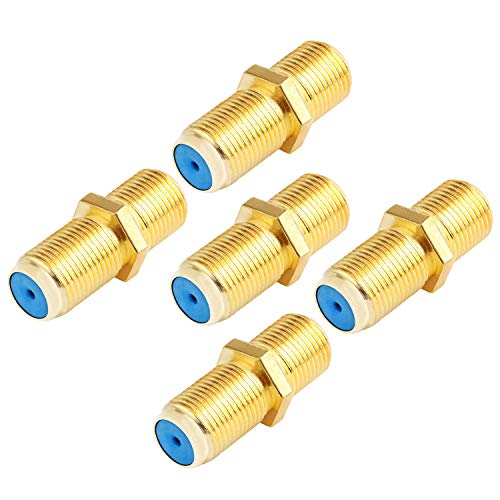
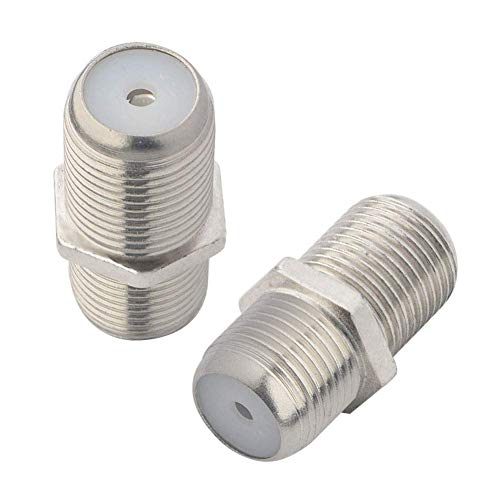
The best female-to-female f-pin coaxial tip cables are usually F81 barrel couplers: short adapters with two female F-type ports that join two coaxial cables. In the supplied listings, these products are described for RG6, RG59, RG58, or RG11 cable runs and for equipment such as televisions, antennas, satellite receivers, cable modems, and related F-type systems. The correct choice depends less on appearance than on the cable family, frequency requirement, installation environment, and physical clearance.
Confirm the connector arrangement
A female-to-female coupler has threaded female ports on both ends. It is intended to receive the male F connectors already attached to two coaxial cables. VCE, TechDirect, Pasow, Cable Matters, SAISN, and the two THE CIMPLE CO listings all document this basic splice or extension role.
Do not confuse a barrel coupler with a complete coaxial cable. The selected products are connector adapters rather than long cable assemblies. A complete cable may be more appropriate when you need a new fixed-length run with male connectors already installed.
Match the cable type
RG6 is the most frequently documented fit in this group and is the stated match for the VCE, Cable Matters, VCE gold-plated, EZYUMM, and Boobrie options. RG6 is common in television, satellite, antenna, and modem installations, but the connector still needs to match the cable and attached F fittings.
If your setup uses more than RG6, the two THE CIMPLE CO designs provide the broadest documented compatibility. They list RG58, RG59, RG6, and RG11, including both 75-ohm and 50-ohm styles in the weather-sealed version. That broader specification can be useful when the cable type is known to vary across an installation. Pasow and TechDirect specifically document RG6 and RG59 compatibility.
Consider frequency support
Several selected connectors list support up to 3GHz. This includes VCE, TechDirect, Pasow, Cable Matters, SAISN, EZYUMM, and both THE CIMPLE CO designs. A 3GHz specification is a useful way to distinguish these models from basic couplers whose listings do not state a maximum frequency.
Boobrie documents the RG6 and RG59 connection role but does not provide a maximum frequency in the supplied evidence. VCE and TechDirect go further by listing additional transmission or shielding details. Treat those descriptions as specifications rather than a guarantee of performance in every installation, since this comparison does not include hands-on testing.
Choose protection for the installation location
Indoor installations generally need a secure threaded connection and a suitable cable match. Outdoor or moisture-exposed routing calls for more explicit protection documentation. TechDirect lists moisture-sealed ends and weather-resistant construction. The weather-sealed THE CIMPLE CO model lists internal O-rings and indoor/outdoor use, while Pasow describes flat port ends for moisture-ingress protection and interference rejection.
By contrast, the VCE, Cable Matters, VCE gold-plated, EZYUMM, SAISN, and Boobrie listings emphasize materials, compatibility, or installation but do not clearly document sealed outdoor protection. That does not establish that they cannot be used outside; it means the supplied evidence does not support making that claim. For an exposed connection, prioritize a model whose listing explicitly mentions sealing or weather resistance and still protect the complete cable junction appropriately.
The selected products use several construction descriptions. TechDirect and Pasow specify nickel-plated brass, while the VCE 3GHz model specifies nickel construction. THE CIMPLE CO describes corrosion-protected metals and precision machining.
Plating can be relevant where corrosion resistance is a concern, but it does not replace a correct mechanical fit or environmental protection. A metal description also does not establish a particular signal result. Look for the combination of compatible cable type, suitable F-type threading, and any needed sealing features.
Check clearance and handling
A coupler adds a small amount of length to a cable path. Pasow and TechDirect state an added length of 1.02 inches, and the Cable Matters listing gives dimensions of about 0.71 by 0.31 inches. These details matter behind a television, wall plate, modem, or satellite component where a larger connection can put stress on the cable.
Pasow and THE CIMPLE CO describe physical features intended to aid handling, including flat ends or a finger grip. VCE, EZYUMM, SAISN, and Boobrie describe tool-free or screw-on installation. Before connecting, align the threads, tighten the connector nut by hand, and avoid twisting the cable itself. The listings support tool-free installation, but they do not provide a universal torque specification.
Select the pack size deliberately
The comparison includes two-, three-, four-, and five-piece sets. A two-pack suits one extension with a spare. Three- and four-piece packages can support several connection points, while five-piece sets are suited to installations with multiple cable runs. Pack quantity is not a substitute for compatibility, frequency support, or sealing, so confirm those details first.
Final Recommendation
TechDirect 3GHz Weather-Resistant F81 Couplers ranks first overall in this specification-based comparison under the published weighted criteria.
VCE 3GHz RG6 Female-to-Female Couplers is the first overall specification-based choice for the best female-to-female f-pin coaxial tip cables in this comparison. Its documentation combines RG6 and standard F-type compatibility, 3GHz support, a cable-diameter range, nickel construction, and stated shielding details.
For outdoor or moisture-exposed routing, TechDirect 3GHz Weather-Resistant F81 Couplers and THE CIMPLE CO Weather-Sealed F81 Couplers have the clearest protection documentation. For broad cable-family compatibility, the two THE CIMPLE CO designs and Pasow are especially well documented. Cable Matters and VCE’s gold-plated model fit multi-room RG6 work, while SAISN and EZYUMM offer clear 3GHz specifications without documented outdoor sealing.
Among the top female-to-female f-pin coaxial tip cables, the final choice should follow the installation rather than pack quantity. Match the cable family first, then verify frequency support, sealing needs, connector material, and available clearance.
Frequently Asked Questions
What does a female-to-female F-pin coaxial coupler do?
It joins two coaxial cables that have male F-type connectors. The coupler has female threaded ports at both ends and is commonly used to extend a cable run or connect two existing cable sections. The selected VCE, TechDirect, Pasow, Cable Matters, and Boobrie products all document this general function.
Are these connectors suitable for RG6 cable?
Yes. RG6 compatibility is explicitly listed for every selected product, although some listings also identify RG59, RG58, or RG11 compatibility. Check the cable type and connector dimensions before installation, especially when using a broader multi-coax model such as THE CIMPLE CO Weather-Sealed F81 Couplers.
Which of the best female-to-female f-pin coaxial tip cables document outdoor protection?
TechDirect lists moisture-sealed ends and weather-resistant construction. THE CIMPLE CO Weather-Sealed F81 Couplers list weather sealing and internal O-rings, while Pasow describes moisture-ingress protection. Other selected models do not provide equally explicit outdoor-sealing details in the supplied evidence.
No. A 3GHz label states the supported frequency range described by the listing; it does not account for the cable, connectors, routing, interference, or the rest of the system. VCE, TechDirect, Pasow, Cable Matters, SAISN, EZYUMM, and THE CIMPLE CO list 3GHz support, but this article does not add test results.
How should I choose between a two-pack and a larger pack?
Choose according to the number of cable junctions and whether you want a spare. A two-pack is suited to one extension, while three-, four-, and five-piece sets can support multiple runs. Confirm compatibility and environmental requirements before using pack size as the deciding factor.