Buying Guide
The best male-to-male f-pin coaxial tip cables are not all the same type of product. Some are complete coaxial cables with an F male connector at each end, while others are short metal couplers that join two existing cables or ports. Start by deciding whether you need a finished cable run or only a male-to-male connector.
Cable versus coupler
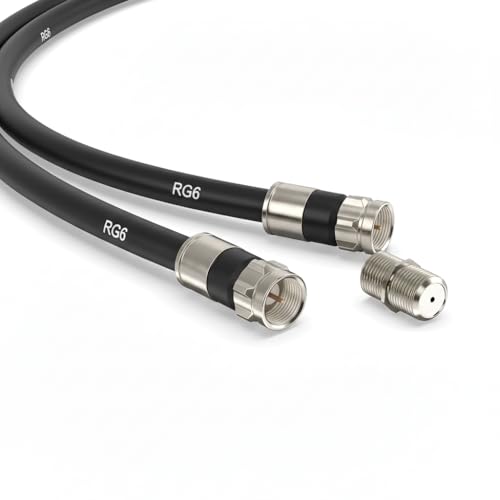
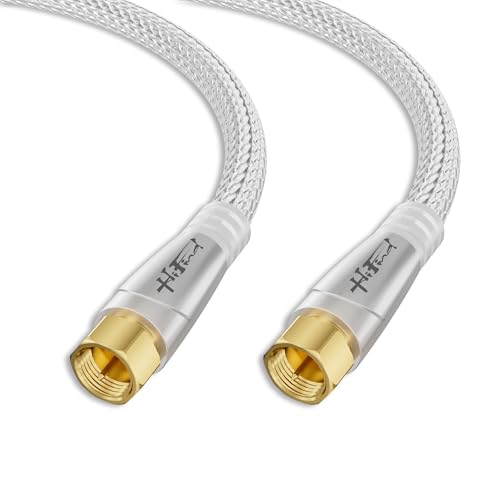
A complete cable is the straightforward choice when you need to connect a television, antenna, satellite receiver, modem, or similar device over a defined distance. The TUOLNK, HiFind, BlueRigger, FUSIONWIS, Ullnosoo, pibidi, and Nixsto selections are cable-format products. Their listed lengths range from a compact 20-inch jumper to a 40-foot run, with several middle-length choices.
A coupler is more appropriate when two existing coaxial cables already terminate in female F ports. PASOW, RFAdapter, and CNARIO are male-to-male F connectors rather than cable lengths. They are small, easy to store, and useful for extending a run, but they cannot replace a complete cable. Confirm that both items being joined have compatible female F ports before ordering.
Match the connector geometry
Most of the selected products use threaded F-type connections. These connectors are tightened by hand onto a compatible port. The FUSIONWIS cable documents a right-angle F-male end, which can help when a television sits close to a wall or cabinet. Its flat cable body is also presented for narrow gaps. A straight connector is usually more flexible for ordinary routing, while an angled connector is a deliberate clearance choice.
Connector gender deserves special attention because product titles can be abbreviated. TUOLNK explicitly states F male to F male. The PASOW, RFAdapter, and CNARIO listings also directly identify male-to-male adapters. Some longer cable listings identify F connectors or a male F connector without describing both ends in equal detail. If the exact end arrangement is essential, inspect the variant and connector images before purchase.
Consider impedance and cable construction
The selected designs are centered on 75-ohm television and broadband applications. HiFind, TUOLNK, FUSIONWIS, BlueRigger, pibidi, Nixsto, and CNARIO provide explicit 75-ohm information in the supplied evidence. For TV, satellite, antenna, and cable-modem connections, matching the system’s expected impedance is a sensible starting point.
Shielding detail varies considerably. HiFind lists a four-layer composite shield, while BlueRigger specifies triple shielding. FUSIONWIS describes braided shielding, and Ullnosoo, pibidi, and Nixsto provide less detailed protection descriptions. More shielding detail can be useful where a cable passes near other electronics, but the supplied listings do not establish measured results. Treat shielding claims as specifications, not as a guarantee of a particular picture, sound, or internet outcome.
Conductor material also differs. HiFind and BlueRigger list pure copper conductors, CNARIO specifies pure copper for its connector, and TUOLNK identifies pure brass conductors. Nixsto describes a copper-plated conductor. These distinctions help compare construction, but they should be considered alongside length, connector fit, and routing needs rather than treated as a standalone performance promise.
Choose the right length
Measure the route before selecting a cable. A short jumper such as the 20-inch TUOLNK or three-foot Ullnosoo model can reduce loose cable behind a television or receiver. The six-foot pibidi and 6.6-foot FUSIONWIS options provide more reach for ordinary equipment layouts. HiFind’s 15-foot length is suited to a longer connection, while BlueRigger’s 40-foot format is intended for widely separated equipment or a more involved indoor run.
Avoid choosing a much longer cable simply because extra length is available. Excess coax can make routing untidy and may place unnecessary bends near the connectors. Conversely, a cable that is too short can put stress on ports and strain relief. Nixsto is notable because the listing documents a broad selection of lengths, allowing the buyer to plan more closely around the route.
Look for environmental protection
For an indoor entertainment-center connection, a standard PVC jacket and suitable connector are often the main practical considerations. Outdoor antenna or satellite routing calls for closer attention to moisture protection. HiFind is specifically positioned for direct burial and outdoor use. The pibidi listing describes weather-sealed ends with rubber O-rings, while Nixsto lists O-ring seals and a water-resistant black PVC jacket.
These features are useful evidence for outdoor-oriented selection, but installation still matters. Protect exposed connections and follow the equipment and cable-routing requirements for the location. A product described as weather resistant should not automatically be treated as suitable for every buried, roof-mounted, or permanently exposed installation.
Installation and package contents
Threaded F connectors generally require hand tightening, and several selected products describe tool-free or plug-and-play setup. Couplers are especially simple when both existing cable ends are compatible. The TUOLNK package includes two complete cables, while PASOW, RFAdapter, and CNARIO offer multiple adapters. Ullnosoo includes a female-to-female coupler with its cable. Check the package contents so you do not buy extra pieces you do not need.
The top male-to-male f-pin coaxial tip cables therefore divide into three practical groups: short jumpers for nearby devices, full-length RG6 cables for longer routes, and compact couplers for joining existing cables. Connector gender, impedance, length, shielding, and environmental protection should guide the final choice more than finish or pack size alone.
Final recommendation
HiFind RG6 Quad-Shielded Coaxial Cable, 15 ft ranks first overall in this specification-based comparison under the published weighted criteria.
HiFind RG6 Coaxial Cable, 15 ft is the first overall specification-based choice among these best male-to-male f-pin coaxial tip cables. Its quad shielding, pure copper conductor, stated 75-ohm design, gold-plated contacts, and outdoor positioning give it the most complete documented specification set.
For a short, clearly identified cable, TUOLNK is the easier recommendation because its F male-to-F male arrangement, RG179 type, 20-inch length, and two-piece package are explicit. BlueRigger is better suited to a long indoor run, while pibidi and Nixsto offer useful weather-oriented features and practical lengths. Choose FUSIONWIS when rear clearance is the main concern. If you already have cables and only need to join female F ports, PASOW, RFAdapter, or CNARIO are the relevant compact alternatives. Together, these are the top male-to-male f-pin coaxial tip cables and connectors for comparing documented fit and construction in US 2026 listings.
Frequently Asked Questions
What does male-to-male F-pin mean?
It means the connection has an F-type male end on both sides. A complete cable can connect two female F ports directly. A male-to-male coupler instead joins two cables or ports that each present a female F connection. The TUOLNK cable and the PASOW, RFAdapter, and CNARIO adapters state this arrangement directly.
Are all F-type coaxial cables 75 ohms?
No. The selected products commonly document 75-ohm designs, but buyers should still check the individual listing. HiFind, TUOLNK, FUSIONWIS, BlueRigger, pibidi, Nixsto, and CNARIO provide 75-ohm information in the supplied evidence. Matching the cable or connector to the equipment system is an important compatibility check.
Should I choose RG6 or RG179?
RG6 is used by several selected cables and is presented for TV, satellite, antenna, modem, and broadband applications. TUOLNK identifies its shorter jumper as RG179. The better option depends on the documented use, required length, and available space. RG179 may suit a compact jumper, while RG6 choices provide more length and, in some listings, more detailed shielding or outdoor protection.
Which of the best male-to-male f-pin coaxial tip cables is suitable for tight spaces?
FUSIONWIS is the clearest choice from the supplied evidence because it combines a right-angle F-male end with a flexible flat body. Its listing specifically discusses wall-mounted TVs, narrow cabinet gaps, and routing behind equipment. A short straight jumper may also help, but it will not provide the same angled connector geometry.
Can a male-to-male adapter replace a coaxial cable?
No. PASOW, RFAdapter, and CNARIO are compact adapters or couplers. They join compatible female F connections but do not provide a cable run. Choose a complete cable when you need a defined distance between devices; choose an adapter only when existing cables or ports already provide the required cable length.