Buying Guide
The best female-to-male aux cables are simple adapters in appearance, but connector wiring, length, and plug geometry determine whether they fit a particular setup. All selected products use a 3.5mm male plug and female jack, allowing an existing male-to-male cable, headphone lead, or device connection to reach farther. The important distinction is whether the cable is TRS or TRRS.
Start with TRS versus TRRS
TRS, or three-pole, cables are designed for stereo audio playback. The Syncwire, J&D, UGREEN 3.3-Foot, MCSPER, MORELECS, FONVOi, VIOY, Ruaeoda, and Kxable listings identify audio extension designs that do not provide microphone functionality. Several of those listings also caution that inline headphone controls may not work when used with four-pole headphones.
TRRS, or four-pole, cables add a contact for microphone signals. The Cable Matters 15-Foot model explicitly supports both headphone audio and microphone input, making it the selected option for one-cable headsets, voice chat, gaming, and similar applications. Check the connector standard on both the source and headset before choosing; a male-to-female shape alone does not establish microphone compatibility.
Choose the length for the physical layout
Measure the route rather than choosing only by the desired listening distance. A 3-foot cable such as the J&D is suited to nearby equipment, while the UGREEN 3.3-Foot model keeps a short connection tidy. The Syncwire 6-foot and MCSPER 6.6-foot options add moderate reach for desks, seats, or portable devices.
For a couch, TV, PC tower, or vehicle installation, 10 feet may be more practical. MORELECS and VIOY both document 10-foot designs. The Cable Matters and Kxable options extend to 15 feet, and FONVOi and Ruaeoda reach 20 feet for larger layouts. Longer cables can introduce extra slack, so look for a way to route or secure them. Kxable includes five cable ties, while a braided jacket can make handling easier but does not eliminate the need for sensible routing.
Examine shielding and conductor details
Listing descriptions commonly identify gold-plated connectors, copper conductors, and shielding as measures intended to support signal transmission. These are specifications, not independent test results, so they should be read as construction information rather than a promise of a measured listening result.
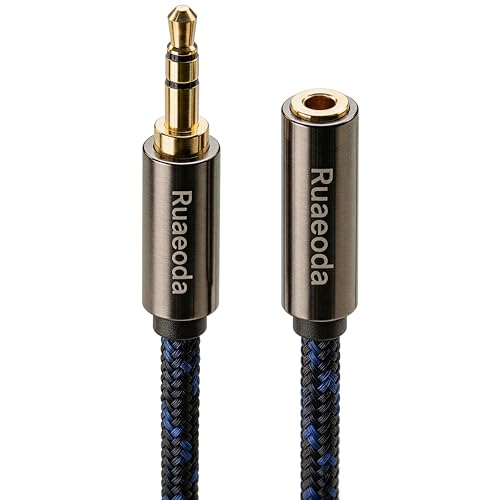
J&D documents multi-layer shielding for RFI and EMI reduction. MCSPER specifies triple shielding and pure copper wire. UGREEN’s 3.3-foot model lists double shielding, while VIOY and MORELECS also document dual-shielded designs. Ruaeoda identifies a 24AWG pure copper core with dual foil shielding, and Kxable lists an OFC core with double shielding. If the cable will run near power cords, computers, or other electronics, these details may be useful when comparing otherwise similar lengths.
Consider plug clearance and connector shape
A step-down or beveled connector can matter when a phone or tablet has a protective case around its audio port. Syncwire, MCSPER, UGREEN, MORELECS, VIOY, Ruaeoda, and Kxable document a case-friendly or step-down design. Confirm that the female jack also accepts the plug on your existing cable; a narrow male plug does not guarantee universal clearance at the receiving end.
Therefore, this comparison does not treat right-angle clearance as a selection feature. For a tight space, inspect the connector shape in the listing before ordering.
Match construction to handling
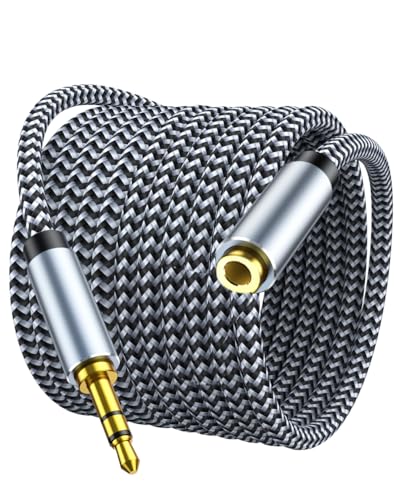
Nylon braiding appears on Syncwire, MCSPER, MORELECS, FONVOi, VIOY, Ruaeoda, and Kxable. J&D uses a flexible PVC jacket with a copper shell, and Cable Matters specifies a braided jacket with gold-plated connectors. Several listings provide bend-cycle figures, including Syncwire’s 15,000-plus figure, MORELECS and VIOY’s 15,000-plus figures, FONVOi’s 10,000-plus figure, and Kxable’s testing beyond 10,000 bends.
These figures describe the suppliers’ stated testing or design claims. They do not replace checking strain relief, avoiding sharp bends, and disconnecting by the plug rather than pulling the cord. A shorter cable may also be easier to keep off the floor, while a long cable benefits from deliberate routing.
Review the audio limitations before connecting
The most important limitation in this category is often microphone support. Audio-only TRS models can extend stereo playback but may not pass microphone input or inline controls from TRRS headsets. The Cable Matters model is the clearest selected match when those signals are required. The other selected models are better understood as stereo audio extensions unless their specific listing documents otherwise.
Also confirm that the source device has a standard 3.5mm jack or AUX port. The selected listings describe compatibility with combinations of phones, tablets, computers, headphones, speakers, car stereos, TVs, and home theater equipment, but newer devices may require a separate audio adapter. An extension cable cannot convert a digital, USB, or proprietary port by itself.
Final Recommendation
Ruaeoda 20-Foot 24AWG Nylon-Braided Aux Extension ranks first overall in this specification-based comparison under the published weighted criteria.
The final choice among the best female-to-male aux cables depends on the documented features that match your intended use.
Syncwire 6-Foot Nylon-Braided 3.5mm Extension Cable is the first overall specification-based choice in this comparison. Its 6-foot length, clearly identified TRS format, gold-plated connectors, enameled copper wires, nylon braid, and stated 15,000-plus bend lifespan create a balanced specification profile for standard stereo extension. It is not the right match when microphone signals are required.
For headset voice input, the Cable Matters 15-Foot 3.5mm TRRS Headset Extension is the more appropriate selection because its listing explicitly supports both audio and microphone signals. J&D is a practical short-run alternative with detailed shielding and heavy-duty construction. UGREEN’s 3.3-foot TRS cable suits compact layouts, while MCSPER adds two moderate-length cables and triple shielding.
For distance, MORELECS and VIOY provide documented 10-foot options, Kxable and Cable Matters reach 15 feet, and FONVOi and Ruaeoda provide 20-foot audio-only runs. Among the top female-to-male aux cables, the right answer therefore depends first on TRS or TRRS requirements, then on the physical route and connector clearance. Compare those specifications before considering jacket style or included accessories.
Frequently Asked Questions
What should I check first when choosing the best female-to-male aux cables?
Check the pole configuration and required signals first. A TRS cable is generally intended for stereo audio playback, while the Cable Matters TRRS model explicitly supports audio and microphone input. Then confirm the needed length and whether the plug must fit around a phone or tablet case.
Can a TRS extension cable carry a headset microphone?
The supplied listings for the TRS models state audio-only limitations or say that microphone functionality does not work with TRRS headphones. If microphone input is essential, choose a product whose listing explicitly identifies TRRS support, such as Cable Matters, and verify that the connected devices use compatible wiring.
Is a longer extension always better?
No. A longer cable can reach a TV, PC tower, car stereo, or home theater component, but it may leave more slack to route and secure. The selected range runs from about 3 feet to 20 feet, so measure the physical path and choose the shortest length that reaches comfortably.
Do gold-plated connectors guarantee better sound?
No guarantee should be inferred from that specification alone. Gold plating is listed on several selected models as a corrosion-resistance or connector-construction feature. Signal results also depend on the devices, connector fit, cable design, and surrounding conditions. Treat the listing as specification evidence rather than an independent performance test.
Will an extension cable work with a phone in a protective case?
Some selected models document step-down or beveled connectors intended to improve clearance around cased devices. Syncwire, MCSPER, UGREEN, MORELECS, VIOY, Ruaeoda, and Kxable include such fit information in their listings. Measure the case opening and inspect the plug profile because case compatibility can vary.