Buying Guide
The best fisheye mirrorless camera lenses differ in more than focal length. Their field of view may be diagonal or circular, their coverage may target full-frame or APS-C sensors, and their focus operation may be manual or supported by an internal focus design. The most useful comparison starts with the camera mount, then moves through the visual effect, aperture, close-focus behavior, and optical construction.
Match the lens to your mount and sensor
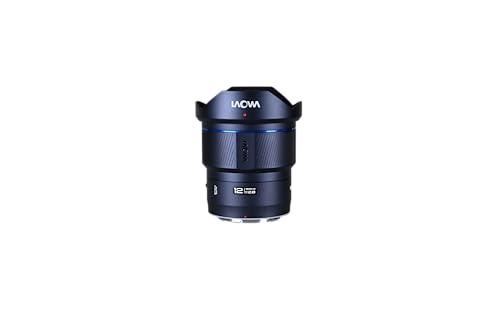
Mount compatibility is the first practical filter. The Canon RF selections in this guide are intended for Canon RF mirrorless cameras, while the Nikon Z choices cover both full-frame and APS-C-oriented designs. Sony E is represented by a full-frame 10mm option, Canon EF-M by the Samyang 8mm, and Micro Four Thirds by the Panasonic 8mm. L Mount photographers have the AstrHori 12mm, which names Leica, Panasonic, and Sigma bodies in its supplied compatibility information.
Sensor format also affects how the lens should be interpreted. The Brightin Star 7.5mm is identified as an APS-C lens, while the 7artisans 10mm Nikon Z listing describes a full-frame fisheye. The Panasonic lens is designed for Micro Four Thirds cameras. A lens can be physically compatible with a camera mount yet still produce a different composition depending on the sensor format, so verify the camera body and intended framing before choosing.
Choose circular or diagonal coverage
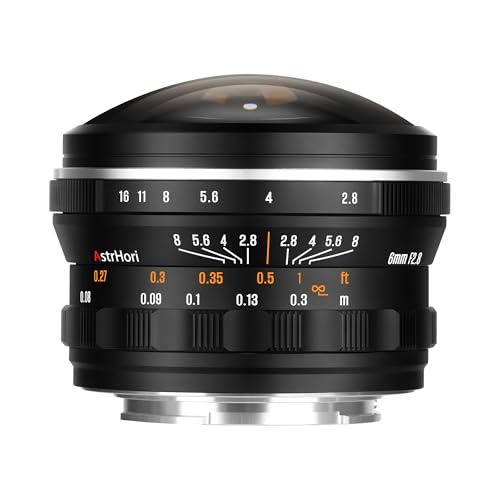
Fisheye coverage is the defining creative characteristic. Circular designs place a round image within the frame, while diagonal designs fill the frame with a strongly curved ultra-wide image. AstrHori’s 6mm lenses document a 220-degree circular presentation, making them especially specialized for surreal, close-subject, and experimental work. The Canon RF 7-14mm is unusual in this group because its listing documents both circular imagery at 7mm and full-frame diagonal imagery at 14mm.
Other lenses offer very wide diagonal-style coverage. The 7artisans and AstrHori 12mm listings document 185 degrees, the Brightin Star 7.5mm documents 190 degrees, and the Panasonic 8mm documents 180 degrees. These figures describe the expansive perspective claimed by the listings, but they do not by themselves determine how much of the final frame will be filled on every sensor format.
Consider aperture for the scene
Most selected lenses list a maximum aperture of f/2.8, including the AstrHori 6mm, 7artisans 10mm, Brightin Star 7.5mm and 11mm, AstrHori 12mm, and Samyang 8mm. A larger aperture can give the photographer more exposure flexibility in the documented low-light, night-sky, concert, or interior use cases. The Panasonic 8mm is listed at f/3.5, while the Canon zoom varies from f/2.8 at 7mm to f/3.5 at 14mm.
Aperture design also affects creative rendering. The Panasonic lists seven rounded blades, the Canon RF Brightin Star lists eight blades for an eight-point starburst, the Nikon Z Brightin Star lists a five-piece aperture for a 10-point star effect, and the AstrHori 6mm Nikon Z lists eight blades with a de-click capability in its description. These are documented design features, not guarantees of a particular image in every setting.
Compare focus behavior and close perspective
Manual focus is common in this category. The AstrHori, 7artisans, Brightin Star, and Samyang listings identify manual operation or provide no autofocus claim. This can suit deliberate compositions, particularly when a fisheye is used at a fixed distance or with a large depth of field. The Brightin Star 10mm APS-C listing, which is not included in the final 10, explicitly describes hyperfocal operation, but it is not used here as a product recommendation.
Close-focus specifications are more concrete differentiators. The AstrHori 6mm lenses list a 0.08m minimum focusing distance, the Panasonic lists 0.1m, and the Samyang lists one foot. These distances support exaggerated near-subject perspectives in which foreground objects appear very large against a dramatically curved background. The Panasonic also documents an inner-focus system, giving it a different focus-design profile from the manual lenses.
Read the optical construction details
Element and group counts provide useful specification context, although they are not a substitute for testing. The Canon RF zoom does not list an element count in the supplied evidence, but it does document an L-series designation and adapter drop-in filter support. The Panasonic uses ten lenses in nine groups and includes an ED lens. The AstrHori 6mm Nikon Z uses 10 elements in eight groups, the AstrHori 12mm uses 11 elements in eight groups, and the Samyang uses 11 elements in eight groups.
The 7artisans Nikon Z listing describes an updated optical design and claims reduced flare and ghosting. The Brightin Star Canon RF listing identifies four high-refractive-index lenses and two ED lenses, while its Nikon Z counterpart lists two low-dispersion and three high-refraction pieces. These details can help separate designs on paper, but this comparison does not treat them as hands-on performance results.
Match the design to your subject
For architecture and interiors, the 7artisans 10mm Nikon Z, Brightin Star 11mm Canon RF, and Panasonic 8mm all document relevant wide-scene uses. For astrophotography or night scenes, the f/2.8 options provide the clearest aperture specification, while the Canon RF Brightin Star and Nikon Z Brightin Star specifically mention starburst effects. For close, surreal portraits or experimental video, the AstrHori 6mm lenses document the most extreme coverage and closest focus.
For travel and portable shooting, the Brightin Star 7.5mm Nikon Z lists an approximately 260g weight, and the 7artisans Nikon Z listing describes a compact build. For a broader framing workflow, the Canon RF 7-14mm is the only selected zoom and documents two distinct fisheye presentations. These are specification-based distinctions; handling in the field can vary with the camera body and shooting technique.
Final Recommendation
Canon RF 7-14mm F2.8-3.5 L Fisheye ranks first overall in this specification-based comparison under the published weighted criteria.
The final choice among the best fisheye mirrorless camera lenses depends on the documented features that match your intended use.
Canon RF 7-14mm F2.8-3.5 L Fisheye is the highest-scoring returned product and the first overall specification-based choice. Its documented 7-14mm range, 190-degree view, circular and diagonal modes, variable f/2.8-3.5 aperture, and filter-adapter support give it the broadest feature set in this comparison.
For a specialized circular effect, the AstrHori 6mm F2.8 220° Fisheye for Nikon Z and its Canon RF counterpart document the most extreme coverage and 0.08m close focus. The 7artisans 10mm options suit full-frame Sony E or Nikon Z users who want 185-degree coverage and f/2.8. Micro Four Thirds photographers should look closely at the Panasonic Lumix G Fisheye 8mm F3.5 because its 180-degree view, 0.1m focus, and inner-focus system are clearly documented.
Among the top fisheye mirrorless camera lenses, the right selection depends on whether the priority is a circular frame, a diagonal image, close-focus exaggeration, a particular sensor format, or a specific mount. Confirm those requirements first, then compare aperture, focus method, optical structure, and documented creative features.
Frequently Asked Questions
What should I check before choosing the best fisheye mirrorless camera lenses?
Confirm the lens mount and sensor-format fit first. Then decide whether you want circular or diagonal coverage, review the listed aperture, and check whether the focus method matches your shooting style. Minimum focusing distance matters when you want an exaggerated foreground, while a documented internal-focus design such as the Panasonic’s may appeal to photographers who prefer that approach.
Are circular and diagonal fisheye lenses interchangeable in use?
They create different frame presentations. The AstrHori 6mm lenses document a 220-degree circular view, while the Panasonic 8mm and several 10mm and 11mm lenses document very wide diagonal-style coverage. The Canon RF 7-14mm is distinctive because its listing describes circular imagery at 7mm and full-frame diagonal imagery at 14mm.
Which selected lens has the closest documented focus?
The two selected AstrHori 6mm lenses list a 0.08m closest focusing distance. The Panasonic 8mm lists 0.1m, and the Samyang 8mm lists one foot. These specifications indicate the minimum distances supplied for the products; they do not describe a hands-on focusing test.
Do all fisheye lenses in this comparison use autofocus?
No. Several selected listings identify their lenses as manual focus, including the AstrHori, 7artisans, Brightin Star, and Samyang options. The Panasonic listing documents an inner-focus system, but the supplied evidence does not make a general autofocus claim. Check the individual product specifications and camera settings before selecting a lens for a specific workflow.
Which options document f/2.8 apertures?
The Canon zoom lists f/2.8 at its 7mm position, while the AstrHori 6mm, 7artisans 10mm, Brightin Star 7.5mm and 11mm, AstrHori 12mm, and Samyang 8mm list f/2.8 maximum apertures. The Panasonic lists f/3.5, and the Canon zoom changes to f/3.5 at 14mm.