Buying Guide
The best float sump pumps are selected first by matching the pump’s documented controls and capacity to the water-removal task. A pump for a basement sump basin has different priorities from one used to empty a pool, hot tub, crawl space, or rain barrel. The listings in this comparison describe submersible pumps with automatic float switches, but their float designs, start levels, discharge fittings, and low-water claims vary considerably.
Start with the water volume and lift
Flow rate is usually expressed in gallons per hour, while lift describes how high the pump can move water. These figures are useful comparison points, but they are not a complete prediction of real-world output because hose size, hose length, fittings, and vertical height affect the system. LANCHEZ lists the highest maximum flow at 6000 GPH and a 30-foot head. WAYNE CDU980E lists 5490 GPH, while POXURIO lists 5300 GPH and a 30-foot lift.
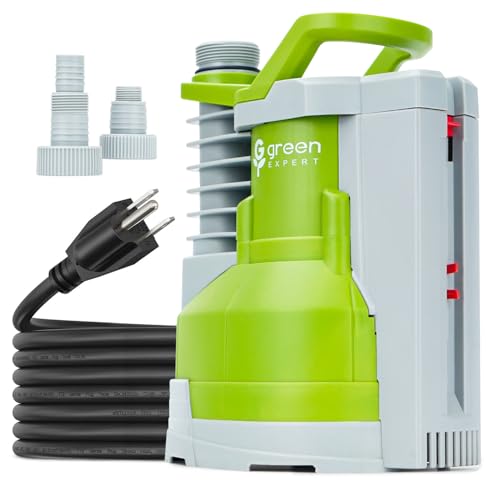
For a smaller household drainage job, a lower-capacity pump may be adequate if the discharge route is short and the water volume is limited. Green Expert lists 3000 GPH and a 26-foot lift, while FLUENTPOWER lists 3500 GPH and a 26-foot lift. The 6699 model lists 2500 GPH and a 23-foot lift, making it more oriented toward shallow or moderate utility drainage than rapid flood removal.
Understand float-switch designs
A float switch automates starting and stopping as water rises and falls. Vertical floats can be helpful in narrow pits, provided the basin has enough room for the float to move freely. WAYNE CDU980E, WAYNE CDU800, Westinghouse, and FLUENTPOWER document vertical float designs. A built-in float can reduce the space taken by an external switch; Green Expert describes its integrated switch as suitable for automatic and manual operation.
Some listings provide exact thresholds, which makes planning easier. FOTING states that its automatic switch starts above 7 inches and stops below 1.5 inches. FLUENTPOWER lists an 8-inch start and a stop range of 3.2 to 5.5 inches. Green Expert offers an adjustable automatic start between 4 and 7 inches, with a 2.5-inch stop level. The 6699 model lists a low automatic starting level of about 1.4 inches. Compare those figures with the normal water level and available pit depth before choosing.
Check the low-water claim
Low-water removal matters when the pump will be used on flat floors, shallow pits, or after the main volume has been removed. It is also important to distinguish automatic shutoff from manual operation. FOTING lists suction down to 0.43 inch, while the 6699 listing states 1/25 inch. POXURIO lists removal to current listing information inch, and Prostormer lists manual removal to 1/4 inch.
These figures should be treated as listing specifications rather than guarantees for every installation. A pump may need to be placed at the correct angle, fully submerged during startup, or unplugged promptly in manual mode. Several supplied listings warn against dry running. If automatic shutoff is important, focus on the documented float thresholds instead of assuming that the lowest manual-suction figure will apply automatically.
Match debris handling to the water
Clean water and slightly dirty water place different demands on an intake. Top-suction designs can help reduce air-lock and clogging concerns in some sump installations. WAYNE CDU980E, WAYNE CDU800, Westinghouse, and FLUENTPOWER document top-suction or anti-airlock features. Bottom or screened intakes are also common: POXURIO, FOTING, and the 6699 model describe intake or screen designs that filter debris.
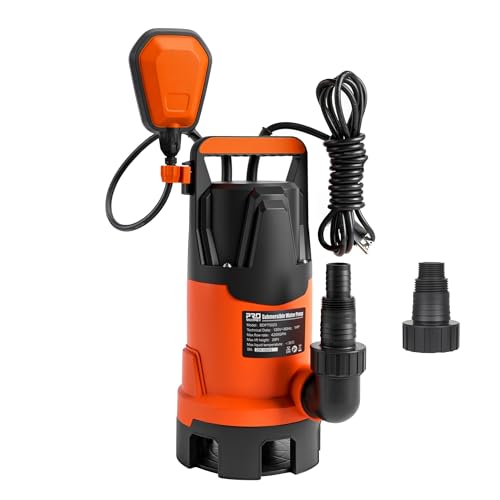
For genuinely dirty water, Prostormer documents handling solids up to 1.25 inches, the largest stated particle passage among these selections. LANCHEZ lists passage for particles up to current listing information inch. Other models list smaller solids capacities or do not provide a solids dimension. Do not infer that a clean-water pump can handle large sediment simply because it is labeled a utility or sump pump. Inspect the intake and follow the supplied operating guidance for debris-prone water.
Consider construction and motor protection
Construction details can help distinguish a temporary transfer pump from a model intended for recurring sump use. Stainless steel appears in LANCHEZ, FOTING, WAYNE CDU980E, WAYNE CDU800, and the 6699 model. Thermoplastic housings appear in POXURIO, Prostormer, Green Expert, and other selected pumps. The material alone does not establish expected service life, but it is relevant to corrosion and cooling claims documented in the listings.
Thermal overload protection is listed on many of the selected products, including LANCHEZ, POXURIO, FOTING, Westinghouse, Green Expert, and the 6699 model. LANCHEZ and Prostormer also document IPX8 waterproofing. These are specification features, not substitutes for correct submersion, suitable electrical connections, and avoiding dry operation.
Plan the discharge connection and reach
Before buying, check the pump outlet against the discharge hose or pipe. POXURIO lists four outlet formats. LANCHEZ includes a 1.5-inch NPT discharge plus adapters, while FLUENTPOWER lists several hose and threaded fittings. The 6699 model also lists multiple outlet sizes. These options can simplify setup, but an adapter does not eliminate the need to confirm the hose’s internal diameter and the route’s total lift.
Cord length affects where the pump can be placed relative to a suitable outlet. Green Expert lists a 25-foot grounded cord, and POXURIO lists 26 feet. LANCHEZ lists 16 feet, while several other selected models list 10 feet. A longer cord can improve placement flexibility, but the outlet must remain appropriate for the installation. Never treat a longer cord as permission to use an unsuitable extension arrangement in a wet area.
Choose by use case
For high-volume drainage, start with LANCHEZ, POXURIO, WAYNE CDU980E, or WAYNE CDU800 based on their listed flow capacities. For shallow residual water, FOTING, the 6699 model, POXURIO, and Prostormer provide the clearest low-water specifications. For narrow pits, compare the vertical-switch models from WAYNE, Westinghouse, and FLUENTPOWER. For debris-heavy water, Prostormer has the most specification-aligned stated solids capability. Green Expert is worth considering when adjustable start depth and cord reach are more important than maximum flow.
Final Recommendation
LANCHEZ 1.6HP 6000GPH Sump Pump ranks first overall in this specification-based comparison under the published weighted criteria.
LANCHEZ 1.6HP 6000GPH Sump Pump is the first overall specification-based choice among these best float sump pumps. Its listed combination of 6000 GPH flow, 30-foot head, automatic float control, stainless steel casing, IPX8 protection, and large-particle passage gives it the broadest documented capability for demanding drainage. POXURIO is a practical alternative when cord reach, outlet flexibility, and low stated residual water are priorities. FOTING is especially compelling for shallow-water removal, while Prostormer is the clearer choice when the supplied solids-handling specification matters most.
The top float sump pumps are not interchangeable in every pit. Confirm the automatic start and stop levels, discharge route, available outlet, and maximum pit dimensions before selecting one. Treat maximum flow and lift as listing benchmarks, and follow the operating instructions for priming, manual mode, debris cleaning, and dry-run prevention.
Frequently Asked Questions
What should I compare first when choosing the best float sump pumps?
Start with the required lift and the amount of water to be moved, then compare automatic float thresholds and low-water removal. A pump with a higher maximum GPH rating is not automatically the right fit if its float cannot operate properly in the basin or its outlet does not match the discharge setup.
Are vertical float switches suitable for narrow sump pits?
They can be, when the pit provides enough room for the float to move. WAYNE CDU980E, WAYNE CDU800, Westinghouse, and FLUENTPOWER document vertical float designs. Measure the basin and check the listed dimensions or installation guidance before committing to a model.
Which selected pump has the clearest dirty-water specification?
Prostormer 1HP 4200GPH Clean/Dirty Pump documents handling solids up to 1.25 inches. LANCHEZ also lists a large particle passage of current listing information inch. Other models may include screens or debris-resistant designs, but the supplied evidence does not support assigning them the same solids capability.
Can a float pump run in manual mode?
Several selected products document manual operation, including FOTING, Prostormer, FLUENTPOWER, and Green Expert. Manual mode may allow lower water removal, but it can also bypass automatic shutoff. Follow the listing’s instructions and unplug the pump before it runs dry.
How do I compare the top float sump pumps for shallow water?
Review the stated minimum suction level and the automatic stop level separately. FOTING lists 0.43 inch, the 6699 model lists 1/25 inch, and POXURIO lists current listing information inch. Those are published specifications; actual results depend on placement, surface conditions, hose routing, and the selected operating mode.