Buying Guide
The best foldable tripods vary widely. Some are full-size camera supports with multi-section legs, while others are phone-first selfie sticks that open into small stands. Start by deciding whether the tripod must hold a dedicated camera or only a smartphone. A camera-oriented model generally offers more useful threaded mounts and a more conventional leg structure. A phone-oriented design usually prioritizes low weight, fast extension, remote capture, and portrait-orientation shooting.
Match the tripod to your device
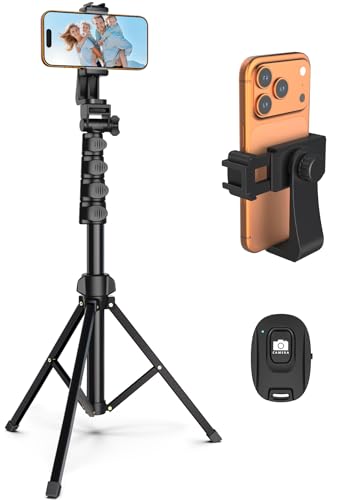
For interchangeable-lens cameras, the SmallRig CT-10 and K&F Concept models provide the clearest camera-tripod specifications in this selection. The SmallRig lists both 1/4-inch-20 and 3/8-inch-16 threaded holes, while the K&F Concept lists a standard 1/4-inch screw and Arca-Swiss-style plate compatibility. The XXZU is a hybrid choice with a phone holder and 1/4-inch mount, and the ANXRE adds a phone clamp, camera mount, and cold shoe.
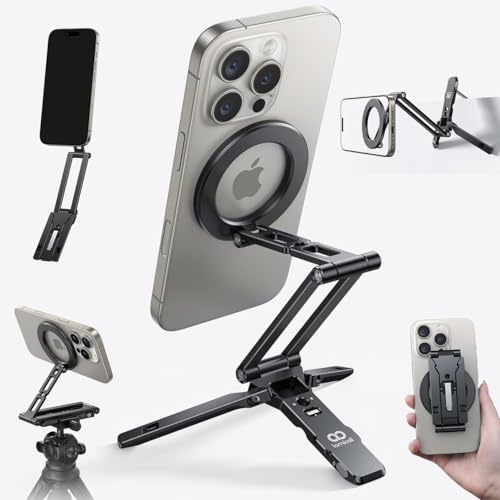
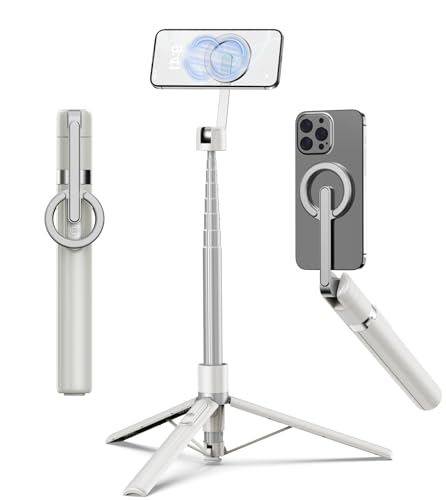
Phone users should check the holder type as carefully as the height. The TONEOF and Lamicall models use magnetic attachment, with a metal-ring solution described for nonmagnetic devices. Confirm the stated phone-width range before buying, especially if a thick case is installed.
Consider folded size and weight
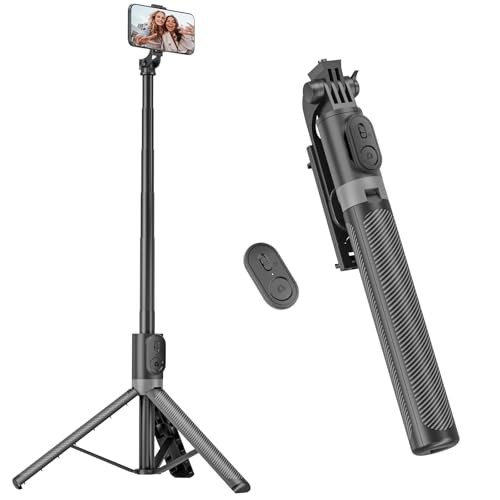
Folded length is one of the most useful portability measurements. The TONEOF folds to 11 inches, the RISEOFLE to 12.2 inches, and the K&F Concept to 15.5 inches. The Insta360 kit uses a metric folded measurement of 16.6 cm with a camera attached. Lamicall is identified by its 90-gram weight rather than a folded-length figure, so the available evidence supports its compactness but not a direct length comparison.
Full-size models naturally trade some portability for reach and support. SmallRig lists a 16.9-inch folded size and a 3.37-pound weight. That is still travel-oriented compared with studio support, but it is not as easy to slip into a small everyday bag as a phone selfie-stick tripod. Where a listing does not provide folded dimensions, avoid assuming that the product is unusually compact.
Choose the height range you actually need
A tall tripod can frame standing subjects and group scenes without requiring furniture or an elevated surface. The XXZU reaches 75 inches, the SmallRig reaches 71 inches, and the RISEOFLE and ANXRE reach about 71 inches. The TONEOF reaches 68 inches, while the K&F Concept reaches 64.1 inches. These figures describe maximum extension, not a guarantee of stability at every height.
Minimum height matters for tabletop, low-angle, and close-up work. The XXZU lowers to 15.35 inches, the SmallRig starts at 16 inches, and the K&F Concept can use an inverted or short center column for lower compositions. The Lamicall is better suited to compact phone positioning, including overhead and low-angle arrangements, rather than conventional tall-camera work.
Look for useful control features
A remote is valuable for solo recording and group photos because it allows capture without touching the phone. Remote controls are documented with the TONEOF, RISEOFLE, ANXRE, EUCOS, Lamicall, and Insta360 selections. The EUCOS listing also states a wireless range of up to 33 feet, while the Insta360 kit includes a mini remote. These are listing specifications, not independently verified operating results.
Rotation and tilt determine how easily you can switch between portrait and landscape framing. The XXZU and K&F Concept use ball-head designs, while the SmallRig lists a 360-degree metal ball head and inverted center-pole operation. Phone-focused products commonly describe 360-degree holder rotation. The Lamicall goes further with three stated adjustment axes, and the TONEOF lists 360-degree horizontal rotation with 200-degree vertical tilt.
Evaluate stability without overreading claims
Rubber or silicone feet, weight hooks, reinforced bases, and a documented load figure are useful evidence. The XXZU lists anti-slip rubber feet and a bottom hook. The ANXRE lists a reinforced base and silicone feet.
For a camera setup, load information is particularly important. SmallRig lists 15 kg vertically and 5 kg on tilt; K&F Concept lists 8 kg for its ball head. For products without a stated capacity, keep the equipment light and follow the maker’s instructions rather than inferring a load rating.
Final recommendation
XXZU 75-inch Camera, Phone, and Monopod Tripod ranks first overall in this specification-based comparison under the published weighted criteria.
XXZU 75-inch Camera, Phone, and Monopod Tripod is the highest-ranked specification-based choice among the best foldable tripods in this comparison.
It combines a 75-inch maximum height, a listed 14.37-inch dimension, tripod-to-monopod conversion, a phone holder, remote, levels, angle locks, and a weight hook. The top foldable tripods are not interchangeable, however. Choose SmallRig CT-10 for camera versatility and documented load information, K&F Concept for a compact full-size camera format, TONEOF for a lightweight magnetic phone setup, or Lamicall for ultra-compact multi-axis mounting. Insta360 is the focused choice when the listed action-camera ecosystem is the priority.
Frequently Asked Questions
What should I check before choosing the best foldable tripods for a camera?
Check the mount thread, stated load information, folded length, maximum and minimum height, and whether the head supports the framing you need. SmallRig and K&F Concept provide the clearest full-size camera-oriented specifications here. A 1/4-inch mount alone does not establish a product’s safe capacity.
Are magnetic phone tripods suitable for every phone?
Not automatically. TONEOF and Lamicall document magnetic attachment and describe metal-ring options for nonmagnetic devices. Check whether your phone or case supports the relevant magnetic standard, and verify that the supplied ring is appropriate for your setup before relying on it.
Is a taller tripod always better?
No. Greater height can help with standing shots and group photos, but it may increase the importance of careful placement and a level surface. XXZU reaches 75 inches, while compact models such as Lamicall prioritize portability and positioning flexibility over tall extension.
Which foldable tripod is best for solo video recording?
A phone model with a remote is the practical starting point. RISEOFLE, TONEOF, ANXRE, and EUCOS all document wireless remote inclusion. Choose based on phone fit, folded size, accessory mounting, and the height range required for your recording location.
Can a selfie-stick tripod replace a camera tripod?
Only for compatible, relatively light devices and suitable shooting conditions. Insta360 is specifically built around listed Insta360 cameras, while several phone models include a 1/4-inch mount. For larger camera setups, SmallRig or K&F Concept provides more complete camera-tripod evidence, including threaded compatibility and documented load information.